Ancient Egypt
Early World3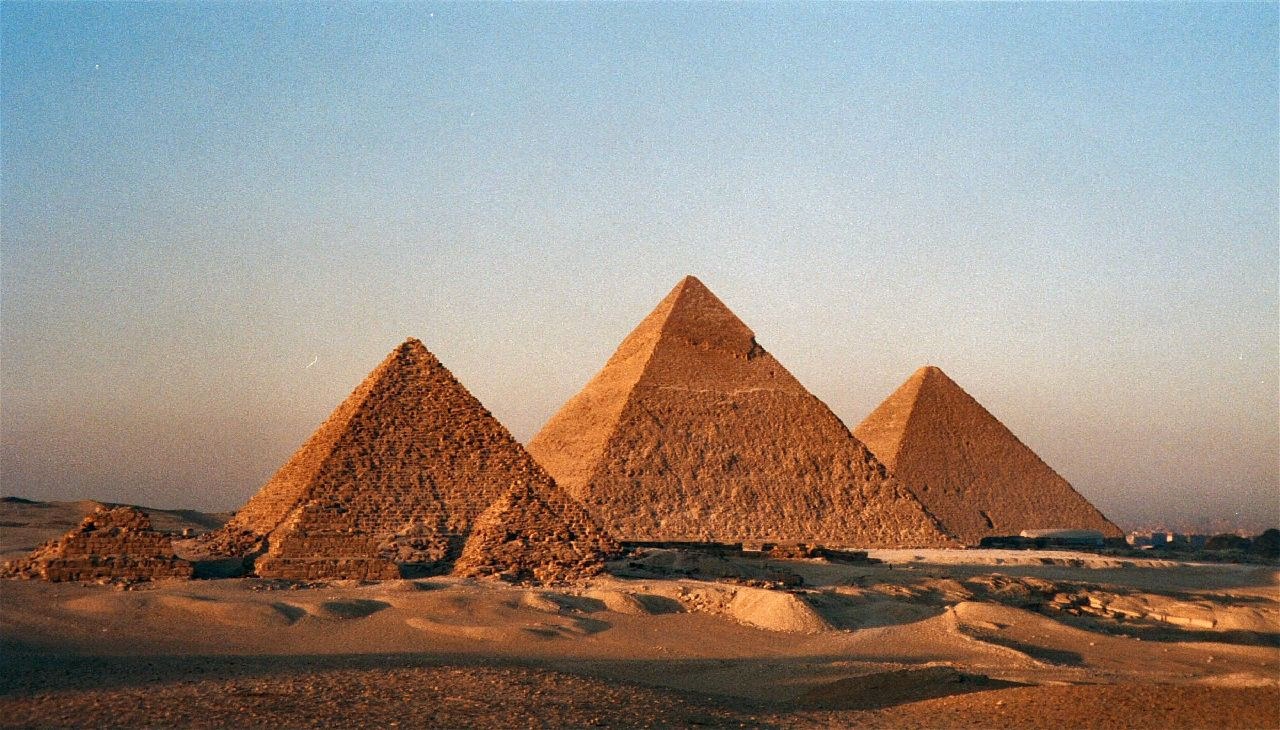
The cultural influence of ancient Sumer in Mesopotamia extended to neighboring Ebla in northwestern Syria and Elam in southwestern Iran as well as to the distant Indus River Valley in Pakistan and northern India. Merchants from Sumer also entered the Nile River Valley in search of the metals, gold and copper, and there stimulated the emergence of yet another complex culture, which would eventually create a culture and state that dominated the Bronze Age world.
The Nile River is one of the longest rivers in the world. It flows from south to north, from the mountains of central East Africa to the Mediterranean Sea, and floods the Nile River Valley like clockwork in the summer months, thereby, depositing rich alluvial soil along the banks of the river. The Nile River Valley therefore is a very rich agricultural region that can support a very large population. The Neolithic Revolution began in this region around 7000 BCE with the introduction of the technology to domesticate wheat and barley as well as sheep and cattle through contact with Levant (Syria, Palestine). In Ancient Egypt as well as in Mesopotamia, bread and beer from wheat and barley were staples in people's diets.
During the Pre-Dynastic period (3500-3000 BC), traders from ancient Sumer first began to trade with the inhabitants of the Nile River Valley in search of gold and copper. In Egypt the villages along the river came under the control of powerful rulers who adopted the palace/temple redistributive economic system from ancient Sumer. Egyptian artisans who worked for these temples and palaces at first imitated the artistic styles of Sumer. In Egypt however in this period a new and distinct complex culture developed over time. Unlike Mesopotamia, in Egypt a single river, not two, flows through the land. This geographical feature made it easier for rulers to unite the peoples of this valley. Also the Nile River is much more navigable than either the Tigris and Euphrates in Mesopotamia, which allowed for relatively easy communication along the river valley. By 3000 BC a certain Narmer had united both Upper (southern) and Lower (northern) Egypt into a united kingdom. Unlike Mesopotamia, ancient Egypt in the Bronze Age was usually a single state instead of divided into a number of warring states, as was the situation in ancient Mesopotamia. Egyptians also were able to develop a distinct, unique culture over time since Egypt through its geographical situation was naturally protected from foreign incursions, unlike Mesopotamia, which was subject to periodic invasions by different neighboring peoples. On both sides, east and west, the Nile River Valley was surrounded by large hot and dry deserts, which were difficult to cross, which made the Nile River Valley into a kind of island in a sea of desert.
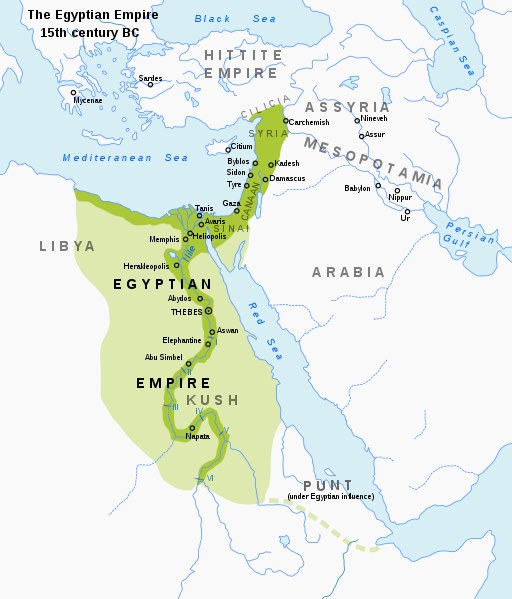
Map of Ancient Egypt
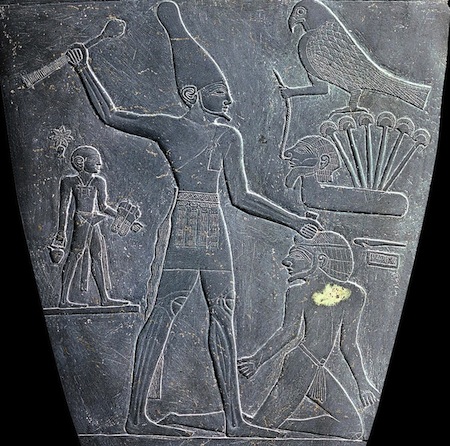
Narmer
During the Early Dynastic Era (3000-2650 BC), Egypt developed its very unique culture. Ancient Egyptians organized their past into different periods when Egypt was ruled by different families or dynasties. Modern historians have designated the early developmental period of the first two dynasties of Egyptian rulers as the Early Dynastic Era. In Egypt the ruler or Pharaoh ruled over a kingdom that was much larger than any contemporary state. Historians estimate that the population of the Egyptian state at this time numbered as many as two million people, whereas a typical Sumerian Lugal ruled only around 30,000 subjects. The temple/palace system in Egypt was therefore on a much vaster scale than anywhere in Mesopotamia. The term "Pharaoh" in ancient Egyptian is translated as "big house". This term no doubt arose due to the large size of the palaces along the Nile valley where the the Egyptian ruler resided and administered his lands.
The Pharaoh was also not merely a political figure, but he also served as the high priest and was revered by his subjects as a god. The Pharaoh united the lands by performing as high priest religious rituals to honor the different gods that were worshiped up and down the Nile River Valley. The Pharaoh himself was the human form or incarnation of the god Horus, who was the god of justice and truth. When a new Pharaoh assumed the throne, he would adopt a Horus name, which came to be the name under which he was worshiped as a particular incarnation of this deity. Egyptians believed that the divine presence of the just god-king maintained justice (ma'at) throughout the land, which in turn maintained peace and prosperity, as reflected in the annual flooding of the Nile River. Egyptians were particularly devoted to their Pharaoh and viewed themselves as his slaves. In Egypt all land and herds of sheep and cattle were officially the possessions of the Pharaoh, who allowed his subjects to partake of these goods. Egyptians, however didn't enslave each other, but only foreigners.
Ancient Egyptians were polytheists, who worshiped many deities who controlled forces of nature. For example, Ra was the god of the sun and Isis, the earth goddess of fertility. Osiris was associated with the Nile River. The annual flooding of the Nile River was explained through the myth of Osiris, who was murdered by his brother Seth, the god of the desert wind, but then resurrected by his devoted wife Isis. The Nile River (Osiris) was at its lowest in the summer when the hot desert wind was blowing (Seth), but then was "resurrected" when it flooded its banks. and brought life giving water to the earth (Isis). Horus (the Pharaoh) was the child of Isis and Osiris. Since Osiris was a god who had died, he was also the lord of the underworld and the judge of the dead. Ancient Egyptians believed that Osiris would reward people who had practiced a righteous life, with a blessed afterlife in the underworld, whereas he would punish wicked evildoers.
Modern historians have learned much about Egyptian society and religion through their written records. Egyptians developed their own unique writing system known as hieroglyphics around 3000 BCE. In this complicated system known only to professional writers or scribes, written symbols represented both sounds and ideas. Egyptians scribes recorded their ideas in stone inscriptions on the walls of temples and tombs, but they also used papyrus, a reed plant along the banks of the Nile, to produce a writing material like paper, which could be rolled up and stored as records. When Egyptians disposed of old records, they would bury the papyrus rolls in the hot, dry desert, which fortunately preserved this material, so that these old records could be found and read by modern archaeologists after hieroglyphics were deciphered in the 19th century.
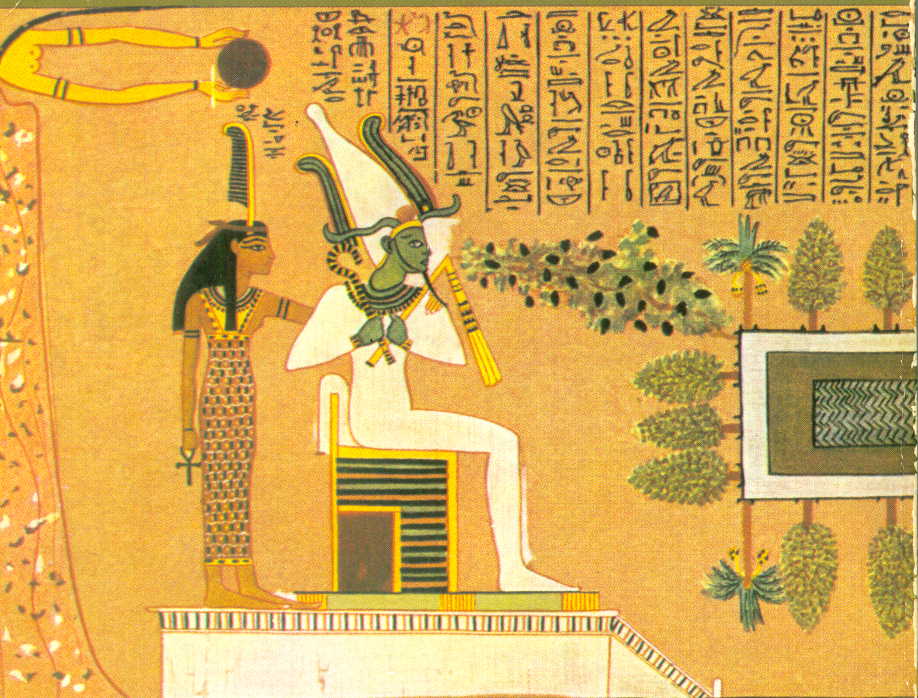
Osiris
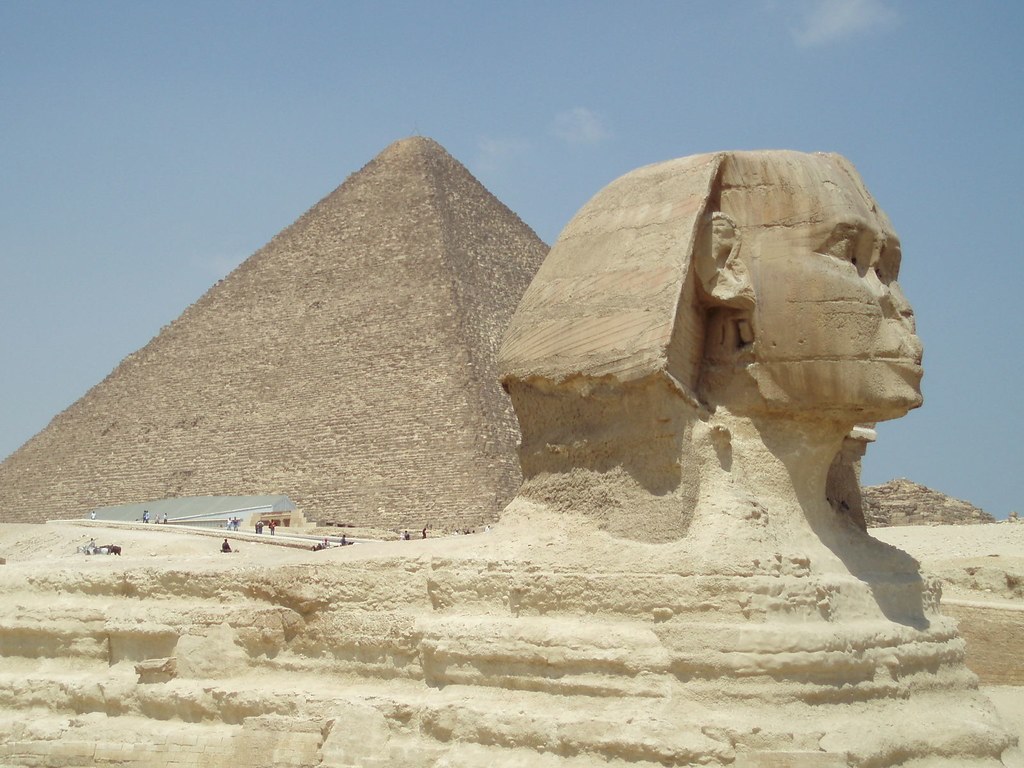
The Old Kingdom ( 2650-2200 BCE) is the period that covers the third through the sixth dynasties of pharaohs, who built the great pyramids. The wealth and power of the period reached its peak during the fourth dynasty of pharaohs (around 2500 BCE). The Pharaoh Khufu of this dynasty constructed the largest pyramid of all at a height of nearly 500 feet. Each pyramid served as the tomb of a pharaoh. Egyptians believed that such tombs were necessary to preserve the Ka or spirit of the pharaoh so that he could be united with the other gods in the heavens. Egyptian rulers invested heavily in time and resources to construct these tombs. Entire cities were built to support the workers who constructed these tombs, who enjoyed a privileged position in Egyptian society.
In the fifth and sixth dynasties, the pyramids of pharaohs became less grand over time, whereas regional governors began to build pyramid tombs that came to rival those of the pharaohs. Modern historians maintain that powerful warlords at the local level at this time were usurping power from the central government and challenging the reigning pharaohs. Between 2200 - 2000 BCE, the central government collapsed and there were five different dynasties in power (dynasties seven through eleven). Civil war erupted as rival dynasties waged war with one another. Historians refer to this period as the First Intermediate Period. During this period, there was a prolonged drought in the mountains of Central Africa, the source of the Nile River, due to climate change. Consequently the Nile River failed to flood, resulting in famine in Egypt. People may have attributed such famines to the presence of a fraudulent pharaoh, who was not a true god-king and could not preserve ma'at in the land. Such pharaohs thus faced revolts and challenges to their authority by competitors for the throne.
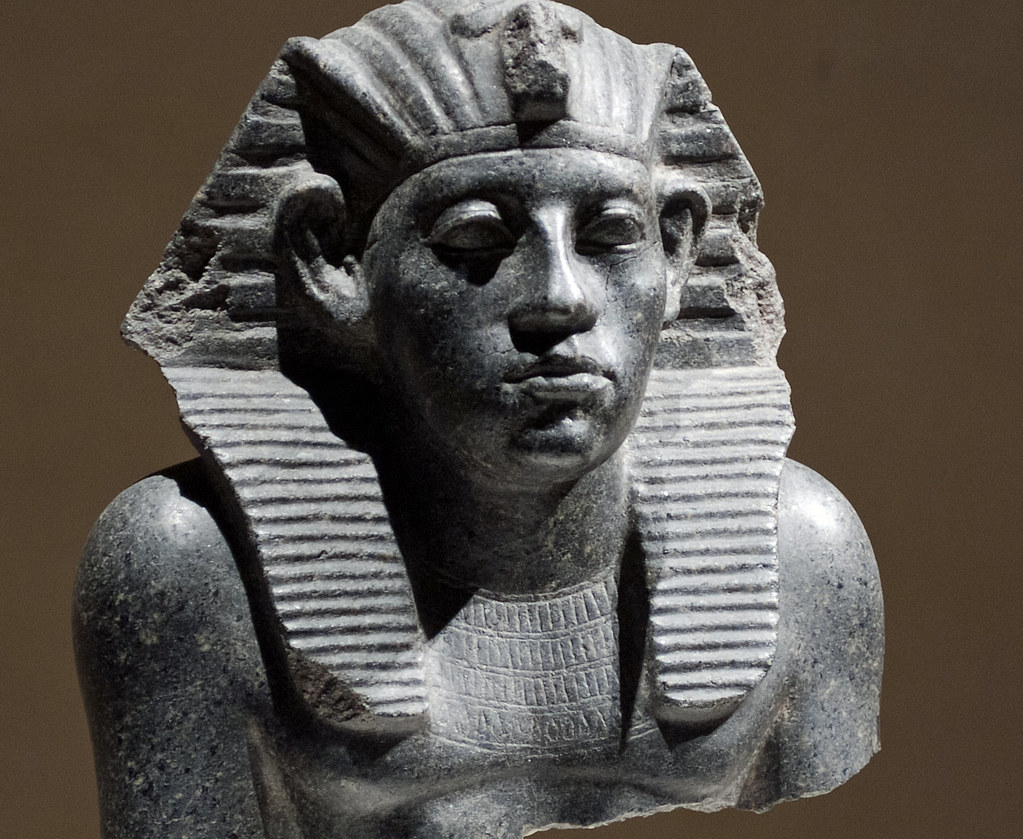
Aound 2000 BCE, Amenemhat, a powerful warlord from Thebes in Upper Egypt, defeated his rivals and re-united Egypt. Amenemhat founded the 12th Dynasty of pharaohs, which together with the 13th Dynasty would rule Egypt during the Middle Kingdom (2000-1700 BC). During this period Thebes remained the capital of the kingdom. To unify the kingdom, pharaohs emphasized the cult of Amon-Ra at Thebes. This deity was a a combination of the sun-god Ra, worshiped in the north of Egypt and Amon, a sky god revered in the south of Egypt. Amon-Ra was portrayed as the king of the gods and the father of each reigning pharaoh. The pharaohs of the Middle Kingdom also replaced hereditary local governors with officials appointed as governors by the pharaoh. These regional governors or Nomarchs therefore owed their position and wealth to that pharaoh. This change prevented the rise of powerful families at the local level that might challenge the central government. Pharaohs in this period also maintained large standing armies and imposed tribute on neighboring states such as the small kingdoms of the Levant to the north and in Kush to the south in what is today Sudan. These armies and the imposition of tribute strengthened the status and power of the central government in the eyes of the Egyptian people and warded off a repeat of the internal dissent and conflict of the First Intermediate Period.
After 1700 Egypt faced its first experience of foreign invasion. Nomadic peoples from the Levant and the Sinai Peninsula known to the Egyptians as the Hyksos or "shepherd kings" successfully invaded Egypt. Their success was due to their use of horses to cross the desert to reach the Nile River Valley. The occupation of Egypt by these invaders began the Second Intermediate Period (1700-1550 BCE), which covers the period from the 14th through the 17th dynasties of pharaohs. The Hyksos kings adopted Egyptian culture and claimed to be true pharaohs, but the Egyptians continued to view them as barbaric savages. Around 1550 BCE, the native Egyptian prince of Thebes united the Egyptians against the occupiers and expelled the Hyksos. This Second Intermediate Period would be followed by the New Kingdom period when Egyptian power would reach new heights in the ancient world.


