The Empires of the Iron Age
Early World5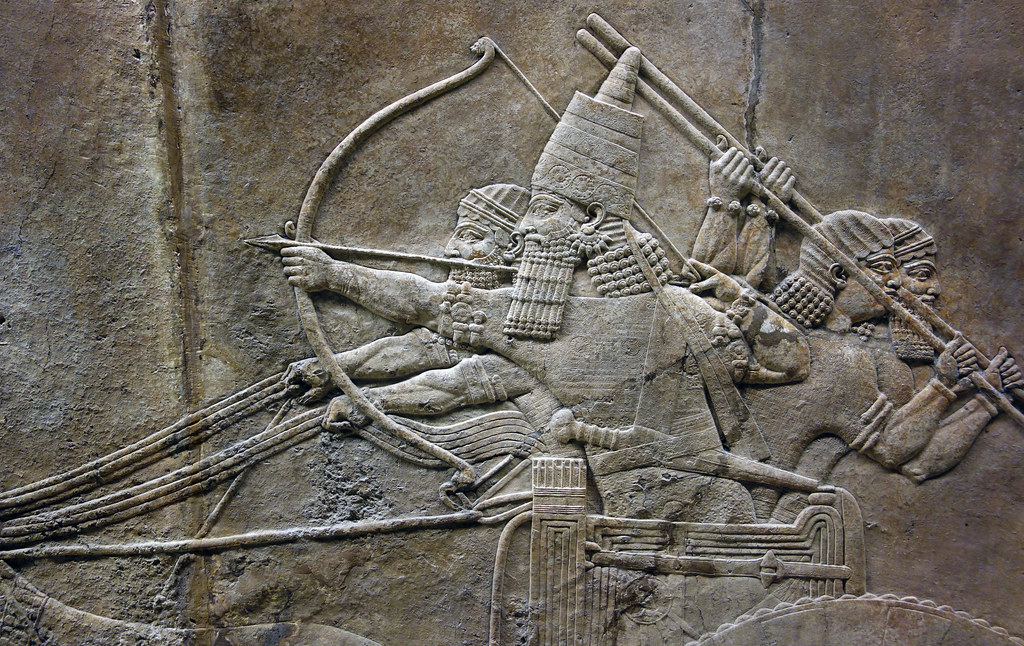
In the Iron Age across western Asia there emerged a series of mighty empires, culminating in the Persian Empire (550-330 BCE), which was the largest empire in world history up to that point. Iron technology enabled these empires to equip large armies with weapons and armor. This same period also witnessed the invention of the alphabet by the Phoenicians, a technology that allowed for more complex economic and political organization than in any previous era. Additionally, this era witnessed the writing of the Hebrew Bible, also known as the Old Testament, by the ancient Israelites. The ideas of this literary work, especially its emphasis on monotheism, the belief in a single, supreme God, was the basis of the modern religions of Christianity and Islam, whose adherents number in the billions today.
The first great empire of the Iron Age was the Assyrian Empire. The ancient Assyrians originated from the city of Asshur, which was located in northern Mesopotamia (modern Iraq). The Assyrians first emerged as a great power during the reign of their king Shamsi- Adad I (1800 BCE) in the Bronze Age. For much of the Late Bronze Age, Assyria was a second rate power compared to the Mitanni and Hittite Empires. At the close of the Bronze Age and beginning of the Iron Age, the Assyrian king Tiglath-Pileser I (1100 BCE) was able to defend Asshur from attacks by Aramaean tribes, which enabled the kingdom to survive when other Bronze Age states were collapsing due to war and invasions. One of the great achievements of the Assyrians was their preservation of the legacy of Bronze Age culture and their transmission of this culture to various simple cultures. Assyrian kings often settled defeated Aramaean tribes in Mesopotamia and assimilated them.
In the ninth century BCE, Assyrians kings waged ongoing wars against the small Aramaean and Hittite kingdoms to their west in modern Syria. Ancient Assyrian records indicate the the Israelite king Ahab, whose reign is chronicled in the Old Testament, led a alliance of these states against Assyria in the early ninth century BCE. Another rival to Assyria at this same time was the kingdom of Urartu, which was located north of Assyria in modern Armenia. This kingdom had arisen when Hurrian tribes in this region united under one king to wage war on Assyria. Despite their antagonism with Assyria, the culture of Urartu owed much to Assyrian culture. The most powerful king of Urartu, Minua (800 BCE) for example, built an large irrigation canal, that still functions today, that was built based on Assyrian technology.
The Assyrian Empire vastly expanded after 745 BCE under a succession of successful kings, beginning with Tiglath Pileser III. Under their military leadership, the Assyrian Empire came to include all of Mesopotamia, the Levant, and Egypt. During the reign of Sennacherib (705 BCE), Nineveh was established as the imperial capital. This city of 80,000 would become home of the the world's first botanical gardens, zoo, and a library, which would contain all the classic works of Mesopotamian literature such as the Epic of Gilgamesh and the Enuma Elish.
The military and imperial success of the Assyrians was due to their tactics and unique culture. Assyrian armies were well armed with iron armor and weapons. Assyrian infantry fought in large, tight formations that simply overwhelmed their opponents through the weight of the force of their advance against the enemy. Assyrian armies also struck terror into their opponents. Defeated enemies were often beheaded, impaled, and flayed alive in mass. Assyrians also practiced "ethnic cleansing" against some of their enemies, who were forced from their homes and replaced with loyal subjects. For example, after their victory over the kingdom of Israel in 722 BCE, the Assyrians forced thousands of Israelites from their homes, and settled the area with Arab tribes, that had been loyal subjects of the Assyrians. These Arab settlers intermarried with the remaining local inhabitants and became known as the Samaritans. The Assyrians also encouraged the elites in conquered areas to adopt an Assyrian lifestyle, so that these areas would be less prone to rebel against Assyrian rule. Assyrians also enjoyed great confidence in their military campaigns due to their religion. Assyrians, like other Mesopotamian cultures, were polytheists. But the Assyrians did maintain that their national deity, Asshur, was far greater and more powerful than any other god, a religious belief known as henotheism. Assyrians attributed their victories to this god. When Assyrians defeated an enemy, they believed that Asshur had crushed the gods of their enemies. Assyrians even placed chains on the idols of their enemies' gods after they captured a city, as if these gods were war captives.
The harsh treatment that the Assyrians meted out against their enemies did stir up much hate against the Assyrians. In 612 BCE an alliance was formed by the Chaldaeans from southern Mesopotamia, the Medes from western Iran, and the Scythians, nomadic Iranian tribes from the Eurasian steppe. This alliance sacked Nineveh and either slaughtered or enslaved its population. Assyria then disappeared from world history.
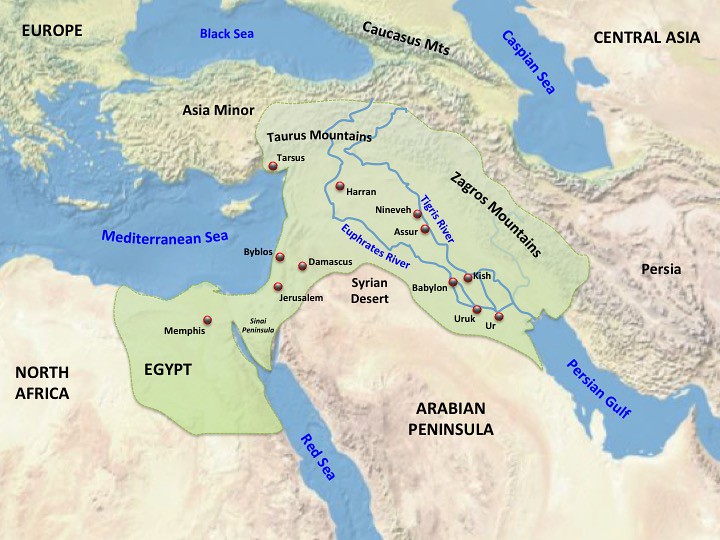
The Assyrian Empire
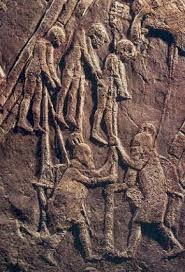
Assyrians impaling captives
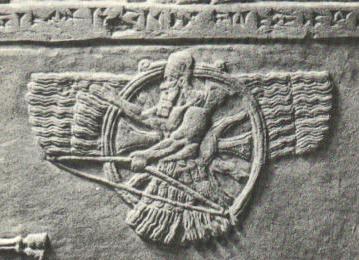
the god Asshur
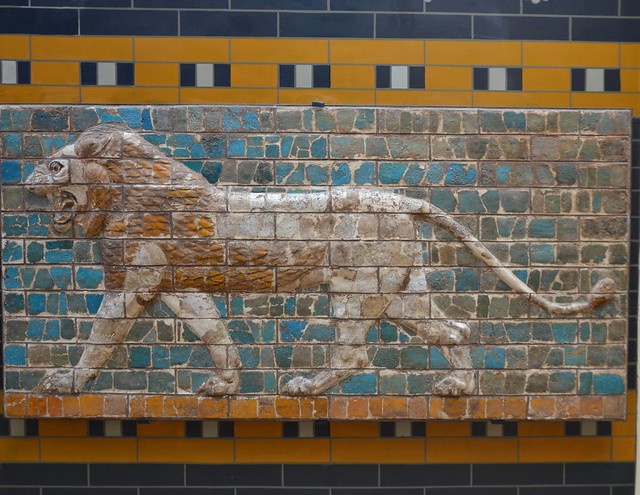
The fall of the Assyrian Empire in 612 BCE resulted in a series of empires competing in western Asia for dominance. The Medes were an Iranian people, who inhabited what is today western Iran. the Medes were originally divided into a number of tribes, who raided Mesopotamia to their west. Due to wars and ongoing contact with the Assyrians, the Medes transitioned from a simple to a complex culture. By 700 BCE, the Medes were united under a single king with a capital at Ecbatana (modern Hamadan). The Kings of the Medes also established themselves as lords over the different local kings of the Iranian tribes of the Iranian plateau. The Medes were especially famous for their hereditary class of priests, known as the Magi, who were experts in the religious rituals and lore of the Medes. Eventually the term Magi came to refer to an expert in esoteric knowledge and is the root of the English word "magic".
The Chaldaeans were a Semitic people who had settled in southern Mesopotamia in the early Iron Age. By the end of the seventh century BCE, the Chaldaeans had gained control of the ancient city of Babylon. The greatest king of the Chaldaeans was Nebuchadnezzar. After the collapse of Assyria, Chaldaean armies conquered all of Mesopotamia and the Levant under Nebuchadnezzar's leadership. The Chaldaean army in the Levant was challenged by Egypt, which had again been reunited under the 26th Dynasty of pharaohs, the Saite Dynasty, whose pharaohs were descended from Libyans who had settled in Egypt at the end of the Bronze Age. At the battle of Carchemish in 605 BCE, the Chaldaeans defeated the Egyptians and went on to dominate the Levant. The Chaldaean Empire is also known as the New Babylonian Empire since Babylon was the capital of this empire.
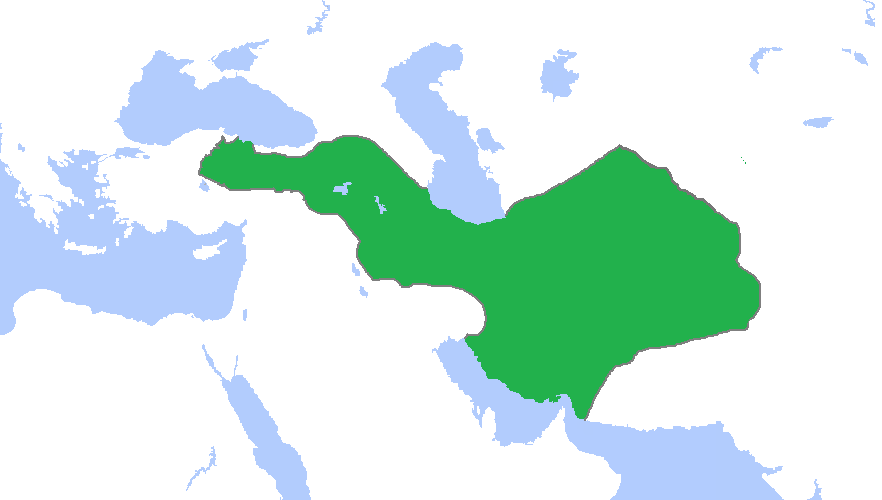
Median Empire
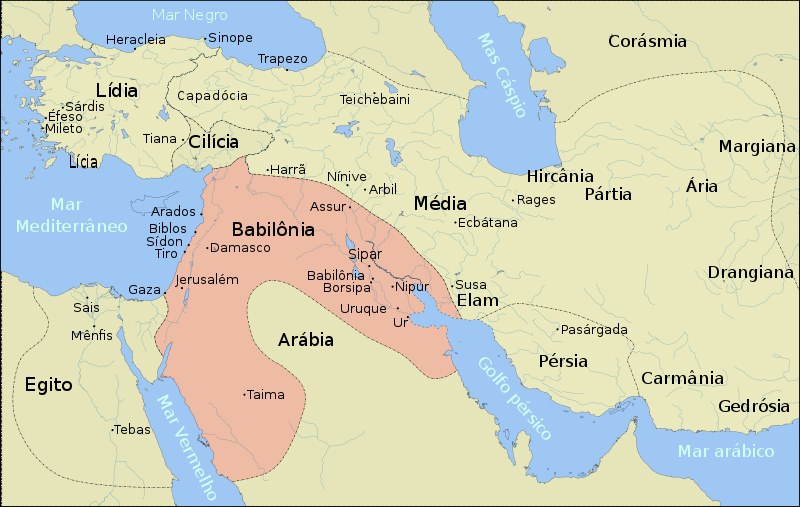
New Babylonian (Chaldaean) Empire
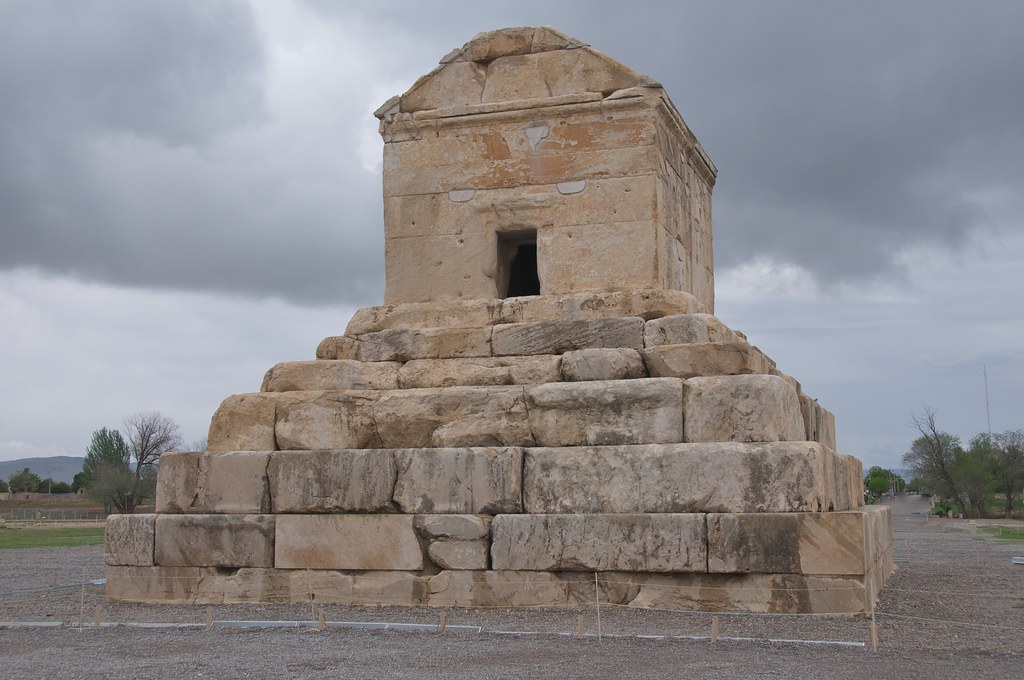
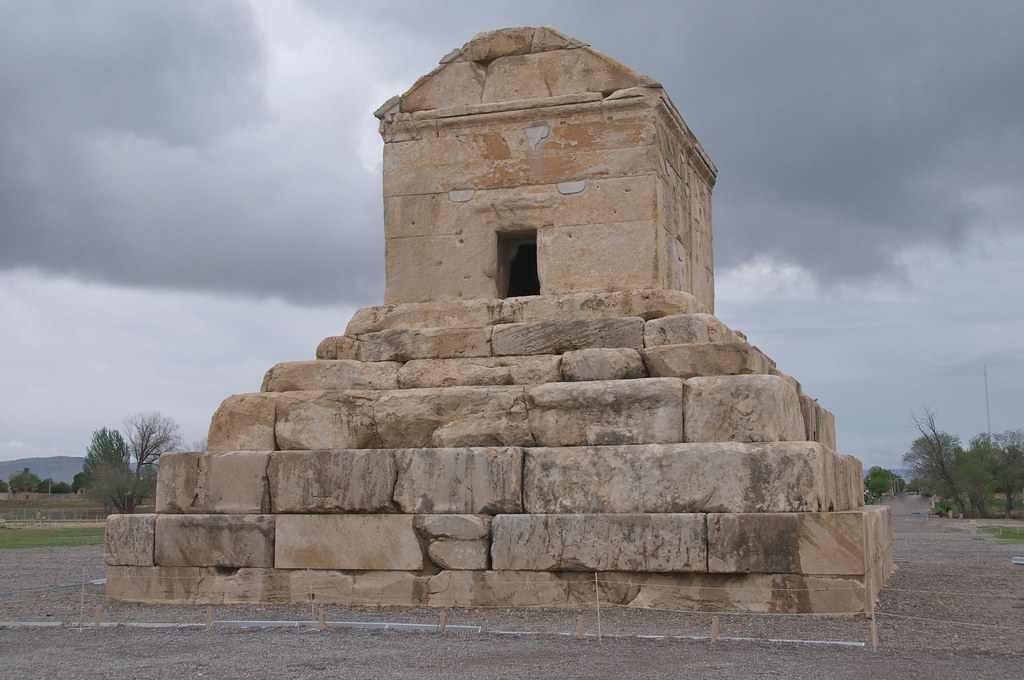
Both empires of the Medes and the Chaldaeans fell victim to the rising Persian Empire in the sixth century BCE. The Persians were another Iranian people who had settled in Anshan in what is now southwestern Iran. In the seventh century BC Assyrian armies had sacked Susa and thousands of Elamites in Anshan had been taken into captivity back to Assyria. The Persians had migrated in to this area after the removal of the Elamites. After 562 BC the king of the Persians, Cyrus the Great, first conquered the Medes, and then the Chaldaean Empire and Babylon fell to his armies. Cyrus at the end of his reign in 528 BCE, advanced against the Scythian tribes in central Asia, where he died in battle. His son Cambyses further extended the empire through the conquest of Egypt. After Cambyses' death without an heir, the Persian nobles elevated one of their own, Darius (524 - 484 BCE). as the new king, as he was a member of the Achaemenid royal family.
While Cyrus was the founder of this empire, leading his spectacular Persian cavalry into battle, Darius consolidated this empire. He established a system of collecting imperial tribute whereas each province was governed by a satrap, who was personally responsible for collecting tribute, which the Persian king determined based on what that province could afford to pay. Wealthy provinces paid more in tribute than less wealthy provinces. Darius also set up a bureaucracy of officials, the king's "eyes and ears", who held the satraps accountable to the king. Darius also established a new imperial capital at Persepolis in Persia in southwestern Iran. Here Darius administered his vast empire with a massive redistribution system, where tribute was stored and distributed to the officials of the empire. Under Darius the empire further expanded into the Indus River Valley in the east and into the Balkans in southeastern Europe in the west.
The Persians sought to win the goodwill of their subjects, who enjoyed the military protection of the empire without paying excessive tribute. The Persians also honored the gods of their subject peoples. Darius for example built temples in the Egyptian style to Egyptian gods in Egypt and had himself portrayed in Egypt as the legitimate pharaoh. He also made great gifts to the temple of the Greek god Apollo at Miletus in Asia Minor (western Turkey).
The Persians built temples to foreign gods, but they practiced their own unique religion, which is known as Dualism. The Persians maintained that there were two main deities, Ahuramazda, the god of light and truth, and Ahriman, the god of darkness and evil. According to the ancient Persians, the cosmic war between these two gods resulted in the creation of the universe, which was a mixture of light and darkness and good and evil. Persian kings viewed themselves as servants of Ahuramazda and champions of truth and justice. The Persians maintained that their religion had been revealed to them by a great prophet named Zoroaster, who was born in what is today Afghanistan. The term Zoroastrianism is thus sometimes used to refer to the ancient religion of the Persians. Some historians assert that this Zoroaster was a historic figure who lived around 600 BCE. The sacred writings of Zoroastrianism were compiled in their present form much later in the Avesta in the third century CE. Some scholars who have examined the language of this work, however, have concluded that these works can be traced back to the beginning of the Iron Age around 1100 BCE and that the prophet Zoroaster is just a legendary figure.
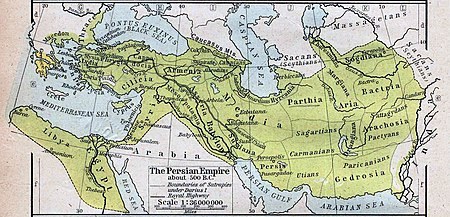
The Persian Empire
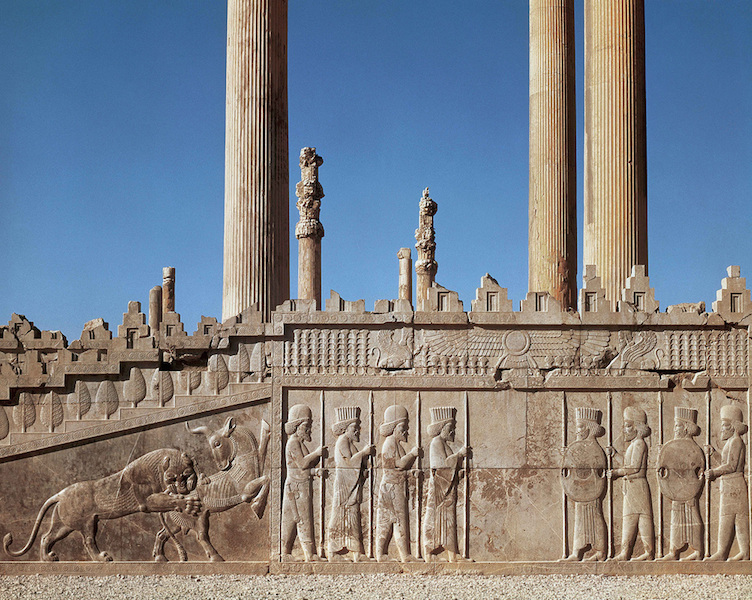
ruins of Persepolis
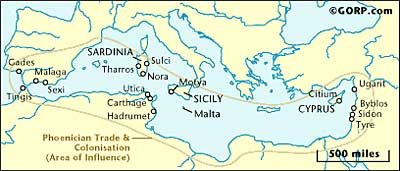
The Iron Age is not simply known for its mighty empires. The Phoenicians were descended from the Bronze Age Canaanites and lived in city states ruled by kings such as Sidon and Tyre in what is today the country of Lebanon. The Phoenicians were great sailors, explorers, and traders. Phoenician traders established trading posts across the Mediterranean in North Africa, Sicily, Sardinia, and Spain. Phoenician explorers sailed along the west coast of Africa and to the British Isles in search of new markets and goods. The Phoenicians also invented the alphabet around 1100 BCE. Their alphabet simplified the earlier script that had been developed by the Canaanites of Ugarit in the Bronze Age. The simplicity and efficiency of this alphabet enabled more people to become literate. Literacy no longer was the monopoly of a small specialized group of scribes. The commercial success of the Phoenicians was undoubtedly due to the fact that they had perfected a better, more efficient system of keeping records that a larger percentage of the population could employ in economic activities such as commercial exchanges. Other cultures quickly adapted the new script to their own language, For example, the Aramaean peoples used this alphabet to write their language. Because so many people spoke Aramaic in the Persian Empire, this Aramaic script became the primary language script for keeping records in the Persian Empire. The ancient Israelites also adopted the Phoenician alphabet to write their Hebrew language.
Historians examine the Old Testament as well as archaeological evidence to study the history of the ancient Israelites. The Old Testament is a collection of books that were compiled at different times by different authors. The oldest books of the Old Testament are known as the Pentateuch and consists of the first five books of the Old Testament. Modern historians maintain that these books may have reached the form that they possess today in the seventh century BCE. Their authors drew material from earlier accounts and traditions that could reach as far back at the Bronze Age. According to the first book, Genesis, the ancestor of the Israelites was Abraham. In the stories about Abraham in this book, his lifestyle is that of a nomad whose wealth is measured in his herds and flocks of cattle and sheep. Bronze Age documents from Mesopotamia and Egypt mention nomadic peoples in the Levant whom they refer to as the Hapiru. Modern scholars have noted the similarities between this term and the name Hebrew, which is how Abraham and his followers are described in Genesis. This same book also recounts how Joseph, a descendant of Abraham became the right hand man for the Egyptian Pharaoh. Such an occurrence could have only occurred when the Hyksos or "Shepherd Kings" ruled over Egypt as pharaohs (1700 -1550 BCE) since Egyptians were generally hostile toward foreigners. According to ancient Egyptian tradition, the Hyksos were in fact Hebrews.
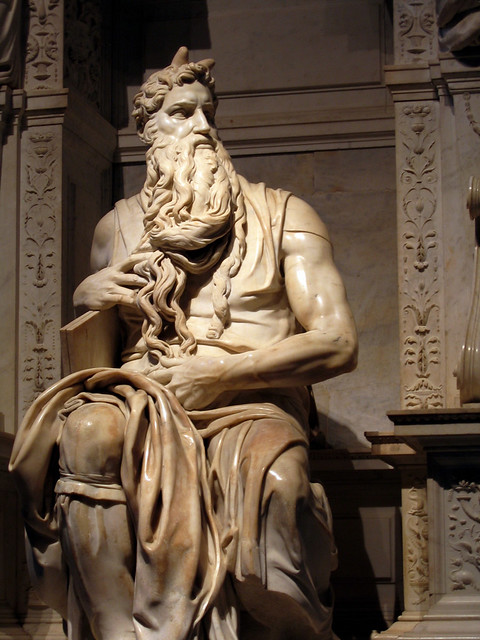
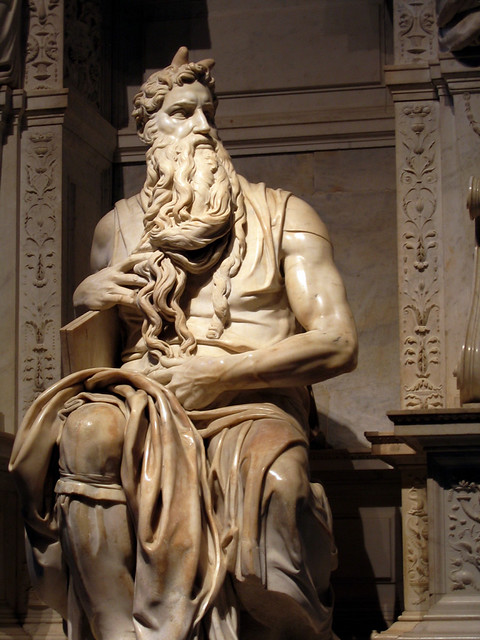
After Genesis, the remaining four books of the Pentateuch, Exodus, Leviticus, Numbers, and Deuteronomy, tell the story of how the Israelites became slaves to the Egyptians, their liberation from slavery under the leadership of the prophet Moses, and their wandering in the Sinai Desert for forty years. The first book of the Old Testament after the Pentateuch, Joshua, recounts how the Israelites conquered the land of Canaan. Some modern historians maintain that the wandering of the Israelite tribes and their migration to Canaan could be based on historical developments surrounding the wars and migrations that marked the collapse of the Bronze Age world around 1200 BCE. However, according to the chronology of the Old Testament itself, the events described in Exodus occurred around 1450 BCE. Unfortunately, archaeological evidence for either date is lacking. For example, Joshua recounts how the Israelites destroyed the city of Jericho, when its walls came tumbling down. There is evidence for a Bronze Age city of Jericho, whose walls crumbled, but this destruction occurred around 1500 BCE. Bronze Age records do at least indicate that the ancient Israelites were enemies of the Egyptians. Around 1200 BCE, an Egyptian pharaoh in one of his monuments described the people of Israel as his enemies, which is the earliest mention of the name Israel outside of the Old Testament.
According to the books of Judges and Samuel, the Israelites were divided into twelve tribes who only united temporarily to fight a common enemy, such as the Philistines. Eventually the Israelites united permanently under a single, great king, David, who established Jerusalem as his royal capital. The book of Kings recounts the construction of a great palace and temple in Jerusalem by David's son and successor, Solomon. These developments reportedly occurred around 1000 BCE. Some modern historians discount these stories in the Old Testament as legends. There is in fact no archaeological evidence for the construction of a temple at Jerusalem in the early Iron Age. However, the construction of palaces and temples by a ruler, as described by the Old Testament would be consistent with the practice of ancient kingdoms since such institutions were important political and economic centers. Moreover, the design of Solomon's temple is similar to temples that archaeologists have uncovered in Syria in the Bronze and Iron Ages. In addition, a recently discovered inscription from Syria from the ninth century BCE appears to indicate that descendants of David were kings in Jerusalem, which is the earliest evidence for David outside the Old Testament.
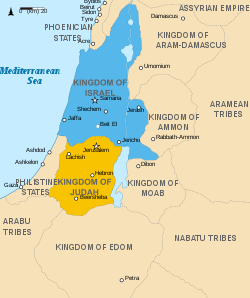
According to the book of Kings, the kingdom of Israel split in two after the death of Solomon. Israel was the northern kingdom with its capital at Samaria, and Judea was in the south and based in Jerusalem, where the descendants of David were kings. Assyrian records mention a number of the kings of these kingdoms, who waged war or paid tribute to the Assyrians, such as king Ahab in the early ninth century BCE. In 722 BCE the Assyrians destroyed the northern kingdom and deported thousands of Israelites (the so-called ten lost tribes of Israel) back to Assyria. The kingdom of Judea, whose inhabitants became known as Jews, survived the Assyrians, but the kings of Judea became allies of Egypt and thus incurred the wrath of the Chaldean king Nebuchadnezzar, who in 586 BCE, sacked and destroyed Jerusalem and took thousands of Jews into captivity to Babylon. In 539 BCE after Cyrus conquered Babylon, the Persian king allowed the Jews to return to Judea and to rebuild Solomon's temple in Jerusalem, and he even allocated funds for construction. Judea remained under Persian rule for the duration of the Persian Empire, and the Persians did not restore the royal House of David to power.
The hereditary priests of Israel, the Levites presided over the rituals at the temple at Jerusalem, and they also compiled and organized the books that would become the Old Testament. These books not only tell the story of Israel's history, but they stress that Israel's god, Yahweh, is the only supreme God, which is why the Israelites were the first people in world history to embrace monotheism. Moreover, Yahweh had made a Covenant or binding agreement with the Israelites that they would enjoy peace and prosperity in the Holy Land of Israel as His people, only so long as they obeyed God's laws and commandments (The Ten Commandments) that Yahweh had revealed to the prophet Moses on Mount Sinai in the desert. The Old Testament also stressed how Yahweh due to His love and mercy had saved the Israelites again and again after they had violated His commandments and afterwards repented of their misdeeds. The restoration of Jerusalem and rebuilding of Solomon's temple by the Persians reportedly was another example of Yahweh's love and mercy for His people. The Old Testament also tells how Yahweh in His love mercy also inspired holy men and women or prophets, like Moses and Elijah, to advise the Israelites. The Old Testament also includes certain books that were attributed to these prophets such as the books of Isaiah, Ezekiel, Jeremiah, and Daniel. The books of the prophets also stress that Yahweh would someday restore the House of David through the Messiah or "anointed one" who would be a descendant of David and would restore the Kingdom of Israel. This belief in a Messiah among the Jews would later be the basis for the rise of the religion of Christianity.
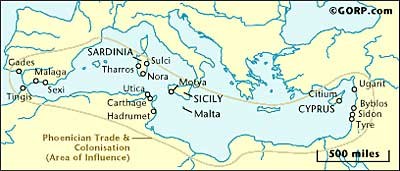
Phoenician trade and colonies
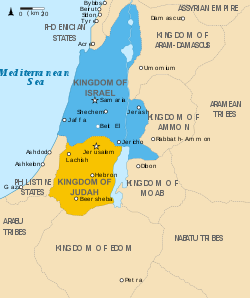
Map of ancient Israel