The Roman Republic
Early World10
During the Greek Archaic period (800 - 500 BCE), Greeks established colonies on Sicily and in southern Italy. These new city-states shaped and influenced the native population of Italy. By the end of the sixth century BCE (around 500 BCE) inhabitants in central Italy, who spoke the Latin language, had adopted much of Greek culture as their own, including the idea that the people of a community, as citizens should have a voice in the governance of the state. The people of the small city-state of Rome referred to their state as the Res Publica or "Matters of the People" from which the word "Republic" is derived. These Romans adopted other aspects of Greek culture as well, such as their gods and myths. When the Roman state expanded and built an empire, the Romans transmitted this culture, which was so heavily indebted to Ancient Greece, to the Celtic and German tribes of Western Europe. For example, the languages of Spain and France spoken today are known as "Romance" languages because they are descended from the Latin language spoken by the Romans. The "Classical" civilization of Ancient Greece and Rome was thus the foundation for European or "Western" civilization.
The Romans passed down many traditions about the early history of their republic, which were recorded by ancient Roman historians such as Livy in the first century BCE. These stories often reflected the values that the Romans revered. According to Roman tradition, their city was founded by twin brothers, Romulus and Remus, sons of the god of war, Mars, in 753 BCE. Romulus killed his brother when Remus mocked his brother's construction of a wall around the new city and jumped over it. This story brought into focus for Romans their great respect for boundaries and private property. Romulus assembled a group of criminals and debtors to inhabit his new city, but the men had no wives. To secure wives, Romulus invited the neighboring Sabines to attend a festival in Rome with their unmarried daughters and sisters. During the festival, the Romans seized these girls and forced out their male chaperones. When the Sabines returned with an army to recover these women, these woman, now the wives of the Romans, inserted themselves between the two armies (See image) and related that the Romans had treated then with respect and that they wished to remain as Roman wives. At this point, due to the efforts of these Roman woman, the Sabines and the Romans decided to join together in a single city-state. This story highlighted the fact that in Rome, one did not have to be born a citizen of Rome, but that one could receive the rights of Roman citizenship. The story also explained why Roman woman enjoyed much higher social status than woman in other ancient cultures. In Rome's early history, kings ruled the city such as the Tarquin (or the Etruscan) Dynasty. The last king of this dynasty, Tarquin the Proud, was an especially cruel and unjust ruler. After his son raped a young Roman woman, the Romans in 509 BCE rose up against this tyrant, and expelled him under the leadership of Brutus. The Romans then declared their government to be a Republic and that they would never be subject to tyranny again. This story especially emphasized the Romans' respect for the rule of law. No one, no matter how powerful, was above the law.
Archaeological evidence as well as written accounts from ancient Greek sources indicate that there is an historical basis for these traditions. Archaeologists have found evidence of a wall constructed in the eighth century BCE around the Palatine Hill, which is the location where Romulus reportedly built his wall. Archaeologists at this location also found Greek pottery from this period. The city of Rome was located at a location along the Tiber River where this river was no longer navigable to sea going vessels. Greek merchants would have sailed up the Tiber from the Mediterranean Sea and traded with the settlement there. When Greek merchants and colonists first arrived in Italy at this time, the Iron Age Villanovan Culture had existed in northern and central Italy since 1100 BCE.
These Greek merchants and colonists spurred the development of a new complex culture in northern and central Italy out of the Villanovan Culture. By the seventh century BCE, the Etruscans were organized into a league of independent city states in this region, each ruled by its own king and council of elders. In their art and architecture, the Etruscans followed Greek models. The Etruscans also modified the Greek alphabet to write their language. By 600 BCE the Etruscans had colonized Rome, which became an Etruscan city-state at this time. The traditions of Tarquin Dynasty reflect this Etruscan period of Roman history. The Etruscans strongly influenced the development of Roman culture. For example, in Roman religion, the priests determined the will of the gods through haruspicy, which involved the examination of the entrails of a sacrificed animal. The Romans adopted this custom from the Etruscans. The Etruscan also greatly honored their dead with elaborate tombs, and the Romans also did the same, and maintained that the spirits of their ancestors watched over them. Gladiator contests in Rome had their origins among the Etruscans, who at funerals forced prisoners of war to fight to the death as human sacrifices to their dead. Also the Fasces, the symbol of the authority of Roman magistrates, originally symbolized the authority of Etruscan kings. The Roman alphabet that we use today was based on the Etruscan modifications to the Greek alphabet.
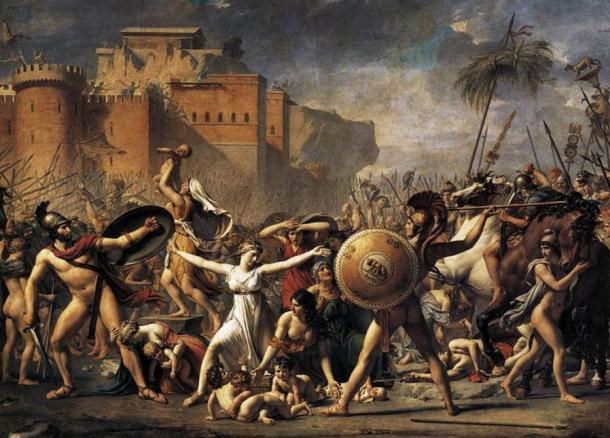
The Sabine Women
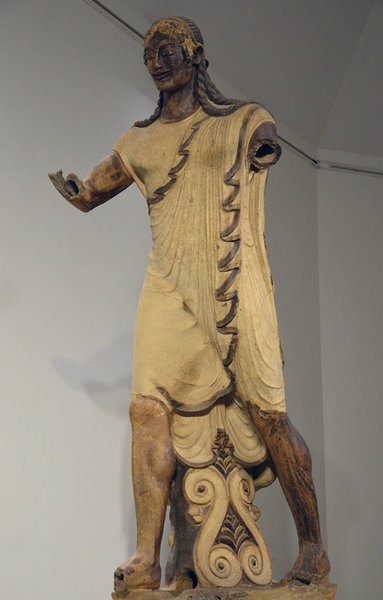
Etruscan Art

Fasces
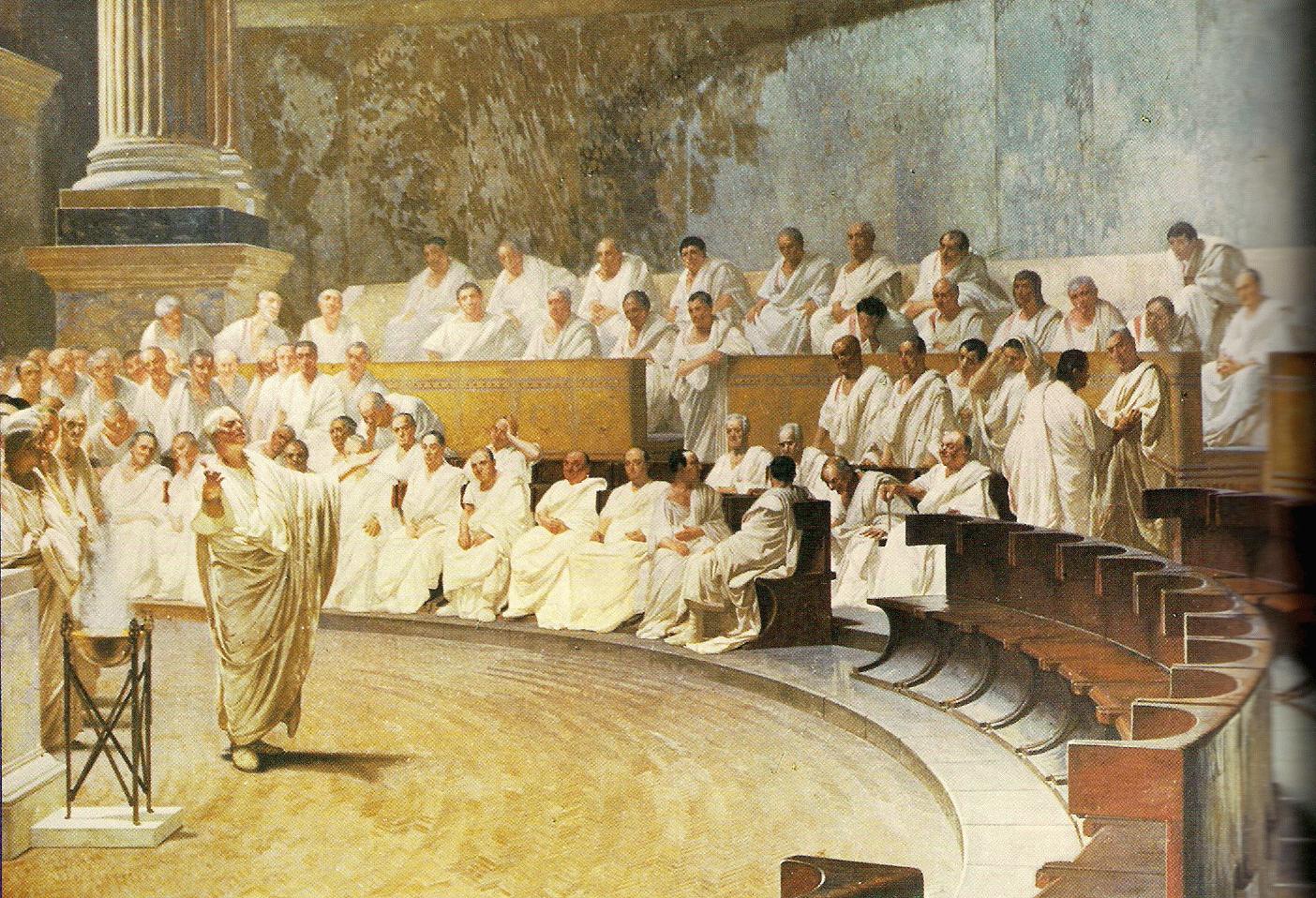
Modern historians maintain that the story of Brutus and expulsion of the Tarquins is based on historical events, which saw the Roman city-state free itself from Etruscan domination and establish itself as an independent republic around 500 BCE. In the early republic, Rome was ruled by elected magistrates (consuls and praetors) instead of kings and by a council of Elders or Senate, which is derived from the Latin word for "old man", senex. Roman society was divided into two classes or orders, Patricans and Plebians. The Patricians were the aristocratic elite, who could alone hold public office and sit in the Senate. From the beginning of the republic through the third century BCE, the Plebians or common people, worked to achieve equality before the law in Roman society. This historical development is known as the "Struggle of the Orders".
The city of Rome was located on a coastal plain known as Latium. East of Latium were the foothills of the Apennine Mountains, which were inhabited by warlike tribes, who periodically raided Latium. It was this constant threat of attack that provided the Plebians with the leverage to negotiate with the Patricians for improving their situation. Patricians needed Plebians to fight in defense of Rome, so at times when Rome was under threat, the Plebians would "go on strike" and refuse to fight for Rome until their demands were met by the Patricians. In 450 BCE, the Plebians went on strike for the first time and demanded that Patricians write down Rome's laws. The Plebians feared that Patrician judges were interpreting the unwritten laws of Rome to take advantage of ignorant Plebians. The Patricians agreed to this demand, and the laws of Rome were for the first time written down in the 12 Tables, so that now Roman laws were accessible to all Roman citizens.
After 450 BCE, the Plebians met together in a Plebian Assembly (Concilium Plebis). This assembly annually elected ten officials known as Tribunes. These Tribunes attended meetings of Rome's assemblies, the Senate, and the law courts. If they saw that any public body or official was taking action that would bring harm to the Plebians, they could say "Veto" or "I forbid" and put a stop to that action. The power to veto by these tribunes provided Plebians with a way to protect themselves and put a check on the power of Patrician officials.
In the fourth and third centuries BCE, Plebians won more concessions by going on strike. After 367 BCE, one of the two Consuls, the highest officials in the republic, had to be a Plebian. After 287 BCE, the Plebian Assembly could pass laws for the republic that were introduced to it by the Tribunes. By the third century BCE the Struggle of the Orders had concluded since it was now possible for Plebians to pass laws, serve as elected officials, and sit in the Senate, as equals to the Patricians under Roman law.
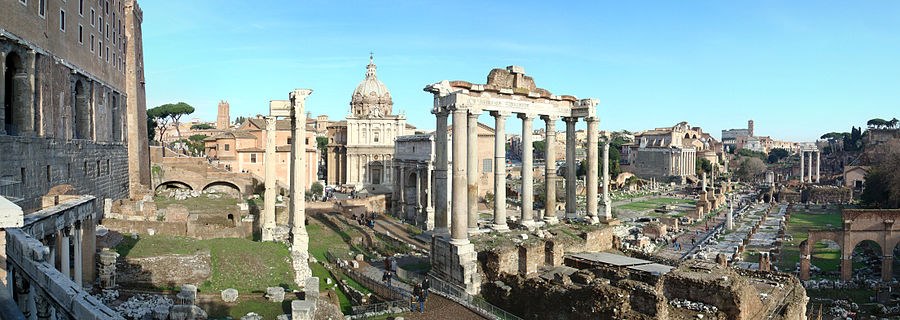
The Roman Constitution was never laid out in a single document like the US Constitution. Instead, the Roman political system was a combination of written laws and political traditions and customs that had evolved over the centuries since the birth of the Republic. Romans were a very conservative people who greatly venerated the Mos maiorum or “Way of the Ancestors”. The Roman political system by the third century BCE consisted of public assemblies, elected officials, and the Senate.
The Roman Republic has three main public assemblies - The Plebian Assembly, the Tribal Assembly, and the Centuriate Assembly. Each assembly annually elected certain officials. Only Plebians could attend the Plebian Assembly. This assembly was organized into 35 tribes, and each tribe could as a block cast a single vote. Roman citizens were organized into these tribes based on their places of residence. Every year the Plebian assembly elected ten tribunes, who possessed the veto power and could present laws to the assembly for its approval. The Tribal Assembly was likewise divided into 35 tribes based on places of residence with each tribe casting one vote, but both Plebians and Patricians could attend. The Tribal Assembly every year elected the Quaestors, who were treasurers in charge of public money. Both Plebians and Patricians also attended the Centuriate Assembly. This assembly was organized into blocks of citizens based on their incomes. Every block of citizens possessed a set number of centuries (one century = 100 men in a military unit). The number of centuries assigned to each block of citizens was based on how many units of 100 men that each block of citizens could afford to equip with weapons and armor. The number of centuries was the number of votes that each block could cast when the assembly voted. Under this system the wealthier citizens thus had more votes in the assembly than the poorer citizens since the wealthier citizens could pay more to support the military. Only the Centuriate Assembly could declare war and approve treaties. Every year the Centuriate Assembly also elected two Consuls, Praetors, and the Censor. The two Consuls commanded Rome's armies in the field and served as judges, and they could present laws to the Centuriate Assembly for its approval. Praetors also served as judges and military commanders , but they were subordinate to the two Consuls. The Censor's main task was to conduct the census to assess the wealth of Rome's citizens based on the grain that their lands could produce. He then assigned these citizens to their block of voters in the Centuriate Assembly.
All elected officials after their term in office joined the Roman Senate. Membership in the Senate was for life. The Senate determined how public money was to be spent and advised elected officials on their course of action. The Senate was by far the most powerful institution in the Roman state. Elected officials rarely ignored the advice of the Senate since they knew that they would be Senators themselves once they had left office.
The Patron-Client system was another important element in the Roman political system. A patron was usually a wealthy Roman citizen who provided legal assistance as a lawyer and financial assistance to his clients, who were normally less affluent Roman citizens. In return for this assistance, clients in the Roman assemblies voted as they were directed by their patrons. Patrons with large numbers of clients therefore wielded great influence in Rome. Patrons often inherited their web of clients from generation to generation. The Patron-Client system enabled the same group of elite, noble families to lead Rome from generation to generation.
This aristocratic elite was made up of families of Patricians and some wealthy Plebians, whose members had succeeded in winning a term as Consul. A Plebian, who was the first in his family to serve as a Consul, was known as a novus homo or "new man". This elite class was focused on maintaining the dignitas or social prestige of their families. Romans believed that their ancestors watched over their lives and would be ashamed if they diminished the dignitas of their family. When a prominent Roman died, a "death mask" was made from the corpse. This mask was then hung from the wall of the house to remind its inhabitants of this ancestor. Young Roman nobles would go from death mask to death mask in their homes and memorize the great deeds of their ancestors. For this Roman elite, public service and military accomplishments were the means to maintain this dignitas. Political and military failures resulted in a loss of this dignitas. For the common Roman citizen, it was vitally important to maintain their libertas, from which the word "liberty" is derived. For these Romans, libertas, was the ability to own land and to pass on that land to their heirs. Roman commoners looked to the Roman elite to help them protect this libertas, which in early Roman history was often under threat from foreign invaders.

Roman death masks
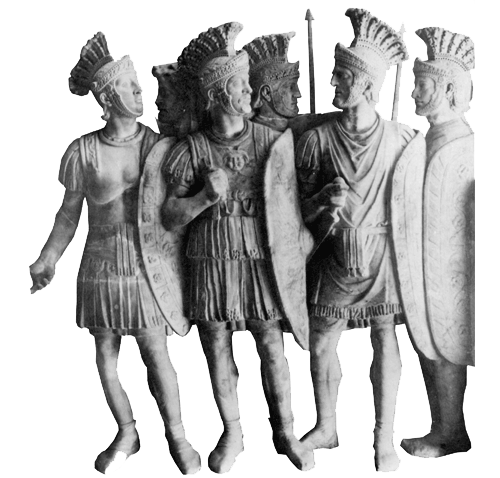
The originally small city-state of Rome didn't plan on building an immense empire. Early Rome was surrounded by hostile city-states and tribes. The Romans however were very successful at defeating these hostile powers. But in the process of defeating these powers, Rome created new enemies. Rome constantly was sending its armies even further out to crush its ever expanding number of enemies until Rome emerged in the second century BCE as the most powerful state in all the lands bordering the Mediterranean Sea.
Rome's success in wars was due in large part to the patriotism and religion of its citizens. The Roman nobles viewed military service to the Roman state as their religious duty to their ancestors to maintain their families' dignitas. For a Roman noble, the greatest military achievement was to lead an army to victory over a Roman enemy as a Consul. Consuls in the field possessed the power of imperium (power to command and to demand obedience from soldiers). Roman soldiers hailed a victorious Consul as an Imperator. The Roman Senate would then grant an Imperator a Triumph, a victory parade for the Imperator and his troops through the city of Rome to the applause of the Roman people. A Roman politician who had won such victories and earned the most respect from the Senate and the Roman people was known as the Princeps Senatus or "leader of the Senate". Roman commoners also saw it as their religious and patriotic duty to fight as soldiers to defend the Patria or "fatherland" and their libertas, as their farmland also served as the burial places for their ancestors that they venerated.
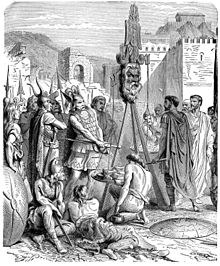
Another factor for the success of Rome in wars was due to the leadership of the Senate. The members of the Senate had collectively decades of political and military experience since all Senators had served as elected officials prior to their service in the Senate. Also since membership in the Senate was for life, the Senate could conduct a war over a long period of time as its membership remained fairly constant over time. The Roman Senate also developed certain policies in conducting wars that proved quite successful. One rule that the Senate followed was to divide and conquer. The Romans always tried to defeat one enemy at a time and avoid waging war against a coalition of enemies. Rome would often attempt to turn their enemies against each other, so that their enemies'energies would be directed against one another instead of against Rome. Another rule for the Roman Senate was to negotiate with the enemy from a position of strength. Rome learned through experience about the agony and humiliation of defeat. In 390 BCE an army of Gauls from what is today France sacked Rome, and the Romans had to pay in gold a huge sum to convince the Gauls to leave their city. From this experience arose among the Romans the expression "Vae victis" or "woe to the conquered". The Romans afterwards pledged to themselves that they would never again be subject to a conqueror. Consequently, the Romans, even after suffering enormous defeats in battles, would continue a war until they could win a major battle and be in a position to negotiate for peace from a position of strength with momentum on their side. Another successful strategy for The Romans was to establish colonies in recently conquered lands. The Roman colonies served as the first line of defense if regions revolted against Rome. Rome also built well constructed roads to link Rome to these colonies, so that Rome could send armies quickly to a region that was in revolt. As a result of these colonies across Italy, the language spoken by the Romans, Latin, over time became spoken across Italy. The Italian language spoken in Italy today is descended from Latin. Another successful policy of the Senate was to transform former enemies into loyal allies (socii). When Rome defeated an enemy, Rome didn't demand tribute or appoint rulers over them. Instead as allies these states enjoyed self-government as long as they had the same friends and enemies as the Roman State. In times of war they were required to provide Rome with troops. These allies came to value this alliance since it provided them with security and peace. Some of Rome's allies who were especially loyal to Rome even received Roman citizenship. Rome thus constructed a system of alliances within Italy that provided it with the manpower to put large armies into the field and expand across the Mediterranean.
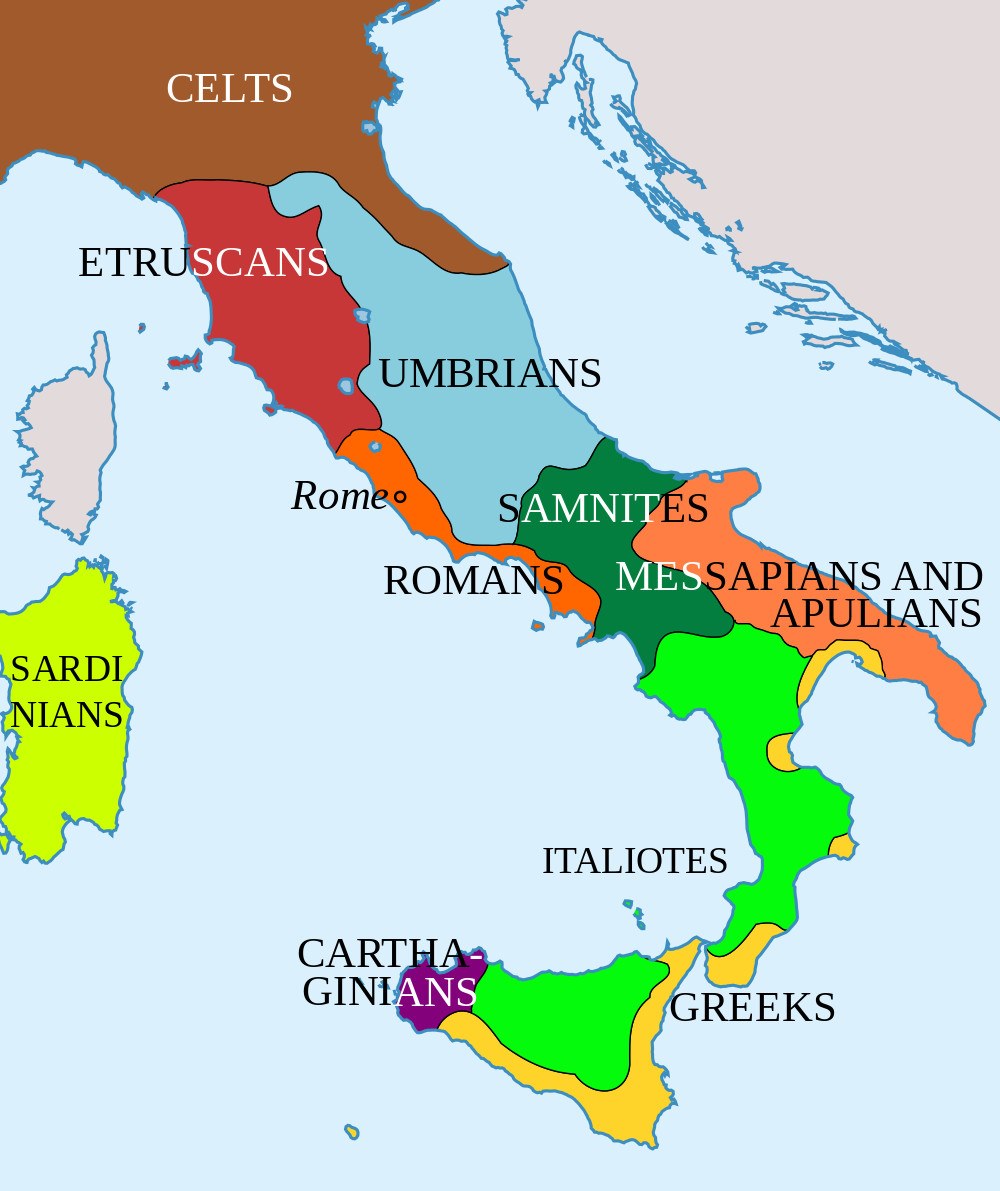
Rome in its early history was surrounded by hostile neighbors. Rome didn't subjugate the small, Latin city-states of the Latium plain until 339 BCE. The Romans also waged war against the Etruscans to their north and the Samnites, who inhabited the mountain valleys of the Apennine Mountains to their east, until 287 BCE when these states were finally crushed and became Roman allies. The Samnites had been hostile to the Greek city states of southern Italy for centuries. When the Samnites became Roman allies, Rome now was an enemy to these Greek states. These city-states led by Tarentum allied themselves with Pyrrhus, the king of Epirus, who hoped to build an empire in the region. Pyrrhus' forces defeated Roman armies repeatedly in the war that followed (280 - 275 BCE), but Rome possessed the manpower to continue the war while Pyrrhus suffered losses that he could not sustain. When Pyrrhus withdrew his forces, the Romans quickly defeated the Greek city- states, and they became new Roman allies.
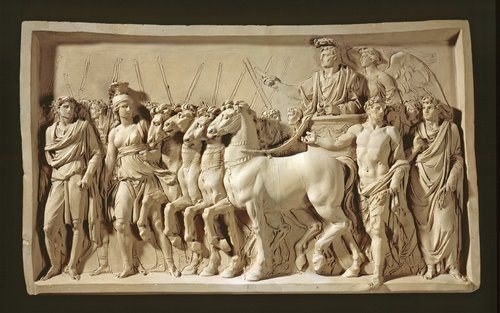
A Roman Triumph
Rome and the Gauls
Map of ancient Italy
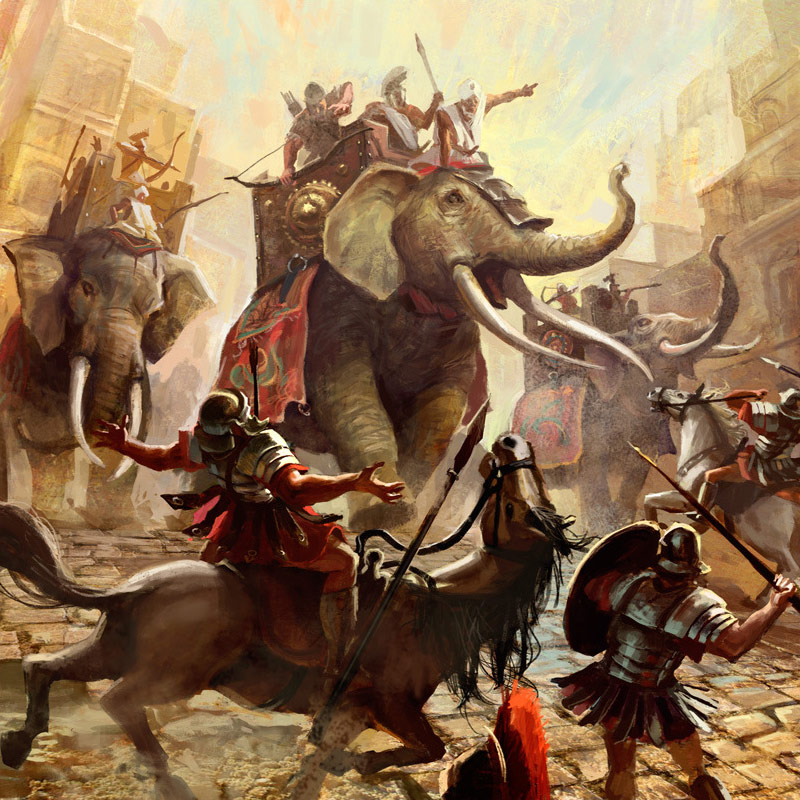
After the conquest of the Greek city-states of Southern Italy, Rome found a new enemy in the city-state of Carthage, located in what is today Tunisia in North Africa. The Greek city- states of southern Italy had been enemies of Carthage for centuries, and now as they were Roman allies, Rome was obligated to defend and support them. Carthage had been founded by Phoenician colonists back in the eighth century BCE. The wars between Rome and Carthage are known as the Punic Wars as the Latin word for Phoenician was Punicus. In the First Punic War (264-241 BCE) Rome and Carthage battled for control of the island of Sicily. In this first war Rome was able to defeat the Carthaginians in sea battles even though the Carthaginians had the largest and most powerful fleet at the time. The Romans in this war won these battles through their inventiveness and ingenuity. The Romans attached a large, iron hook to a long, thick wooden plank. In sea battles, a Roman ship would pull along side an enemy ship and then drop the wooden plank on the opposing ship, so that the iron hook would become affixed on the deck of the opposing ship. After the two ships were thus lashed to one another, the Roman soldiers would use the wooden plank as a causeway to occupy the opposing ship. The Romans were thus able to transform a sea battle, where they were at a disadvantage to the Carthaginians, into a land battle, where the Romans enjoyed the advantage. After the final destruction of the Carthaginian fleet, Carthage sued for peace and the war ended with the Romans annexing Sicily.
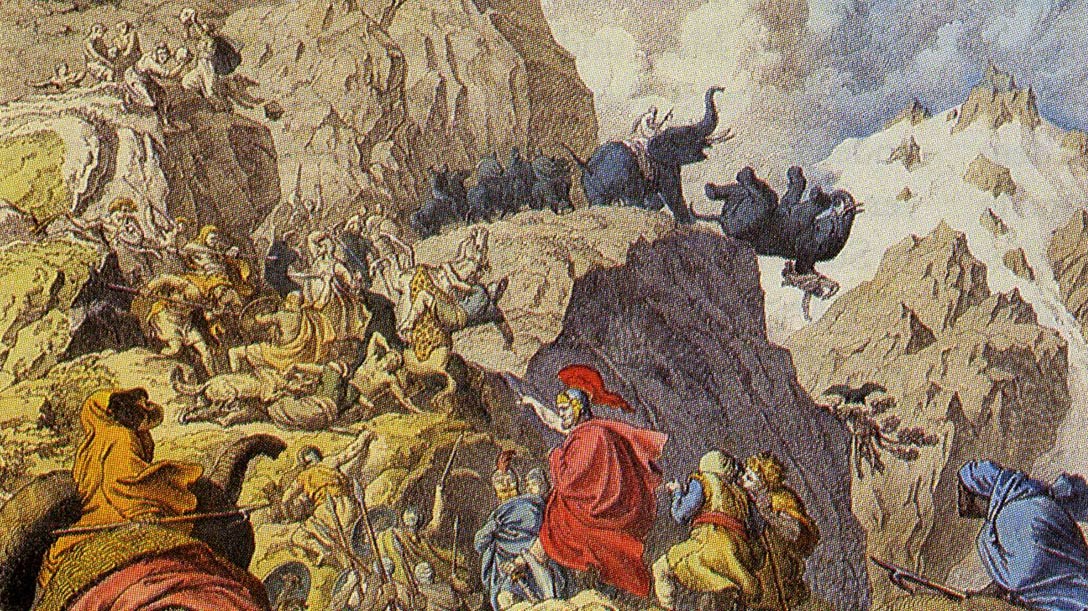
Carthage desired revenge for this defeat. In the Second Punic War (218 -201 BCE) the Carthaginian general Hannibal marched his army from Spain, across the coast of southern France, and then over the Alps (with elephants!) into Italy. Hannibal hoped that Rome's allies would abandon Rome in the face of this invasion of Italy, and Rome would be at his mercy. Most of Rome's Italian allies remained loyal, even after Hannibal's forces repeatedly defeated Roman armies. As Hannibal's army was rampaging through Italy, Rome sent an army across the Mediterranean to North Africa to attack Carthage. Carthage then summoned Hannibal from Italy to defend his homeland from this Roman invasion. At the Battle of Zama in 202 BCE, the Roman army under the command of Scipio "Africanus" defeated an army under Hannibal's command for the first time. Carthage after this defeat sued for peace, and Carthage was deprived by Rome of all its overseas territory by the peace treaty that ended the war,
During the Second Punic War, Philip V, the king of Macedon, made an alliance with Carthage, as he was concerned with the growth of Rome as it was located just across the Adriatic Sea from his own kingdom. After the conclusion of the Second Punic War, Rome declared war against this new enemy. Philip V's Macedonian phalanx won numerous victories over Roman armies, but in 196 BCE at the Battle of Cynocephalae in northern Greece, Philip V suffered a defeat. Whereas Rome had the manpower to continue to wage war despite losses, Macedon did not possess such a resource. Consequently, after this defeat, Philip agreed to become an ally of Rome.
The defeat of Philip V, emboldened the king of the Seleucid Empire, Antiochus III to advance his army into Greece, hoping to obtain for himself territory that Philip had vacated after his defeat by Rome. Rome feared that Antiochus' occupation of Greece posed a threat to Italy, just as had Philip V before his defeat. In 190 BCE Roman armies smashed the forces of Antiochus III at the Battle of Magnesia in western Asia Minor.
Rome discovered in the second century that there was no end to the threats to Italy by hostile powers. Perseus, the son of Philip V, renounced the alliance with Rome. When Perseus made allies with Balkan tribes, who threatened to invade Italy, Roman armies invaded Macedon and defeated Perseus' army at the Battle of Pydna in 168 BCE. After this defeat, Rome dissolved the monarchy in Macedon, which became a Roman province. Perseus died of starvation as a prisoner in Rome. When the Achaean League in the Peloponnese in Greece challenged Roman control of Greece and Macedon, Rome declared war and sacked Corinth, the League's largest city in 146 BCE. In that same year Roman armies sacked and destroyed the city of Carthage in the Third Punic War since Rome feared the city's revival as an economic and military power. After 146 BCE, there was no power left in the Mediterranean that could challenge Rome.
Hannibal crossing the Alps
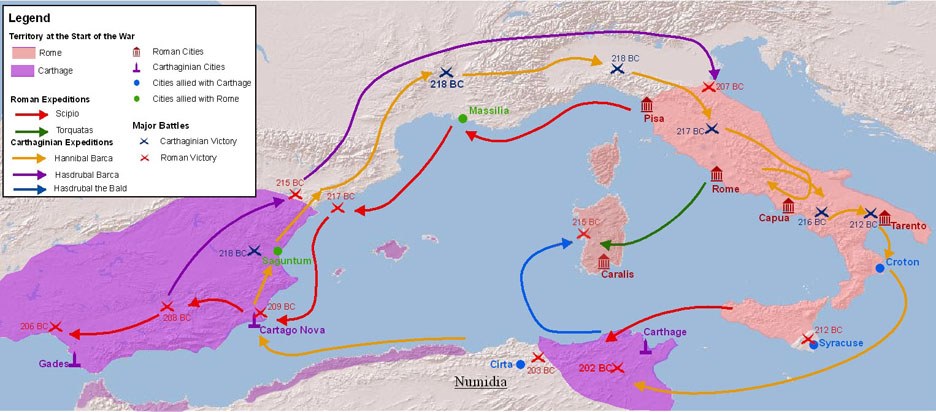
Map of the Punic Wars
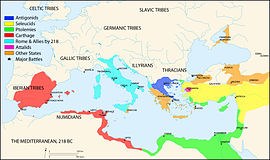
The ancient Mediterranean world