The Roman Revolution
Early World11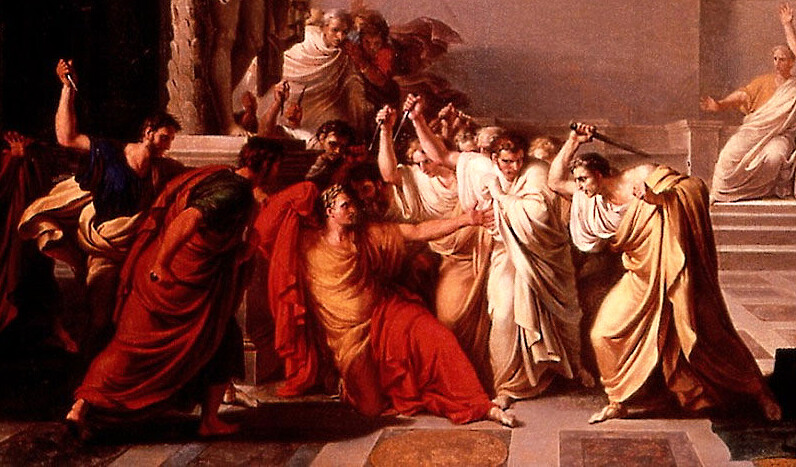
Rome's constant wars and conquests in the third and second centuries BCE created a host of social, economic, and political problems for the republic. In this time of recurring crisis, the Roman people grew dissatisfied with the leadership of the Roman Senate and the aristocratic elite. Increasingly the Roman people looked to a strong military leader to address these problems. Consequently, the republic collapsed and was replaced with a military dictatorship. This period of transition from an aristocratic republic to a popular military dictatorship occurred in the years 133 - 31 BCE and is known as the Roman Revolution.
From the foundation of the Roman Republic, most Roman citizens had owned and operated small family farms. The notion of libertas had sprung from the desire of Roman farmers to pass on these family farms from generation to generation. The wars that were fought beginning with the Punic Wars, however, greatly diminished the number of Romans who owned farms. Since these wars were fought far from home and required Roman soldiers to be away from their family farms for extended periods of time, these farms were often neglected in their absence. Roman soldiers returning from wars abroad often decided to sell these dysfunctional farms and move themselves and their families to the expanding city of Rome, where they joined the growing ranks of the landless working class. By the first century BCE the population of the city of Rome may have exceeded one million. The landless workers in the cities became known as the Proletariat. In the Roman census for the Centuriate Assembly, the poorest Romans who owned no land and could only contribute their offspring (proles) to the state were known by this term.
The growth of the Proletariat in the city of Rome disrupted the Roman political system and invited large scale corruption. The traditional Patron-Client system collapsed since landless Romans in the cities didn't need the assistance of Roman patrons. A person who has no land has no need of a lawyer to settle property disputes. Roman politicians therefore had to employ non-traditional ways to win the political support of the urban masses through free food and entertainment, such as gladiatorial combats, and promises to create jobs through public work projects. Some politicians even organized the poor into violent gangs to frighten their political rivals. The urban poor often were unemployed and hungry. They lived in crowded and dirty apartments. In addition crime was rampant as Rome didn't even possess a police force to maintain law and order. These conditions resulted in widespread dissatisfaction with the government of the republic.
Roman farmers often sold their family farms to large landowners when they moved to the city of Rome. As the city of Rome expanded rapidly, there was a strong demand for grain, wine, and olive oil to feed the urban population. To meet this demand, large landowners bought up land from poor Roman farmers and leased public land in Italy from the Roman state to create large plantations or latifundia. These plantations were very profitable due to low labor costs since large landowners could purchase large number of slaves at low prices to work on these plantations. Rome's wars resulted in large numbers of slaves. For example, after the defeat of Perseus of Macedon in 168 BCE, the Romans enslaved 150,000 people from Epirus as punishment since this kingdom had been allied with Perseus in the war. The large number of slaves on the market drove down the prices for slaves. To meet this demand for cheap slaves, pirates from Cilicia (in southeast Turkey) and from the Greek island of Crete kidnapped people throughout the eastern Mediterranean and sold them to Roman traders. The island of Delos in the Aegean sea became a massive slave market for these Roman traders in the second century BCE where reportedly 10,000 slaves were bought and sold every day.
Since prices for slaves were so low due to their large supply, operators of latifundia literally worked their slaves to death since they could easily replace slaves that died. Because of horrible working conditions, slaves across Italy were desperate and rose up in massive revolts beginning in the second half of the second century BCE. The most famous of these slave rebellions was led by Spartacus, a slave and gladiator from Thrace (modern Bulgaria in southeast Europe). In 76 BCE Spartacus and other enslaved gladiators rose up against their owners, and they were quickly joined by hundreds of thousands of rebellious slaves in Italy. Spartacus' army of rebellious slaves defeated two Roman armies before Roman armies crushed Spartacus' forces in 71 BCE. The Romans crucified thousands of rebel slaves along Italy's major roads to send a warning to slaves across Italy. These violent and bloody slave rebellions also reminded Romans of the ongoing problems and weakness of the Roman Republic.
Rome's wars and conquests made it possible for some Romans to profit as owners of latifundia as well as slave traders. The most profitable enterprise, however, for Roman entrepreneurs was as public contractors or publicans. The Roman republic relied on these publicans to construct public works such as aqueducts and theaters as well as to operate government owned mines and to collect taxes. In the collection of taxes, the publicans were especially ruthless since they profited from collecting more revenue from Rome's subjects than what they had promised to provide the Roman state when they bid for the contract to collect these taxes. Roman governors often looked the other way or assisted the publicans in squeezing additional tax revenues from the population of Rome's provinces. In Rome's system of governing its provinces, a Roman Consul and Praetor would be assigned a Roman province to govern after their one year term was over and would become a Proconsul and Propraetor, which were the titles of Roman provincial governors. Since running for office had become so expensive due to the high cost of winning over the urban masses, Roman politicians had to borrow large sums to run for office. Publicans were also bankers who loaned money to these politicians with the understanding that these politicians would aid the publicans once the politicians had become Roman governors. In addition to loaning money to politicians, publicans loaned money at very high interest rates to the people in Rome's provinces, so that they could pay their taxes to these very same publicans. In Rome the ranks of these newly rich Romans, who profited as bankers, publicans, slave traders, and plantation owners were known collectively as Equestrians since the richest Romans in the Centuriate Assembly were required to provide a horse (Equus) to the Roman army. The traditional Roman elite in the Roman Senate often looked down on these "new money" Equestrians, whereas these Equestrians resented the "old money" Senators, who disrespected them. Equestrians also looked to new leadership for the Roman Republic.
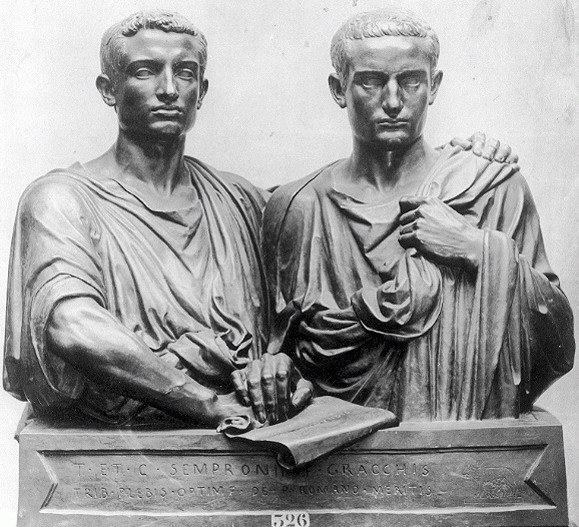
Beginning in 133 BCE the Roman Republic went from crisis to crisis, resulting in the people of Rome losing faith in the traditional leadership in Rome. The Roman Revolution began with the political careers of two brothers, Tiberius and Gaius Gracchus or the Gracchi brothers, who were Plebians, but whose families had been members of the elite for generations. Tiberius, the older of the two brothers, was concerned with the drastic decline in the number of Roman farmers. He was shocked to see that the countryside was dominated by large plantations worked by foreign slaves. He feared that Rome's military was in danger since Rome relied on its land owning farmers to serve in the army. In 133 BC as a tribune, he proposed a law to the Plebian Assembly to set aside public land in Italy to distribute to landless Romans. Many Senators objected to this proposal since they leased this public land to operate their own latifundia. These Senators then convinced another Tribune to veto Tiberius' proposal in the Assembly. Tiberius however convinced the Assembly that this opposing Tribune was acting against the interests of the Plebians, and the Assembly voted to remove that Tribune from office. Afterwards, the Assembly voted to approve Tiberius' proposal. Many Senators were horrified by Tiberius' actions since he had violated the traditions of the Republic by ignoring the wishes of the Senate and having a Tribune removed from office. The Senators were convinced that Tiberius was plotting to make himself king and tyrant with the support of the common people; so the Senate declared a state of emergency and a group of Senators brutally beat Tiberius to death.
Ten years later in 123 BCE, Tiberius' younger brother, Gaius was elected Tribune. Gaius was an astute politician who won political support from dissatisfied groups in Roman society. He won over poor Roman farmers with his proposal to establish new Roman colonies to provide land for these Romans. He also provided free grain for the poor in the city of Rome. In addition he called for new public works projects in Rome to create jobs for the urban working class in the city and lucrative contracts for wealthy publicans. Gaius used his position as Tribune to have his measures passed through the Plebian Assembly. He also ran and was elected to this same office for two years straight, which was in violation of Roman political tradition. When Gaius sought a third term as tribune in 121, Senators feared that Gaius was seeking to become a king and tyrant with the support of the masses, just like his brother. So during the election a mob of Senators and their retainers attacked and killed Gaius and 600 of his political supporters.
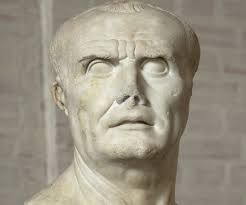
After the assassination of Gaius Gracchus in 121 BCE, Rome's political class was divided into two warring factions. The Populares were politicians who like Gaius Gracchus sought the political support of discontent groups in Roman society such as the landless Proletariat and wealthy Equestrians, whereas the Optimates were the champions of the old order and the traditional leadership of the elite in the Roman Senate. Marius was a Plebian and commoner who rose up the ranks of the Roman army and emerged as the leader of the Populares. In 112 BCE Rome went to war against Jugurtha, the king of Numidia (modern Tunisia/Algeria) in North Africa after this king slaughtered Romans living in Numidia who had supported Jugurtha's brother as king. Roman armies suffered defeat after defeat at the hands of Jugurtha, and Rome due to the decline in numbers of Roman farmers, was having a difficult time filling up the ranks of the army. In 107 BCE, Marius ran for Consul. He was the first person in his family to run for this office. Marius denounced the traditional Roman elites as weak and ineffective generals and promised to end the war with Jugurtha quickly, once in command as Consul. Marius won the election and led his army against Jugurtha. To raise an army quickly for this war, Marius recruited soldiers among the urban poor with the promise to provide them with land as a reward for their military service. Marius was an excellent general and loved by his troops. Within a year in 106 BC, Jugurtha suffered defeat and was led back to Rome in chains.
In 105 BCE Rome faced another war when Germanic tribes, the Cimbri and Teutones crossed the Rhine River into Southern Gaul (modern France) with the intent of crossing the Alps into Italy. The Romans elected Marius Consul for five consecutive terms (105-101 BCE) to lead his professional army against these enemies. After victories over these tribes, in 100 BCE, a Tribune, who was a political ally of Marius, proposed to the Plebian Assembly a law to provide Marius' military veterans with the land that Marius had promised as their reward for their service. Marius' political enemies in the Senate, the Optimates, wanted to embarrass Marius politically, so they raised up an armed body that murdered this Tribune and prevented his proposal from becoming law. Marius was intimidated by these events and retired from politics. The Optimates rejoiced over Marius' disgrace, but many Romans viewed these Senators as petty and mean spirited politicians who had denied Roman veterans their just reward for their service.
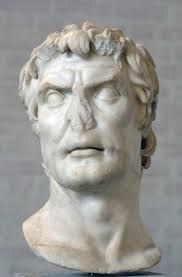
In 90 BCE, Rome once again was in turmoil when Rome's Italian allies (socii), revolted against Rome after years of providing Rome with troops without having any voice in directing government policies. During this war, the Optimates found a member of their ranks who was also an excellent general, Sulla. The Romans under Sulla's leadership defeated the rebels by 88 BCE but only after awarding rebels with Roman citizenship if they laid down their weapons and surrendered to Rome. In 88 BCE Rome's provinces in Greece and Asia Minor revolted against Roman rule after years of heavy taxes and corrupt governors. The rebels massacred thousands of Roman citizens in these provinces.These rebels rallied around Mithridates, the king of Pontus in north Asia Minor. The Optimates in the Senate succeeded in appointing Sulla to command a Roman army to lead against Mithridates. Sulla, like Marius, quickly recruited an army of landless Romans with the promise to receive land as their reward for their service.
The Populares in the Plebian Assembly, however passed a law to assign this command to Marius, who had come out of retirement. When this law was passed, Sulla, who was outside of Rome with his army, convinced his soldiers to march on Rome. These soldiers in 88 BCE who followed Sulla's command, therefore chose personal loyalty to their general and his promise of land over their allegiance to the laws of Rome. These events in 88 BCE marked an important step in Rome's transition to a military dictatorship. After Sulla's army arrived in Rome, many Populares were hunted down and murdered by Sulla' s men. After establishing his own faction in charge of Rome, Sulla proceeded with his campaign against Mithridates.
In 87 BCE, Marius, who had been in hiding, rallied his old veterans and marched on Rome with his loyal troops. Marius' men now hunted down and murdered Optimates. After winning his seventh term as Consul in 87 BCE, Marius died in office from natural causes. Meanwhile, Sulla was waging war against Mithridates in Greece and Asia Minor. After Sulla defeated Mithridates and restored Roman rule in the provinces, he led his army back to Italy and Rome in 83 BCE to overthrow the Populares who were still in charge in Rome. After defeating the Populares, Sulla served as dictator until 79 BCE. In Rome in times of crisis, it was customary for the Senate to appoint a dictator with emergency powers for a limited time. Sulla during his time as dictator ordered the execution of thousands of his political enemies. In 79 BC he retired from politics with the conviction that he had saved the Republic and preserved the power of the traditional elite in the Senate.
Marius
Sulla
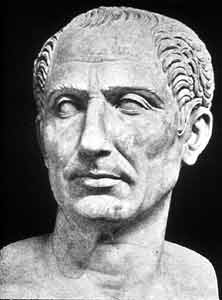
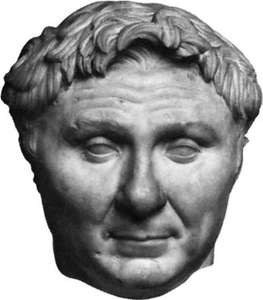
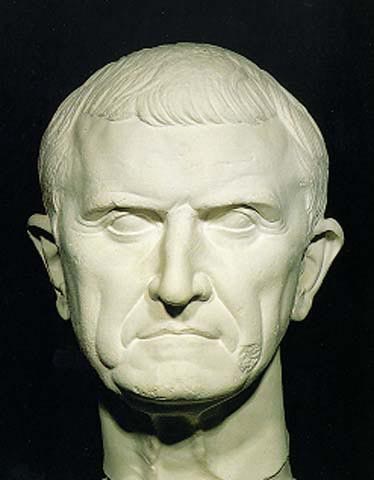
Sulla was unable to crush the Populares completely since there were still discontented groups in Roman society who were opposed to the traditional leadership of the Roman Senate. In the decades after Sulla's retirement, there arose politicians who aspired to hold power in Rome with the support of these groups. Pompey became a popular general. Thousands of landless Romans signed up to fight for his army with the promise of receiving land. In 67 BCE under Pompey's command Roman armies suppressed pirates in the eastern Mediterranean who had threatened Rome's imported grain supplies. Also in the years 66 - 63 BCE, Pompey defeated Mithridates of Pontus and advanced Roman armies eastward to the Caspian Sea and the Euphrates River in Mesopotamia. Another politician, Crassus, won the support of the Equestrian class. He used these political connections to amass a huge fortune. A third influential politician was Julius Caesar whose original source of popularity was the fact that Marius was his uncle.
The Optimates in the Senate distrusted all three of these men and worked together to block their influence in Roman politics. In response, these three men decided in 60 BCE to join forces to advance their interests. This political alliance is known to history as the First Triumvirate. Together these men had the wealth and the political influence to run the Roman Republic. However, the three men were each very ambitious and greatly distrusted one another. After 60 BCE, Julius Caesar took command of the Roman army in Gaul. Over the next ten years, Roman armies under his command conquered all of Gaul and launched attacks against German tribes, across the Rhine from Gaul, and on the island of Britain across the English Channel. The Roman people were amazed at Caesar's military success, and Pompey and Crassus grew jealous of his growing popularity. In 54 BCE Crassus and his army invaded the Parthian Empire. Crassus was hoping for the same military and political success as Caesar. The Parthians were an Iranian people who had carved out an empire stretching from Mesopotamia to the Indus River Valley and Central Asia following the collapse of the Seleucid Empire in the second century BCE. Crassus' invasion, however, was a total disaster and Crassus was captured and executed by the Parthians.
After Crassus' death, Pompey decided to break with Caesar, and he threw his support behind his old enemies, the Optimates. In 49 BCE, the Optimates and Pompey controlled the Senate and demanded that Caesar disband his army in Gaul and return to Rome to stand trial on various charges. Caesar however, convinced his army instead to march on Rome from Gaul. Again, Roman soldiers chose personal loyalty to their general over the laws of the Republic. In 48 BCE Julius Caesar and his army defeated the army of Pompey at the Battle of Pharsalus in Northern Greece. Shortly thereafter Pompey fled to Egypt where he was treacherously murdered by the Egyptian Pharaoh, who was hoping to win Caesar's favor.
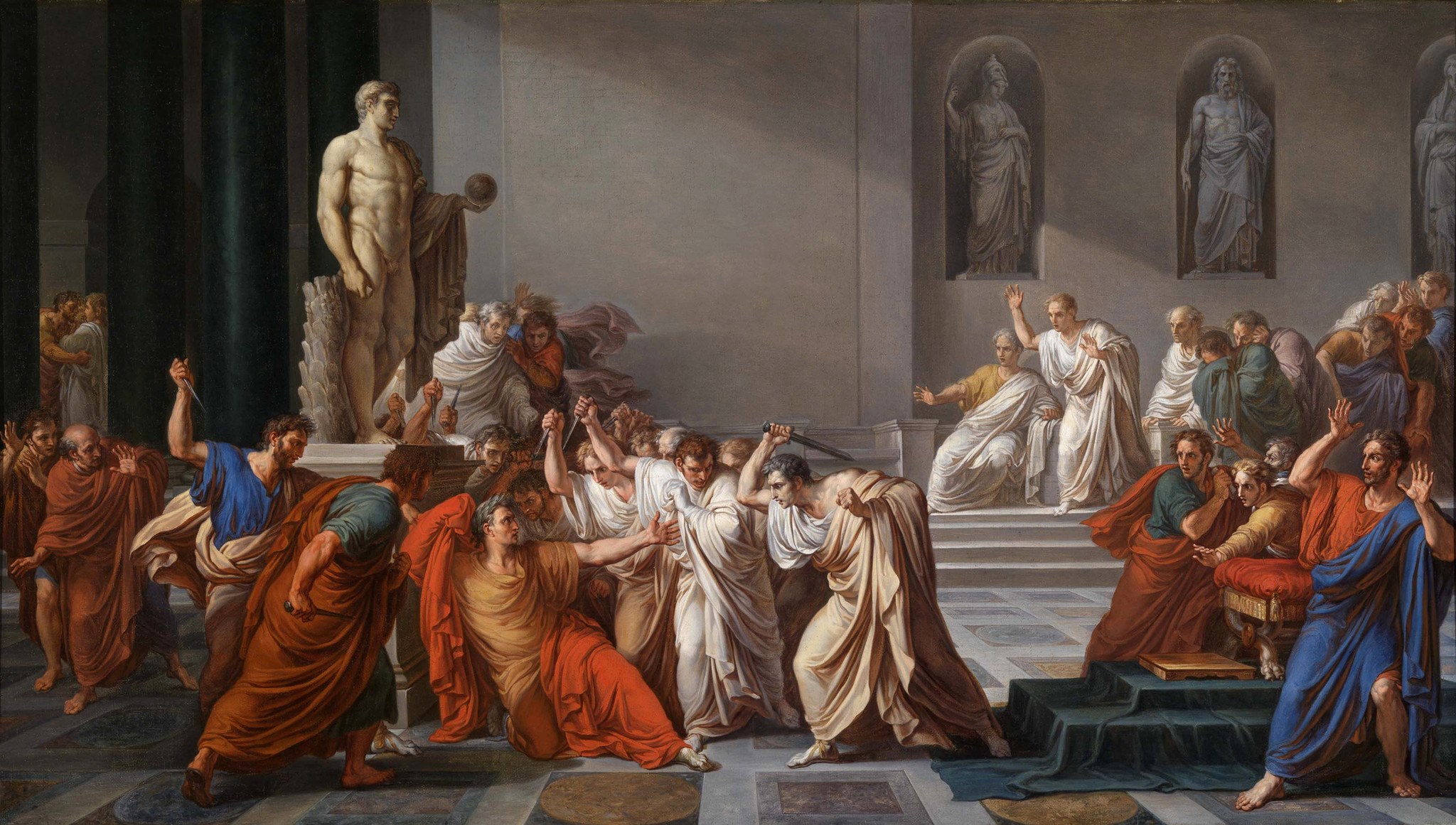
Julius Caesar was now, like Sulla, the dictator of Rome. However, unlike Sulla, Caesar made it clear that he did not plan to retire. After defeating Pompey, Caesar had hoped to win over his former enemies by inviting them to serve again in the Senate and appointing them to positions in his government. These former Optimates however viewed Caesar as a tyrant. In 44 BCE two of these Optimates, Brutus and Cassius led a conspiracy that resulted in the assassination of Julius Caesar.
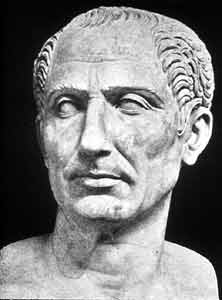
Julius Caesar
Pompey
Crassus
Assassination of Julius Caesar