The Dominate
Early World13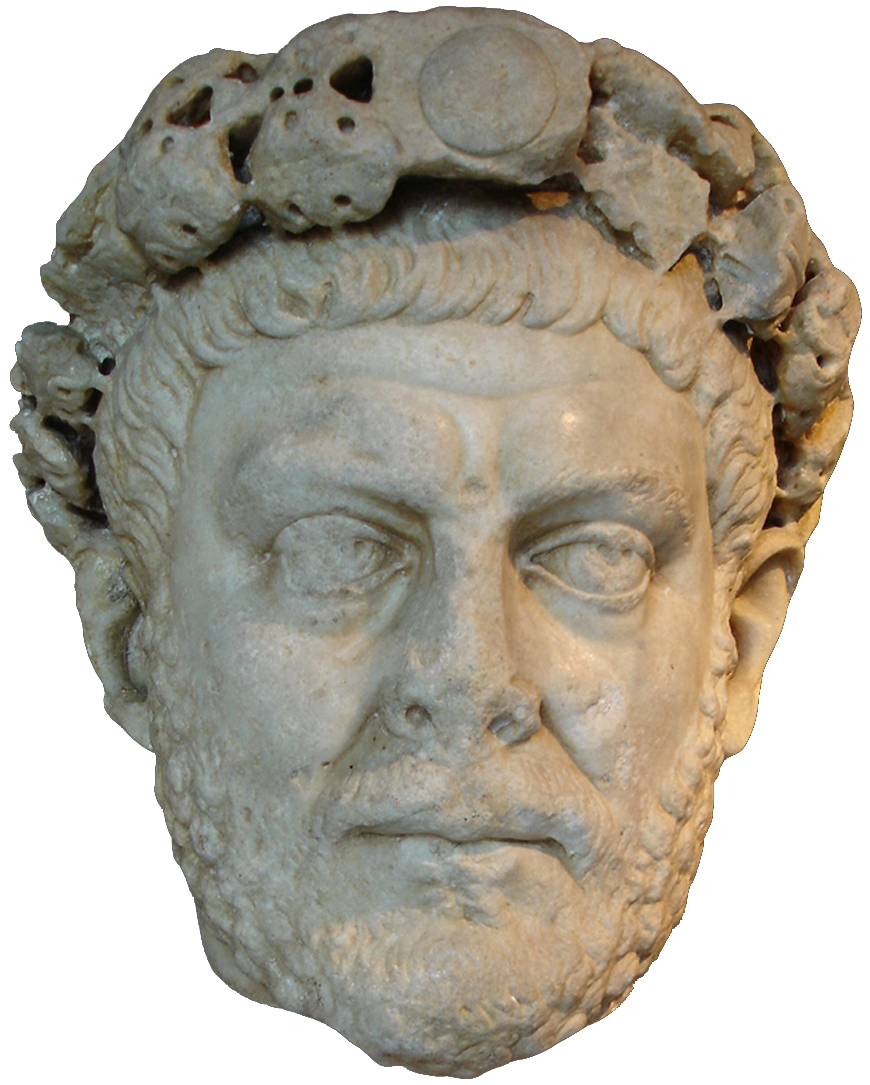
In the third century CE, the Roman Empire almost collapsed due to civil wars, foreign invasions, and economic decline. In the early fourth century CE, the Roman emperors Diocletian (284-305 CE) and Constantine (306-337 CE) instituted sweeping reforms of the Roman state that enabled the empire to survive and thrive for over a century until the Roman Empire in the west was overrun by foreign invaders in the fifth century CE. Historians refer to this new political order in the Roman Empire in Late Antiquity as the Dominate.
In the third century CE, this empire was devastated by destructive civil wars when the Roman army realized that soldiers, and not the Senate, had the power to make and unmake emperors. After the assassination of Commodus in 192 CE, the Senate voted to grant the powers of an emperor to one of their own, Pertinax, but the Praetorian Guard rejected Pertinax's efforts to restore military discipline after years of lax leadership under Commodus, and the Praetorian Guard murdered Pertinax in 192 CE. When the Praetorian Guard offered the throne to the Senator who promised them the largest cash bonus, the soldiers in Roman armies across the empire all wanted a piece of the action, and hailed their respective commanders as emperors in the hope of receiving cash bonuses of their own. After years of civil war, Septimius Severus (192 - 210 CE) defeated all rival emperors and established a Severan Dynasty of emperors who ruled over the empire until 235 CE. Septimius Severus and the emperors of his dynasty granted pay raises and privileges to the Roman army to secure their loyalty, which only served to embolden these troops. In 235 CE, mutinous Roman soldiers murdered the young emperor Alexander Severus and his mother, Julia Mamaea since the soldiers objected to a peace treaty that the emperor and his mother had negotiated with Germanic tribes. The assassination of Alexander Severus initiated a period of nearly 50 years (235-284 CE) of almost constant civil wars throughout the empire, as Roman armies raised up their commanders as emperors and clashed with rival armies, who backed a different contender for the position of emperor. Roman armies often assassinated their own candidate for emperor, if they received a better financial offer from a rival candidate. In this period of strife, 17 emperors were assassinated, and 10 died in battle.
Some emperors in this period died battling against foreign invaders. In this period the Roman Empire faced new threats from beyond it borders. By the third century CE Germanic tribes known as the Goths had migrated from Scandinavia (modern Sweden, Denmark) into the region north of the Black Sea (modern Ukraine) from which they launched raids against the Empire in southeastern Europe and even threatened Italy itself. In 250 CE the Roman emperor Decius died in battle against these Goths. Across the Rhine River in modern Germany, Germanic tribes at this time organized themselves into a new, powerful confederation known as the Franks ("The Free Men"). The Franks plundered Roman Gaul and Spain. In the east in the third century CE, across the Euphrates River in Mesopotamia, the Persians under the Sassanid Dynasty of Shahs (kings) overthrew the Parthians and established an immense empire that stretched from Mesopotamia to Central Asia. These Sassanid shahs desired to restore the glory of the former Achaemenid Persian Empire. The ancient religion of Zoroastrianism was restored as the official religion of this Sassanid or New Persian Empire. The Sassanid Shahs also invaded Roman provinces in Asia Minor, Syria, and Egypt since these lands had once been part of the former Achaemenid Empire. In 260 CE, the Roman emperor Valerian was captured in battle against the Persians and died in captivity.
The constant civil wars and foreign invasions of this period disrupted food production in the empire, which resulted in famines and outbreaks of epidemic diseases as malnutrition weakened peoples' natural immune system. Population loss hurt the empire's economy along with runaway inflation. Due to a shortage of precious metals (silver and gold), Roman emperors debased the currency by adding more and more base metal (iron) to their coins whenever they needed to pay their troops more money, which happened quite frequently in this period. Consequently the value of coinage in the empire declined drastically over time and prices for goods skyrocketed. This inflation hurt people in cities especially since they could not raise their own crops to feed themselves and were dependent on markets for their food supply.
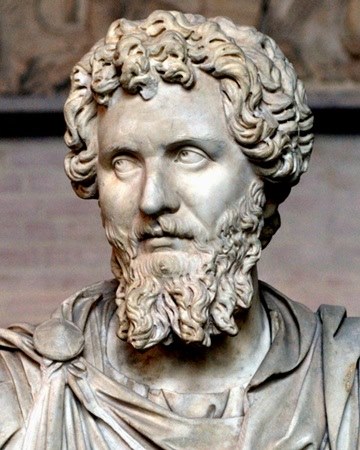
Septimius Severus
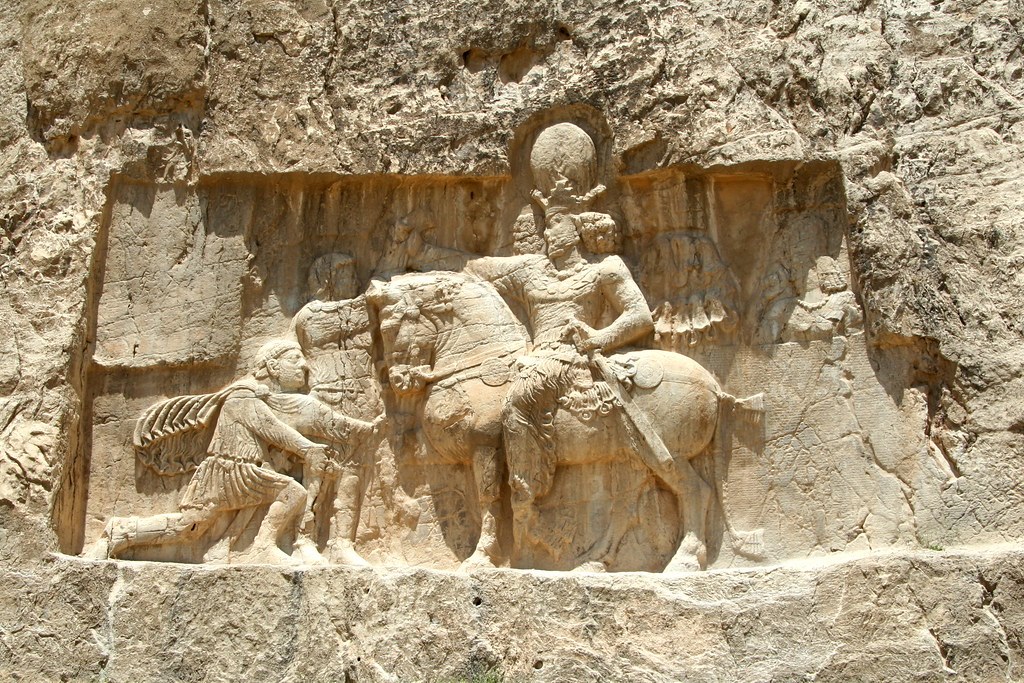
Persian stone relief showing the emperor Valerian surrendering to the Persian Shah
In the late third century, a series of emperors successfully drove back these invaders and reunited the empire. These emperors are known to history as the Illyrian Emperors since they were from Illyria, which was an ancient region in modern Albania, Croatia, Montenegro, and Bosnia. These emperors had risen up the ranks of the Roman army before their reigns as emperors. These emperors are also known as the Savior Emperors due to their success in saving the empire from foreign invaders, and as the Barracks Emperors since they spent their entire reigns with the army conducting military campaigns. The first of these emperors was Claudius II "Gothicus" (268 -270) who defeated the Goths and prevented an invasion of Italy.
Diocletian is the most famous of the Illyrian Emperors. He came to the throne in 284 after murdering the previous emperor to avenge the earlier assassination of another emperor. As emperor, Diocletian didn't want to suffer the same fate as his predecessors. To increase the authority and stature of the emperor in the eyes of the troops, Diocletian claimed to be a god who was chosen to rule by Jupiter, the king of the gods in Roman religion. He assumed the title of Dominus or "Lord". He established practices in his court to elevate the status of the emperor. For example all people were now expected to get down on their knees in the presence of the emperor and chant his name when he entered a room. Under this new system of government, the power of the emperor was not based on the traditions of government of the Republic as under the Principate, but on the divine authority of the gods. Historians refer to this system of government as the Dominate based on the title, Dominus that Diocletian assumed. The growth of Christianity in the empire, however, challenged this new political order since Christians refused to worship the emperor. Diocletian was especially worried about the loyalty of Christians serving in the army and in government. Towards the end of his reign in 304, he ordered an empire wide persecution of Christians by the Roman government. Christians who refused to worship the emperor were executed, and Christian holy scriptures were confiscated and destroyed.
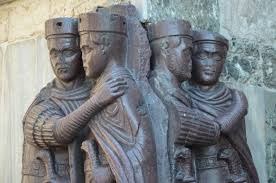
Diocletian also reorganized the government and army. Seeing that the empire was too large for one man to govern, he divided the empire in two, with one emperor in the east and the other in the west. These two emperors each held the title of Augustus. Diocletian was the Augustus in the east. Each of these two emperors in turn appointed an emperor with the title, Caesar to assist him. Diocletian's system of government is also known as the Tetrarchy as the empire had four emperors.Diocletian also devised a system of succession, where each Augustus would retire and be replaced by his Caesar, who would in turn appoint a new Caesar to replace himself. In 304 Diocletian retired along with the Augustus of the west, and they were replaced by their respective Caesars. Diocletian also greatly increased the number of Roman provinces. This reform was intended to deny provincial governors the financial and military resources to rise up against the emperors as usurpers, as had often been the case in the chaotic third century. Diocletian also increased the size of the army due to the constant threat of foreign invasion. By Diocletian's reign the army had swelled to over 600,000, which was nearly three times the size of the army under the Principate. Diocletian divided up the army into local militias and highly trained corps of infantry and cavalry. Along the empire's borders, local farmers were organized into militias under the command of a general (dux). When the empire was invaded, these local militias were the first line of defense. Their job was to slow down the invaders until the crack military units of infantry and cavalry could arrive on the scene and eliminate the invaders. These units were commanded by a "Companion" (comes) since these commanders accompanied the emperor on military campaigns.
Diocletian reorganization of the army and government had a large impact on the economy. When he increased the size of the army and the government, Diocletian raised taxes considerably to finance these reforms. The burden of taxation fell primarily on the Curiales who were a social class of wealthy landowners who served as city officials in cities across the empire. Beginning in the fourth century, these citizens often fled the cities to avoid paying these taxes, which hurt the economy of these cities. Diocletian also tackled the problem of inflation. He attempted to set prices and wages by edict. In cities across the empire he published his edict to control inflation and also to keep costs down for the government.
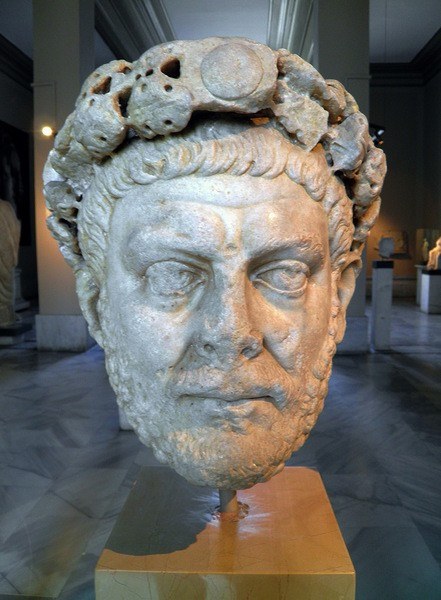
Diocletian
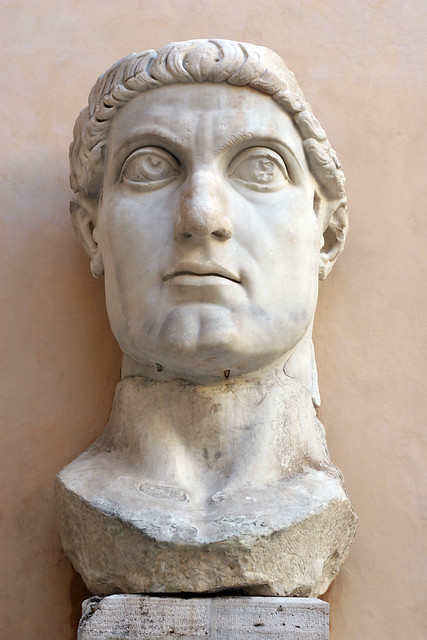
Besides Diocletian, the other founder of the Dominate was Constantine. In 306 when Constantine's father, Constantius died in Britain as Augustus of the West, his father's troops hailed Constantine as emperor. By becoming emperor, Constantine disrupted Diocletian's orderly system of succession. The sons of other emperors now wanted to become emperors as well, and the empire was again plunged into a new round of civil wars. By 324 Constantine had defeated all of his rivals and was the sole emperor. Constantine modified slightly Diocletian's system of governance. He divided up the empire into different regions to be ruled by different emperors as in the system of Diocletian, but now the emperors all belonged to the same family. Constantine, for example divided up the empire among his sons, Constans, Constantius II, and Constantine II. Another difference between Diocletian and Constantine was Constantine's legalization of Christianity in 313 with his Edict of Milan. Just before his death in 337, Constantine was also baptized as a Christian. Historians today are sharply divided over Constantine's motivation for legalizing Christianity. Some historians maintain that Constantine's conversion to this faith was sincere, whereas others maintain that his motivation was political in nature. In Constantine's day Christians were a growing minority in the empire, comprising somewhere between 10% and 30% of the empire's population. By supporting Christians, Constantine won the loyalty of this group within the empire at a time when he was engaged in civil war with rival emperors. Christians didn't worship Constantine, but they did come to believe that the Christian God has chosen Constantine as emperor. A story arose in Christian circles that Constantine had seen a vision in sky of a cross with the words "With this sign you will conquer". Afterwards, he put the sign of the cross on his soldiers' shields, and he defeated a rival emperor in battle. In his public monuments, Constantine no longer mentioned Jupiter or other gods, but claimed that he ruled Rome due to a vague "divine spirit". Constantine could, like Diocletian, thus claim divine authority for his power and unite his empire, leaving it up to pagans and Christians to define this divinity as they saw fit. However, one could also argue that Constantine was a strong believer in this faith. In 330 he founded a new city as the capital of the eastern Roman Empire, which was named Constantinople (modern Istanbul in Turkey). In this new city no pagan temples were constructed.
The legalization of Christianity under Constantine and his successors in the fourth century had a great impact on the Christian churches. One impact was the use government power to enforce church teachings. Since its beginnings, Christians had disagreed regarding the teachings of the church. As early as 49 CE, Christians had a church conference in Jerusalem to settle the issue of whether or not Gentile converts to Christianity needed to be circumcised like Jews. In the early fourth century the Christian Churches were divided over the teachings of Arianism, which held that Christ, the Son of God, was a being created by God, the Father, in time. In 325, the leaders of the Christian churches, the Bishops, at Nicaea in Asia Minor convened to discuss this issue with Constantine in attendance. At this council the Bishops rejected Arianism and affirmed the belief in the Trinity, that God is three eternal persons, Father, Son, and Holy Spirit. After this Council of Nicaea, the bishops expected Constantine and his successors to enforce the correct (orthodox) teachings of the one universal (catholic) church and to punish heretics, who rejected church orthodoxy.
The legalization of Christianity also may have been a factor in the rapid growth of monasticism across the Roman Empire in the fourth century. With the legalization of Christianity, persecution ended as well as the opportunities for martyrdom. When this persecution ended, some Christians decided to devote their lives to witnessing for Christ by denying themselves the pleasures of this life such as sex and wealth and devoting their time to prayer, preaching, and the study of scripture. Such Christians lived apart from society as hermits. One such hermit who was a founder of Monasticism was Pachomius, who lived in southern Egypt in the early fourth century. Pachomius lived out in the desert as a Hermit and soon attracted a large number of followers. Pachomius was a Roman army veteran, so he organized these followers into a disciplined community under a Rule, a strict code of conduct. Pachomius' community of monks was one of the first monasteries. Over the next century such communities of monks arose across the Roman empire. Communities of devout women (Nuns) became known as Nunneries,
In the fourth century the Christian church also more and more required its leaders, the Bishops and clergy, to abstain from sex (celibacy) and to own no private wealth. Some historians have maintained that this trend resulted from increasing competition from the new religion of Manichaeism. Mani lived in southern Iraq in the mid third century and was raised as a Christian. He became convinced that he was an apostle of Christ. Mani maintained that the material world had been created by Satan and was evil. The message of Christ, according to Mani was for true Christians to reject the material world and thus escape the evil world of matter and to become pure spirit. The followers of Mani, known as the Elect, practiced celibacy, vegetarianism, and possessed no personal wealth. Followers of Mani who could not maintain such a lifestyle were known as "Hearers" and hoped that through the teaching and example of the Elect, they could become reborn in another life as one of the Elect.Some historians maintain that Christian leaders saw that these Elect were highly respected and hoped that their own clergy,such as their bishops could attain such a status within the Christian church.
Constantine
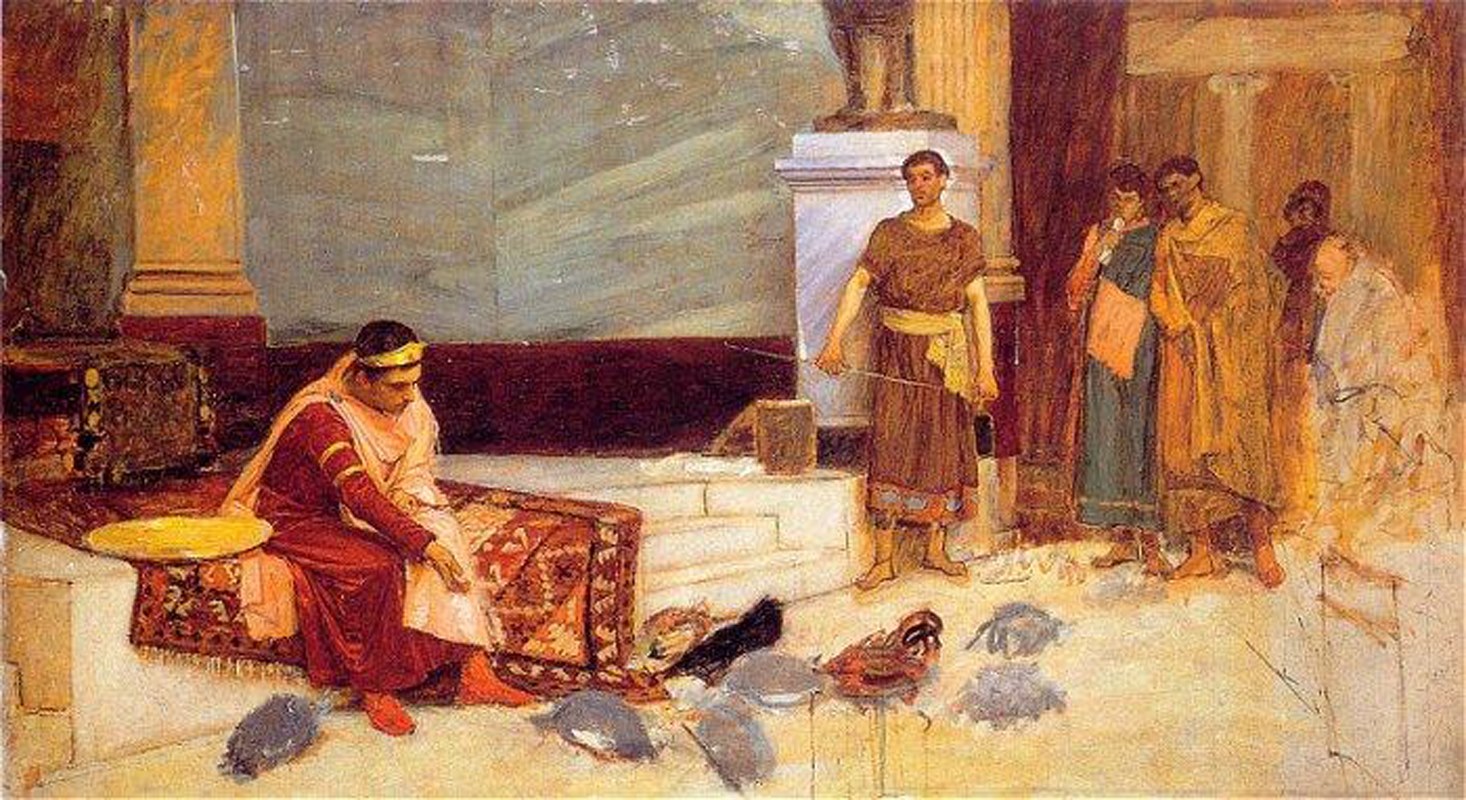
In 476, the Western Roman Empire ended. Historians have debated the cause for the fall of the Roman Empire for centuries. Some historians argue that the empire suffered a serious decline that made it susceptible to invasion and conquest, whereas others maintain that a strong Empire could not survive against the forces arrayed against it. Some historians point to economic problems that slowly weakened the empire such as the decline of cities due to the destruction of life and property in the third century crisis from which the empire never fully recovered. The high taxes of the Dominate also resulted in wealthy citizens abandoning cities to escape the heavy tax burden. Moreover the flow of precious metals out of the Empire to purchase silk from China and spices from India also resulted in crippling inflation in the empire due to the resulting scarcity in precious metals. However other historians point out that this economic decline was not pervasive in the Empire. Archaeological evidence suggest that parts of the Empire such as Britain, Greece, North Africa, and Syria were experiencing economic prosperity and population growth in the fourth and fifth centuries.
Other historians see Rome's decline in its moral fiber and patriotism as the decisive factor in its fall. Selfishness, greed, and pleasure became more important to Romans than public service. For example courtiers at the court of Arcadius in Constantinople in the early fifth century encouraged the emperor to bribe the Visigoths to attack his brother, Honorius' share of the empire in the west to save their own skin rather than to defend the empire from these invaders. Other historians see Christianity as a cause of Rome's decline since Romans as Christians were more concerned with their immortal souls than the here and now of defending the empire. In 430 Augustine, the Bishop of Hippo, in North Africa published his classic work City of God. In this work Augustine argued that governments of this world, like the Roman Empire, come and go, but Christ's Kingdom, the City of God, was eternal. Augustine's modern critics maintain that the Romans at this time of crisis needed to defend their Empire to the death rather than hope for eternal life.
While historians debate whether or not the empire declined internally, all agree that the empire collapsed in the face of a massive migration of Germanic tribes. In the fourth century, Huns from Central Asia advanced into Eastern Europe. The Visigoths (West Goths) fled the Huns and entered the Roman Empire in search of new homes. At the Battle of Adrianople in 378, the Visigoths destroyed the Roman army, and the Roman emperor Valens died in battle. The new emperor Theodosius (378-395). Valens' brother-in-law, was able to hold the Visigoths at bay by ceding territory to them within the empire in the Balkans. During the reigns of Theodosius' two sons, Arcadius and Honorius, the Visigoths advanced into Italy and sacked Rome in 410. The Visigoths later in the fifth century established an independent kingdom in Southern Gaul and Spain. Meanwhile another Germanic tribe, the Vandals, whose original homeland was along the Baltic Sea in modern Poland, crossed the Rhine River, and marched through Gaul and Spain to North Africa. In 455 a Vandal fleet invaded Italy and sacked Rome. Meanwhile the Franks settled in northern and central Gaul, while other Germanic tribes, the Saxons and Angles sailed to Roman Britain and settled there. By the end of the fifth century, Roman emperors in the west ruled Italy alone and were dependent on German troops to serve in their armies. In 476 the German commander of the Roman armies. Odoacer, desired land for his German troops in Italy. In 476 he forced the last Roman emperor in the West, Romulus Augustulus to step down as emperor so that he could distribute land to his German warriors. The Roman Empire in the west thus ceased to exist.
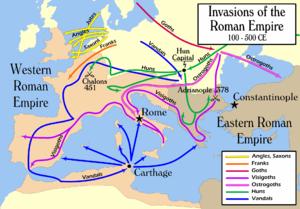
Map of Germanic Migrations
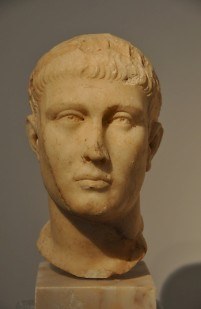
Theodosius


