The Germanic Kingdoms
Early World18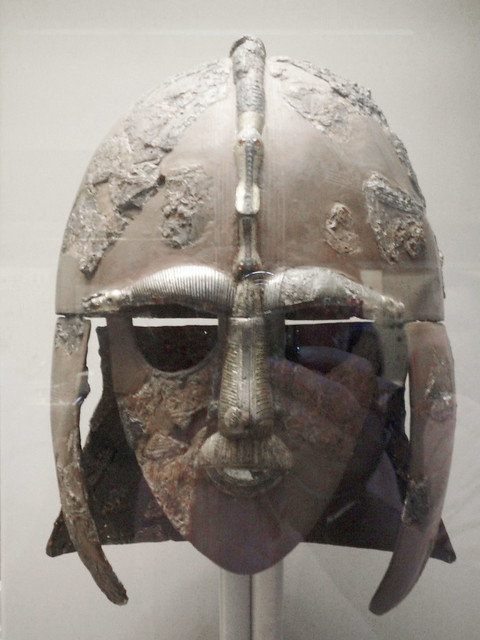
Following the collapse of the Western Roman Empire in 476 CE, Western Europe was divided into a number of Germanic kingdoms, which had been founded by Germanic tribes. In the centuries that followed in this region, Germanic culture merged with Christianity and the classical tradition of ancient Greece and Rome to create a distinctive Medieval Civilization, which was a synthesis or union from these three elements. Historians refer to the period between the end of the Ancient World with the fall of Rome in 476 and the beginning of the Modern period around 1500 as the Middle Ages or Medieval period.
One aspect of Germanic culture that was am important element in forming this synthesis was the German band of warriors (Comitatus). The Roman historian Tacitus (100 CE) observed that Germans were organized into warrior bands. The warriors in these bands swore loyalty the their war chief as long as the chief led them to victory in battle and fairly distributed to them the spoils (land, treasure, weapons) that was seized from the defeated enemy. This practice remained among the Germanic tribes that later invaded and settled within the Roman Empire.
Most of these Germanic kingdoms were short lived. The armies of the Byzantine emperor Justinian conquered the Vandal Kingdom of North Africa and the Ostrogoth Kingdom in Italy in the sixth century. The Arabs conquered the Visigoth Kingdom in Spain in the early eighth century. The German warriors and their families who had formed these kingdoms had numbered in the thousands, and they had adopted the language and culture of the area where they had settled. The kings of the Ostrogoth and Visigoth kingdoms, for example, attempted to rule their lands like the Roman emperors before them. However, the Franks, who settled in Roman Gaul and the Angles and Saxons who settled in Roman Britain established kingdoms that endured
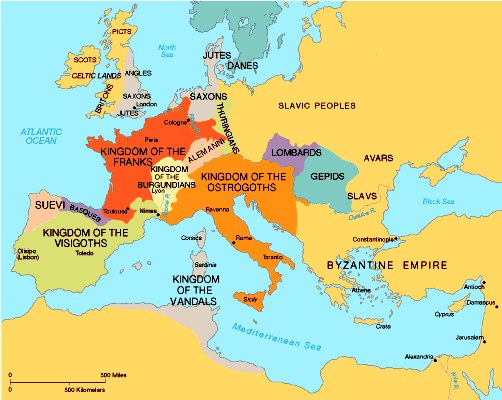
Map of Germanic Kingdoms
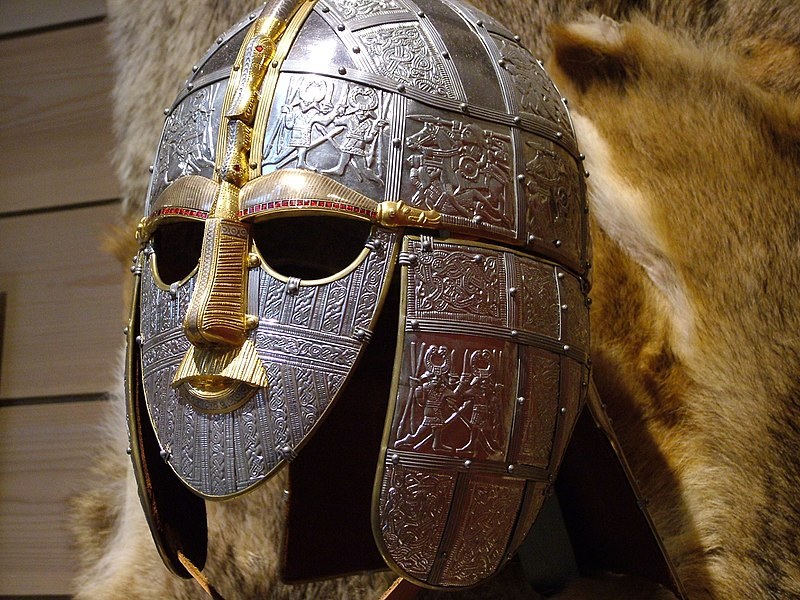
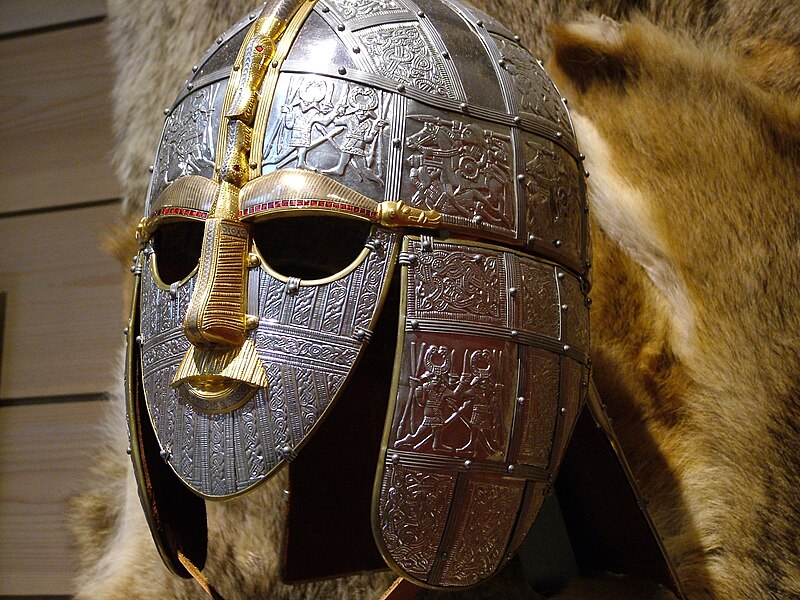
In the fifth century Angles, Saxons, and Jutes from what is today northern Germany and Denmark sailed to Roman Britain and settled there. Many Romano-Celts of Roman Britain subsequently fled this region to northwestern Gaul to an area which became known as Brittany and whose inhabitants were known as Bretons. The Germanic language spoken by the new settlers in Roman Britain evolved into English, a term that derived from the Angles, and the land where they settled became known as "Angle-land" or England. The wars between the Romano-Celts and the Germanic invaders was the historical background for the legends of the Celtic King Arthur, which were preserved in Brittany and Wales in the British Isles, where the Celts held out against the Saxons. The Angles,Saxons, and Jutes by the end of the sixth century had founded seven independent kingdoms in England. These kings each had their bands of warriors (Thegns) who were the elite class and ruled over the common farmers (Coerls)
These "Anglo-Saxons" still worshiped their traditional Germanic gods such as Punar and Wodan (Thor and Odin of Norse myth) until Pope Gregory I in Rome sent missionaries to England in 597. One of the Anglo-Saxon kings, Ethelbert of Kent subsequently converted to Christianity due to the efforts of the missionary Augustine, who became the first Archbishop of Canterbury. Besides these missionaries from Rome, Irish monks also played an important role in the conversion of the Anglo-Saxons to Christianity. In the fifth century, a Romano-Celt monk from Britain, Saint Patrick, went to Ireland and converted the Irish kings and their subjects to Christianity. In the Irish monasteries that arose thereafter, ancient works in Latin and even Greek were preserved and studied by the monks even though, Ireland had never been a part of the Roman Empire. An Irish monk in the sixth century, Saint Columba went to Scotland which was inhabited by Picts and "Scots" (immigrants from Ireland) and converted the population there to Christianity after establishing a monastery at Iona, an island off the coast of Scotland. In the seventh century Irish monks preached the Gospel and established monasteries among the Anglo-Saxons. Eventually Anglo-Saxon monks founded monasteries of their own. The most renowned of these monasteries was at Jarrow in the kingdom of Northumbria. This monastery was organized by the Rule of Saint Benedict, who had written rules for the Benedictine Order of monks back in Italy in the sixth century. Missionaries from Rome introduced this Rule to England. The monastery at Jarrow in the eighth century became a center for scholarship where the monks preserved and studied works in Latin by ancient Roman authors. The Christian Church therefore became a vehicle for the transmission of the Classical culture of Greece and Rome to the Anglo-Saxons, just as the Christian Church earlier had performed this service for the Irish. The Venerable Bede around 735 was the Abbot or head of this monastery and a noted scholar, who composed works on geography and history in Latin. He wrote a history of the Church of England and was the first historian to date events from the birth of Jesus Christ - Anno Domini or AD (Latin for "in the year of the Lord"). Historians today continue to date events using this system, but 500 AD or the 500th year after Christ's birth is now 500 CE or the 500th year of the"Common Era".
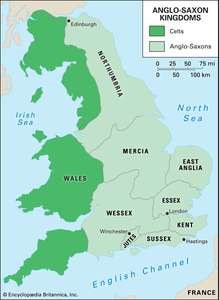
Anglo-Saxon Kingdoms
The Franks settled in northern and central Roman Gaul in the fifth century. One of the Frankish chieftains Clovis (486-511) united all the Frankish tribes under his leadership and founded the Merovingian Dynasty of Frankish kings. Clovis also converted to Christianity and thereby won the support of the Catholic non-Frankish population in his kingdom. After Clovis went to war against the Visigoth Kingdom, which controlled southern Gaul, he annexed this region to his kingdom. Clovis was therefore the first to rule over an area that became known as the "land of the Franks" or Francia (France). Over time the Franks settled in this region adopted the Latin language spoken by the natives, which was at this time evolving into French. Clovis or Louis was the first of eighteen kings of France with that name.
According to the Germanic customs of the Franks, a king's land was divided up evenly among his sons. Consequently the Mervongian kings who followed Clovis divided up their kingdoms into smaller and smaller kingdoms. The kings of these small realms therefore lacked the resources to secure the loyalty of their bands of warriors by leading them victoriously into battle and distributing spoils to them. Consequently, these warriors each went their own way and violence and chaos ensued as these warriors engaged in war against each other. In addition, Merovingian kings often married their first cousins and nieces in an effort to reunite their ancestral lands and prevent them from being divided up among family members. This practice however resulted in the birth of Merovingian kings who were physically and mentally ill. It was impossible for such kings to lead warriors into battle. In this chaotic situation the warriors in these kingdoms who won the loyalty of their fellow warriors by leading them into battle and distributing spoils and gifts to them, became the acting kings while the reigning Merovingian kings became figure heads and kings in name only. The title of these leading warriors and acting kings was the Maior Domus, which is Latin for "Mayor of the Palace". From the ranks of these Mayors of the Palace would arise a new dynasty of Frankish kings, the Carolingians.
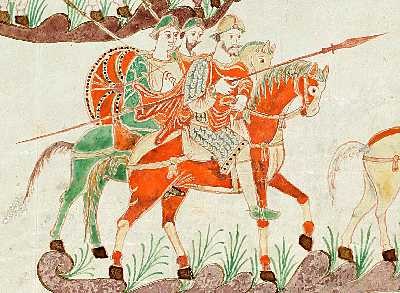
Pepin of Heristal (687-714 ) was the founder of this dynasty. He was the Mayor of the Palace in the Frankish Kingdom of Austrasia located today in northeastern France and Belgium. Pepin was able to reunite all the Frankish kingdoms under his leadership, raising up his king as king of all the Franks. Fortunately for Pepin, he did not have to divide up his lands among many sons. His son Charles "Martel" (The "Hammer") inherited all of his father's lands. Charles therefore had the wealth and resources to secure the loyalty of his warriors. Charles Martel (714 -741) was also a great military leader. In 732 at the Battle of Tours Charles led the Franks to victory over an invading army of Moors and Arabs from Spain. Much of Charles' military success was due to his army of mounted knights. The Huns from Central Asia had introduced the stirrup to Western Europe back in the fifth century. A warrior on horseback could put his weight on the stirrups and have better footing to wield large weapons such as a sword, battle ax, and lance in battle, while on horseback. Charles saw the military potential of an army of such mounted warriors or knights. Learning how to fight on horseback required time and resources for training and weapons, so Charles gave land to these warriors along with the labor of peasants living on these lands, so that these warriors would have the time and resources to devote to training and fighting as mounted knights. Charles often seized land from the Church to provide land for these warriors. To make it up to the Church, Charles also became a supporter of the missionary efforts of Boniface, an Anglo-Saxon monk who became a missionary to the tribes in Germany across the Rhine River. Boniface often converted heathen Germanic tribes by cutting down their sacred trees, so that the Germans would see that their gods were powerless to stop him. He also founded a monastery at Fulda that became a center for scholarship and a base for the conversion of Germans to Christianity. Charles' son, Pepin the Short (741-768), like his father before him, fortunately inherited all of his father's land and wealth. Pepin requested that the Pope in Rome allow him to ascend the throne as king of the Franks since he was already king in every way except in name. Pepin asked for the Pope's blessing for this action since the Pope possessed spiritual authority as the Bishop of one of the most ancient Christian Churches, whose first Bishop had been reportedly the Apostle Peter of the New Testament. The Pope approved Pepin's request; the last Merovingian king retired to a monastery and Pepin was crowned king. Shortly thereafter, when the Lombard king of Northern Italy threatened Rome and the Byzantine Empire was unable to defend the city, the Pope asked Pepin to come to Italy and defend Rome from the Lombards. Pepin defeated the Lombards and afterwards granted lands to the Pope. As a result of this Donation of Pepin in 751, the Pope was not just the Bishop of Rome, but a ruler of a large swathe of territory in Central Italy.
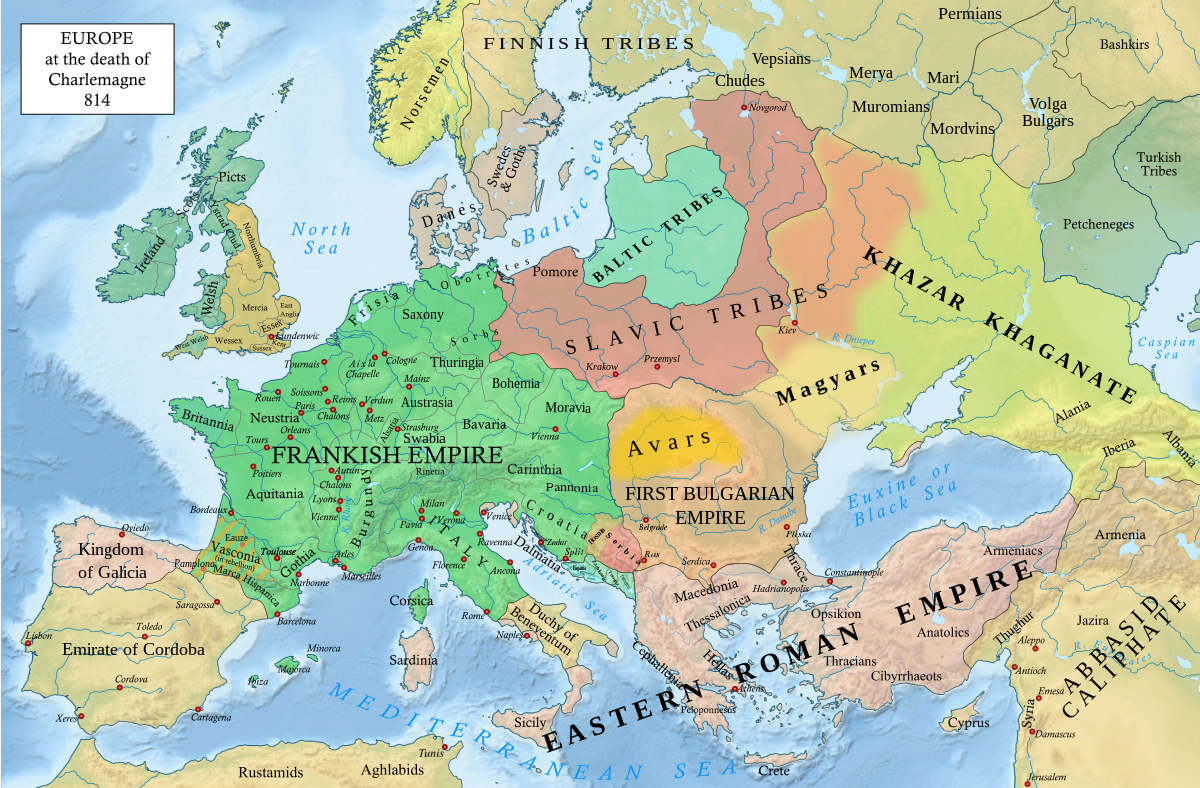
The good fortune of the Carolingian family continued after Pepin's death since his lands were not divided up among multiple sons. His son Charles eventually inherited all his father's lands. Charles was also a great warrior and military leader who became known as Charles the Great or Charlemagne (Carolus Magnus) and gave his name to this dynasty (the Carolingians). Charlemagne waged constant wars throughout his reign. In 774 he defeated the Lombards in northern Italy and was recognized by the Lombards as their new king. In 787 he conquered the Bavarians in southern Germany. In 790 his armies defeated the Avars, who had settled along the Danube River in what is today Hungary in Central Europe, and the neighboring Slavs. Among the South Slavs the term for king , Kralj was derived from Charlemagne, whose name was Carolus in Latin and Karl in German. Charlemagne also fought a series of wars against the Saxons of northern Germany. After decades of war in 804, the Saxons finally surrendered and agreed to convert to Christianity. Since Charlemagne was no longer just the king of the Franks, but ruler over the Lombards, Bavarians, Avars, Slavs, and Saxons, he maintained that he had restored the Roman Empire of old. In 800 while in Rome, the Pope crowned Charlemagne as Roman Emperor, and he accepted the title of Augustus. As Roman emperor, Charlemagne organized his empire into provinces and adopted titles from the Late Roman Empire such as Comes (Count) and Dux (Duke) for the governors of these provinces. These Dukes and Counts however were among Charlemagne's own band of warriors, who remained loyal to him, not because he was Roman emperor, but because he led them into battle and rewarded them with spoils and lands. As Roman emperor, Charlemagne drafted new written laws (Capitularies), and he built a new imperial capital at Aachen near the Rhine River, where he built a great palace and a church that followed Byzantine models. Charlemagne also invited scholars to his court, such as the English scholar, Alcuin of York, who assembled and preserved works in Latin by Roman authors.
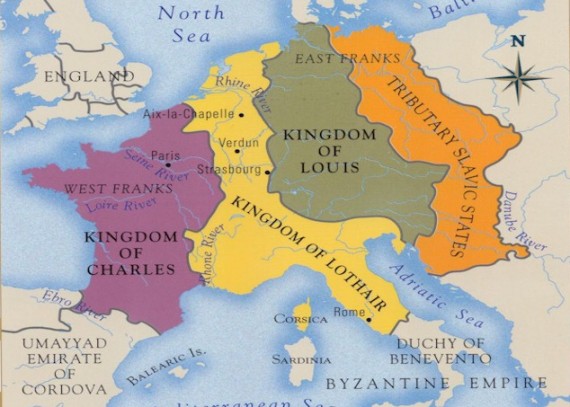
Before his death in 814, Charlemagne crowned his son Louis as emperor. Louis the Pious (814-840) as his name indicates, was a great patron of scholarship and the church, but he was not a military leader. The dukes and counts ignored Louis and governed their lands as independent rulers since he didn't provide them with spoils and lands. After Louis, the luck of the Carolingians ran out as Louis was survived by multiple sons who all wanted a piece of the empire. After Louis' death, his three sons waged war against one another over their shares of the empire. In 843 the three brothers agreed to the Treaty of Verdun. Under the terms of this Treaty, Charles the Bald received the French speaking western portion of the Empire, Louis the German, received the German speaking eastern portion of the Empire, and Lothair received Italy and a strip of territory along the Rhine River Valley along with the prestigious title of Roman Emperor. This division of the empire weakened the resources of all Carlongian kings, which set the stage for the wars and invasions of the following century.
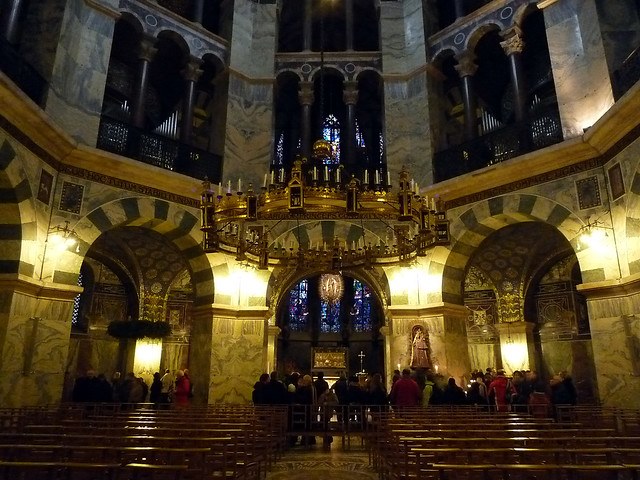
Interior of the Church at Aachen
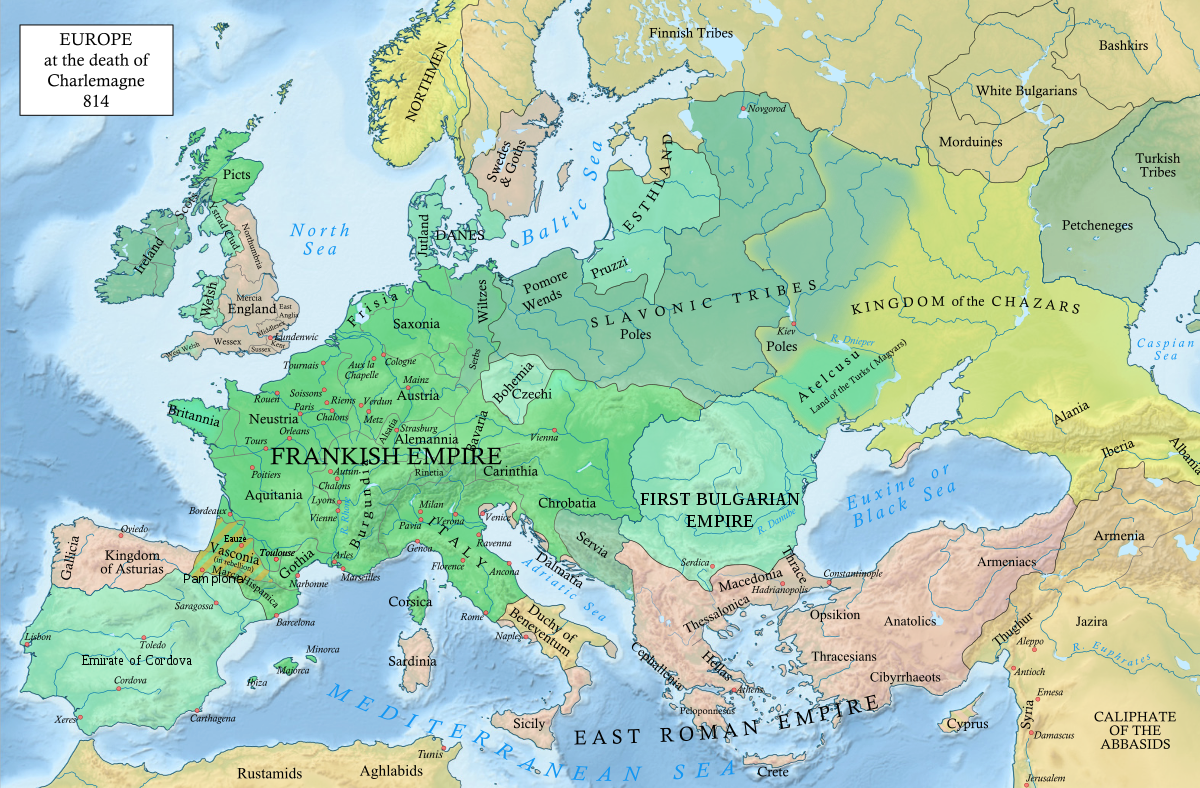
Charlemagne's Frankish Empire
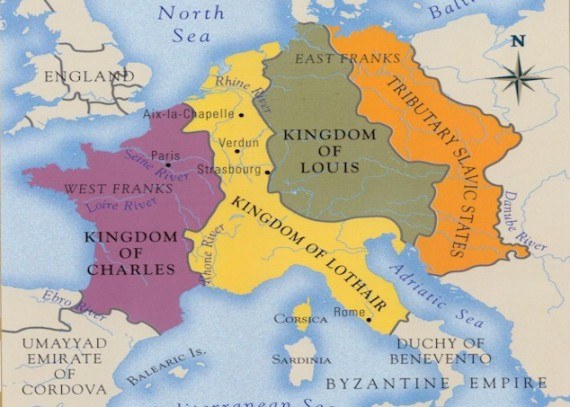
Treaty of Verdun