Alfred, Otto, and Hugh
Early World19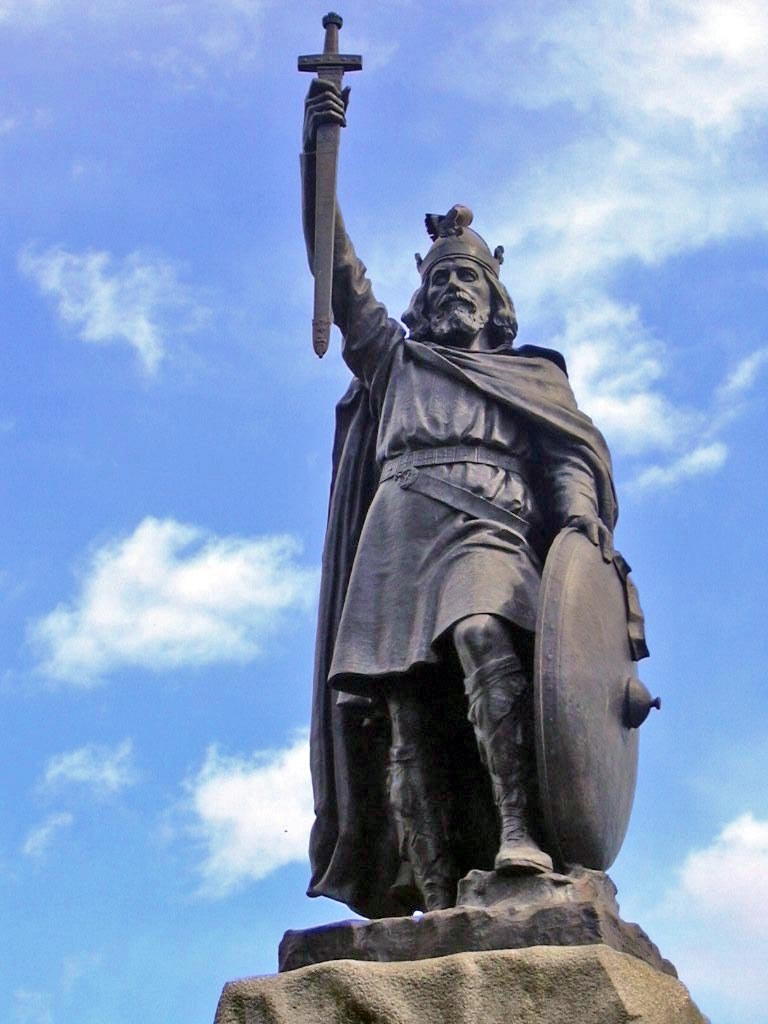
In the ninth and tenth centuries Western Europe faced a new wave of wars and invasions from Vikings from the north, Magyars from the east, and Saracens (Arabs) from the South. In response to these attacks, new states emerged in Europe, which were the forerunners of some of the most influential nations in European history, England, Germany, and France. Due to the leadership of Alfred the Great in England, Otto I of Germany, and Hugh Capet of France, peace and stability returned to this region and the stage was set for the prosperity and cultural achievements of the High Middle Ages (1000-1300).
Western Europe became vulnerable to invasion as a result of the decline of the Carolingian Empire, especially after the Treaty of Verdun in 843. The division of the empire among different members of this family reduced the wealth and land of the later Carolingian kings and therefore their ability to secure the loyalty of the dukes and counts through gifts and land. These kings such as Louis the Stammerer, Charles the Simple, and Louis the Child also lacked the skills and abilities to lead armies into battle, as is evident from their nicknames by which they were known. Across Western Europe, the central government collapsed as local warlords, the dukes and counts, assumed control.
The Vikings from Scandinavia (Denmark, Norway, Sweden), also known as Norsemen and Normans, saw the troubles of the Carolingian Empire as an opportunity to raid and pillage this area. The Vikings were a Germanic people and practiced the ancient Germanic customs of the band of warriors (Comitatus). Viking warriors followed a successful war chief loyally into battle with the hope of receiving war spoils and gifts as a reward for this loyalty. Some of these warrior bands also left their homelands, not just to plunder, but to search for new homes since they didn't wish to stay in Scandinavia under the rule of local kings, who were consolidating their power. In the ninth and tenth centuries, Vikings migrated and settled in Russia (the Rus), northern France (Normandy), England, Scotland, and Ireland. Vikings also colonized the islands of Iceland in the north Atlantic and Greenland. Around 1000 there was even for a brief time a settlement in Newfoundland in Canada. Some historians credit the success of the Vikings in completing such long voyages to their invention of the Viking Longboat, which was well designed even for ocean travel.
Before 1000 the Vikings were still polytheistic in their religion and Norse myths regarding the Norse gods, Odin, Thor, and Loki are still popular as entertainment today. Viking war bands in their raids often targeted churches and monasteries since Christians often dedicated rich offerings of silver and gold in these churches and monasteries. Monks, who recorded the events of their day in chronicles, often portrayed these Vikings in these chronicles as vicious, bloodthirsty murderers. Modern historians, however, maintain that these monks may have exaggerated the cruelty of the Vikings since these Vikings plundered the monks' churches and monasteries. Modern historians have pointed out that Vikings, such as Leif Erikson, who explored the east coast of North America, were skilled seaman, explorers, and merchants. Some Vikings sailed down the Volga River of Russia to the Caspian Sea and traded with Muslim merchants. Contemporary Muslim accounts portrayed the Vikings as traders, not raiders. After 1000, the Vikings began to convert to Christianity and the Viking raids ended, For example Olaf Haraldsson, the king of Norway (Saint Olaf) after 1015 supported efforts to convert his subjects to Christianity.
Another group of invaders in the ninth and tenth century were the Magyars or Hungarians. The Magyars originally lived along the Baltic Sea in northeastern Europe where they spoke a language related to other languages in this area such as Finnish, Estonian, Latvian, and Lithuanian. The Magyars migrated from this region to the Eurasian Steppes in what is today the Ukraine, where they became skilled horsemen. By the ninth century the Magyars had migrated westward to central Europe to the Hungarian plain, where the Avars had once settled. From this base the Magyars launched attacks into Germany, Italy, and France. After the chieftain of the Magyars, Vajk (997 -1038) converted to Christianity and was baptized with name Stephan, he became king and a strong supporter of the Church in Hungary.
In the ninth and tenth century, Arab (Saracens) pirates from bases in North Africa launched raids along Mediterranean coast of Italy and France. Arab forces in the ninth century conquered the islands of Crete and Sicily from the Byzantine Empire, and used these islands to target Christian ports in the Mediterranean. Sicily in the ninth century became an independent Emirate with its capital at the thriving port of Palermo. These Arab seamen were lawful merchants while dealing with fellow Muslims, but became pirates when in contact with infidel Christians. The establishment of strong states in Western Europe by 1000 was one of the main reasons that destructive raids by Saracens as well as Vikings and Magyars came to an end.
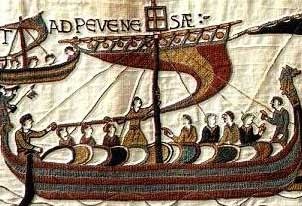
Viking Longboat
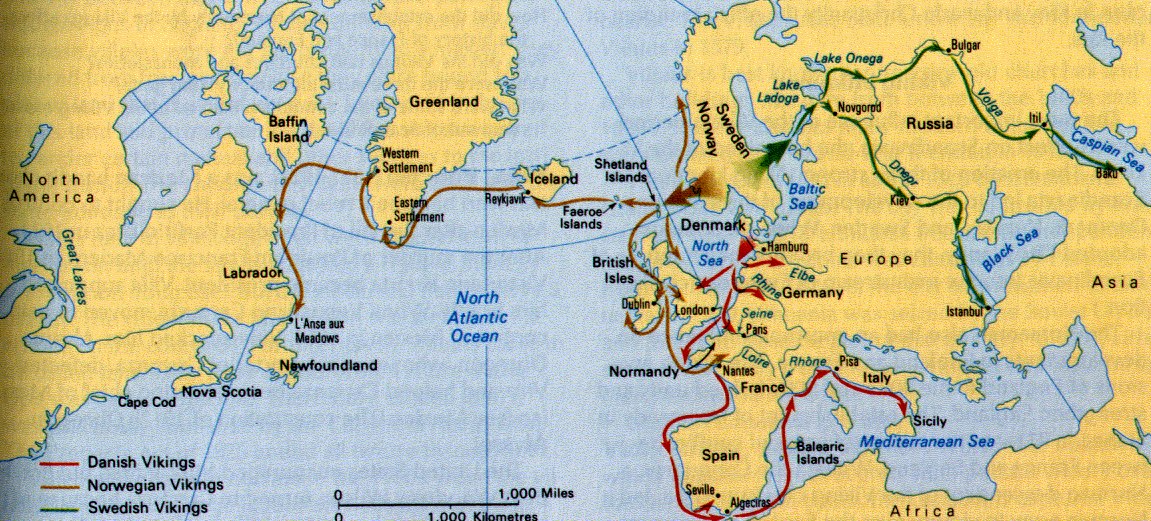
Viking voyages
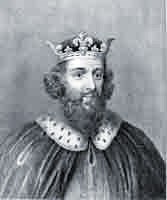
Alfred the Great (871 - 899) in response to Viking attacks united the Anglo-Saxons of England and founded a dynasty of kings of the House of Wessex, which created a strong and stable state. By the time that Alfred of Wessex (West Saxons) came to the throne in 871, the Danes from Denmark had already destroyed the other Anglo-Saxon kingdoms and settled in eastern England. To defend his kingdom from the Danes, Alfred built a navy and constructed forts or boroughs. In 877 at the Battle of Eddington Alfred 's forces defeated the Danes, who agreed to convert to Christianity. By the time of his death, Alfred had become the first king of all England.
Alfred's successors as kings of England in the tenth century created a new system to administer justice and generate revenue for the kingdom. England was divided into provinces or Shires and the kings appointed a Reeve or overseer over each Shire. These Shire-reeves (Sheriffs) presided over the Hundred Courts in their Shires. At these local courts, the Sheriff would settle legal disputes among the people and collect fines from people found guilty of crimes. These fines also became a major source of revenue for the kings. At these courts disputes were settled according to ancient customs. For example, in a process known as compurgation, a person could prove his innocence by having a number of people swear under oath that he was innocent. English "Common Law" had it origins in the legal customs of these courts.
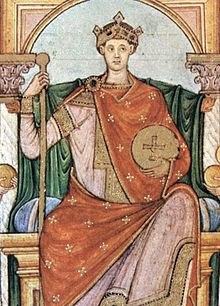
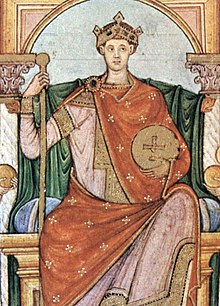
In the ninth and tenth century, the Magyars frequently raided Germany. Since the Carolingian kings were unable to lead warriors into battle to defeat these invaders, the leading dukes in Germany (known then as East Francia) assembled together in 936 and chose one of their own, Otto the Duke of Saxony to lead them as king against the Magyars. In 955 at the Battle of Lechfeld Otto's forces decisively defeated the Magyars and ended their raids. After this victory, Otto's army invaded Italy and Otto, like Charlemagne before him, crowned himself King of Lombardy. In 962 the Pope crowned Otto "Roman Emperor". Otto thus re-founded the "Roman Empire" of Charlemagne. This empire, however was smaller and consisted of what today is roughly Germany and Italy. Eventually this empire became known as the "Holy Roman Empire".
Otto's immediate successors as emperors, the Ottonian Dynasty, maintained that they had the same power and authority as the "Roman Emperors" of the Byzantine Empire. Consequently they appointed the Bishops of the Church. These kings could then draw from the vast wealth of the Church to finance their army and government since their appointees as Bishops administered Church lands. These emperors even appointed the Pope since they were concerned that local powerful landowners in central Italy were appointing their lackeys as Popes, so that they could control the region. Otto III in 1000 appointed as Pope the most eminent scholar of his day, Gerbert of Aurillac, who became Pope Sylvester II. Gerbert had studied Arabic works in mathematics and astronomy in Spain. This scholar and Pope helped introduce Arabic numerals to Europe
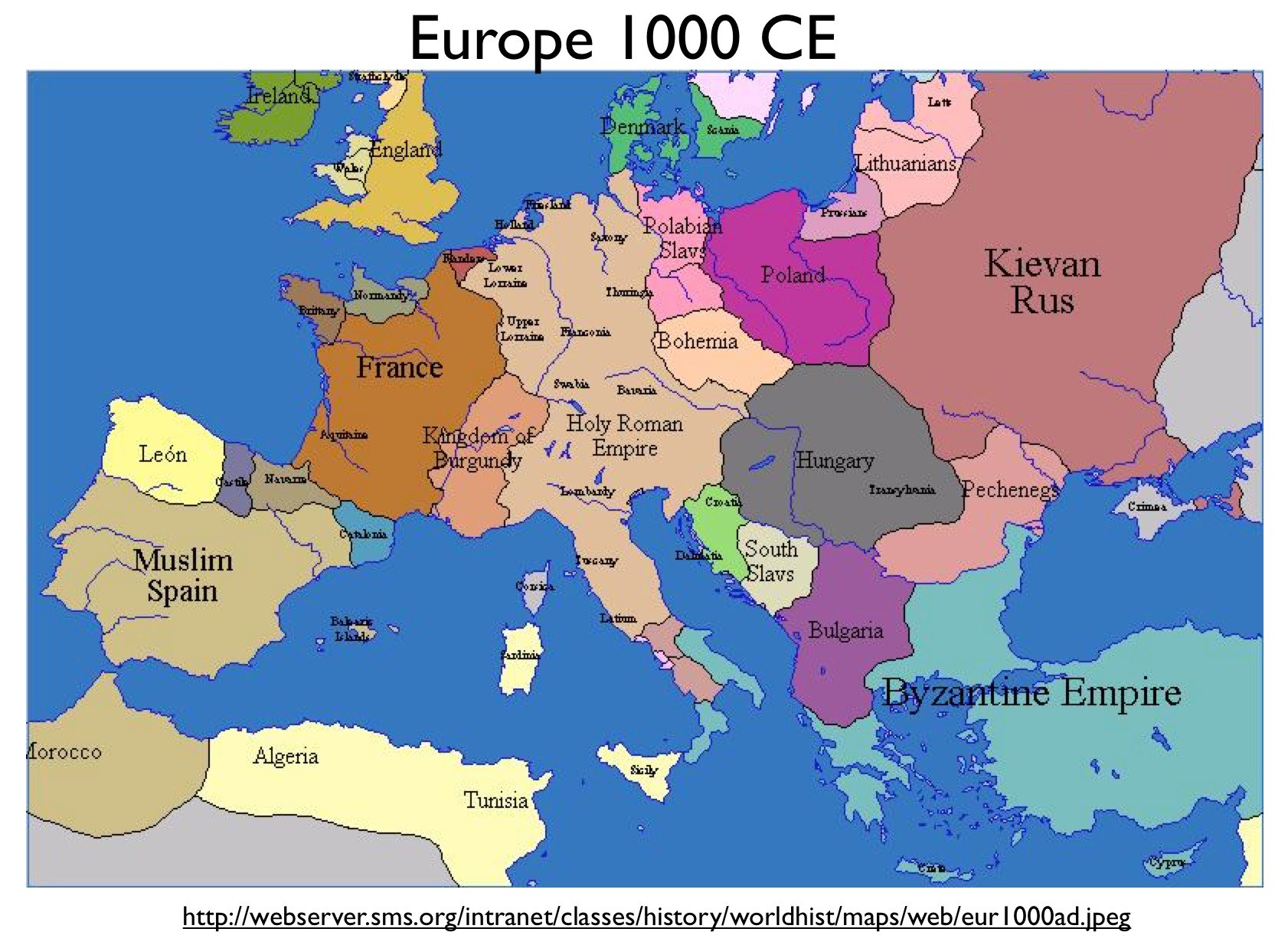
Europe in 1000
France or West Francia experienced more devastation and destruction from the invasions in the ninth and tenth centuries than other regions in Western Europe. Vikings, Magyars, and Saracens all raided and pillaged this area. In the absence of a central government due to the weakness of the later Carolingian kings, local landowners over time created a new political and economic system to restore peace and order. Historians refer to this system as Feudalism. During this period, a large landowner (the Lord) granted land (the Fief) to a knight (Vassal). The Vassal (knight) agreed to fight for Lord, and the Lord agreed to protect the Vassal's land and to allow the Vassal's eldest son and heir to inherit the fief. The Lord and Vassal swore oaths to honor this agreement. With these agreements a landowner could assemble a private army of mounted knights to defend his lands. When a Lord granted a Fief to a Vassal, this land came with the peasants (serfs) who farmed the land, so that the knight could devote his time to his military duties. Feudalism not only provided a system for military defense, but a means to maintain law and order. If the Vassals of a Lord had any disagreements with one another, they were required to attend the court of the Lord to settle their differences. If a Vassal had a disagreement with a knight of a different Lord, that Vassal expected his own Lord to back him up in this dispute. Owners of a Fief also created a court for the serfs, which settled disputes among these peasants. A manor was the estate of a knight where this court operated. Each Manor also included a fortification or castle, where the peasants could find refuge in times of danger. This system of Feudalism created a complicated network of relationships between Lords and Vassals. It was not uncommon for a landowner to be both a Lord with his own set of Vassals, but at the same time to be a Vassal to some other Lord. A landowner could also be a Vassal with multiple Lords for different Fiefs. Feudalism also created a sharp distinction between the aristocratic, elite warrior knights who were Lords and Vassals and the common serfs, who were required to labor on the lands of these landlords on the manors. An example of this system at work concerns the Norman warlord, Rolf or Rollo. In 911 the Carolingian king Charles the Simple as the Lord granted land as a Fief to this warlord , so that Rollo as the king's Vassal would employ his band of warriors to defend northern France from raids by other Vikings. Rollo in turn as Lord granted land to his warriors as his Vassals. The region where these Norman warriors settled became known as Normandy.
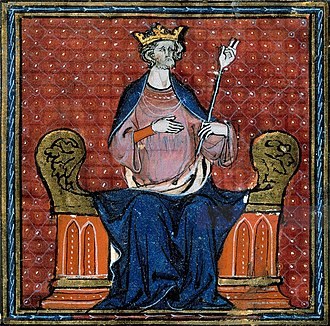
In France the landed nobility became dissatisfied with the poor leadership of the Carolingian kings. In 887 Odo, the Count of Paris successfully defended Paris from the Vikings. The great nobles of France, desiring a strong king, recognized Odo as their feudal Lord and king of France. After his death, the nobles elected the Carolingian, Charles the Simple, king. For nearly a century, the nobles went back and forth, electing a member of the family of Odo as king, then electing a Carolingian. In 987 the nobles elected Hugh Capet, the grandnephew of Odo, to be king. Hugh Capet immediately crowned his eldest son, Robert, as the Crown Prince and successor to the throne, so that the nobles would not elect some other person as the next king upon his death. Hugh thus founded the Capetian Dynasty of kings, which would rule France for over three hundred years. At the time of Hugh Capet the king of France ruled directly only over the region immediately surrounding Paris in northern France. The king's Vassals, the various dukes and counts of France, ruled over their domains as independent principalities.
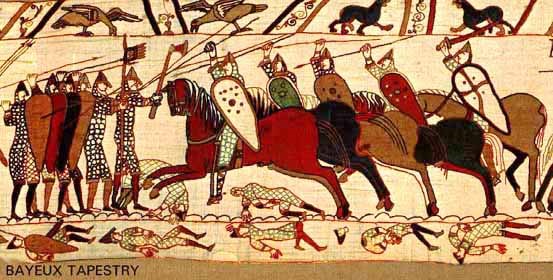
Medieval Knights
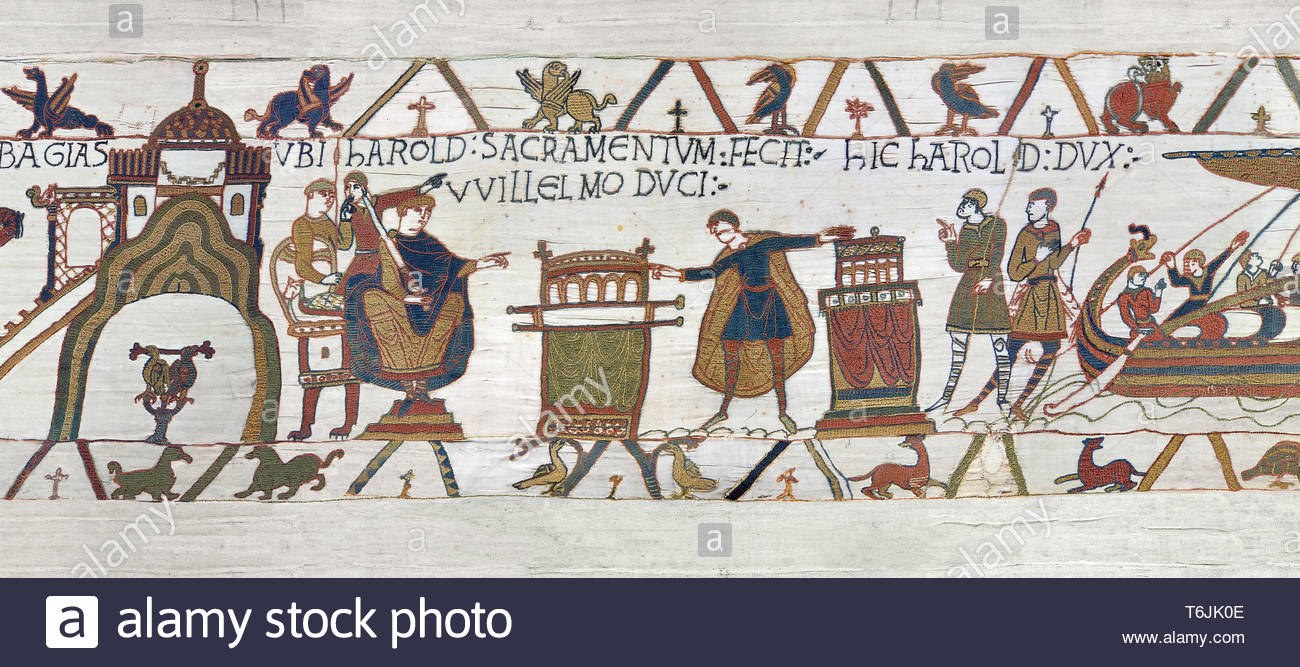
Vassal Swearing oath of loyalty (Fealty) to Lord
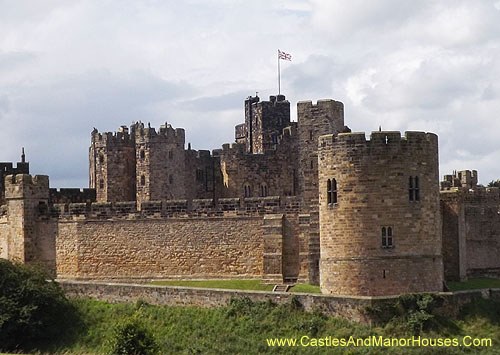
Manor Castle