Feudal Kingdoms
Early World21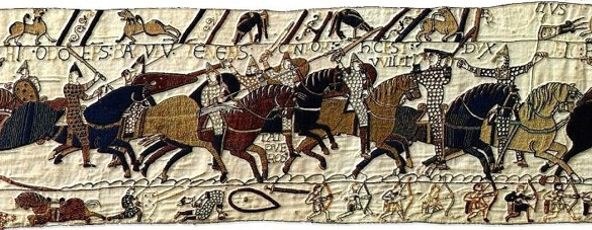
During the High Middle Ages Feudalism impacted different regions in a variety of ways. In England and France, Feudalism provided the political structure for the formation of these future nation-states later in the modern era. Feudalism, however, served as the basis for the emergence of representative government and human rights in England, but for a strong, autocratic monarchy in France. In the Holy Roman Empire (Germany, Italy) Feudalism resulted in the division of this region into a number of independent principalities.
The Norman Invasion of England in 1066 imposed feudalism on England. The conquest of England by Canute, king of the Danes (r. 1017-1035) set the stage for this later invasion. While Canute reigned as king of England, Edward the Confessor, the last king of the House of Wessex. lived in exile in Normandy, across the English Channel. With no children of his own, Edward recognized William, Duke of Normandy as his heir. Shortly after the death of Canute, the leading Anglo-Saxon nobles, the Earls, in 1042 invited Edward to return to England as king. Upon Edward's death in 1066, William claimed the English throne, but the English Earls elected one of their own, Harold Godwinson, king of England. In response William recruited French knights for his army to invade England and make good his claim to the throne. Harold Godwinson in 1066 not only had to deal with this invasion by William's forces, but also with an attack on England by the army of the king of Norway, Harold Hardrada, who also claimed the English throne. At the Battle of Stamford Bridge, Harold Godwinson's force defeated Hardrada's army. But in the subsequent Battle of Hastings against the Normans, Harold Godwinson died and William of Normandy won the battle and earned the name William the Conqueror. William divided up England into fiefs and assigned these fiefs to his French knights as his vassals. The vassals who received their fiefs directly from the king were known as the Tenants-in- Chief and as the Barons. These Barons in turn assigned fiefs to vassals of their own. Archaeological evidence suggests that this conquest was quite brutal. The French invaders apparently burned entire English villages to the ground to impose their rule on this subject population. For the next several centuries, the ruling aristocracy in England spoke French, while English was spoken by commoners.
The relationship between the monarchs of England, who succeeded William, and the Barons was sometimes confrontational. In times of conflict, these Barons claimed that they possessed certain rights based on feudal customs and traditions. Over time all free men, including the middle class in the towns in England would claim to possess these same rights. William's son, William II Rufus (r. 1187-1100) was very unpopular among the Barons since he demanded that the Barons pay him additional feudal aids. These feudal aids were payments that vassals paid their lords on various customary occasions. William II, however, was abusing his position as lord and increasing these payments from the Barons to raise revenue for his government. In 1100 William II died in a hunting accident. Since he had no children, his younger brother, Henry I claimed the throne. His claim on the throne was weak, however, since he had an older brother, Robert, who at the time was off on the First Crusade. Henry I was crowned king in 1100 with the support of the Barons. In his Coronation Oath, he swore that he would not make the same financial demands from Barons as his older brother. This coronation oath set a precedent in that the king was admitting that feudal law and custom placed limits on his power in the government.
Henry I (r. 1100-1135) was an effective administrator. He collected revenue from the fines collected by his sheriffs in the Hundred Courts and established a royal treasury known as the Exchequer. He hoped to be succeeded by his daughter Matilda, but upon his death, the Barons rejected Matilda as their Queen, and elected her cousin, Stephan of Blois as king (r. 1135-1154). Stephan spent most of his reign in France, where he was a count, while the Barons ran their domains as independent states in the absence of the king. Meanwhile, Matilda married Geoffrey, the powerful count of Anjou in France. Their son, Henry, inherited his father's lands in France. He also married, Eleanor of Aquitaine, the heiress to the Duchy of Aquitaine in southwest France. Through this inheritance and this marriage, Henry ruled over two-thirds of what is today modern France as a duke and count. Henry also waged war successfully against Stephan of Blois since Henry claimed the throne of England through his mother, Matilda. Before his death in 1154, Stephan recognized Henry as his successor as king of England.
Henry II (1154-1189) sought to rebuild the royal government in England and rein in the power of the Barons, who had dominated England under his predecessor. Since the Barons now controlled the Hundreds Courts and the Sheriffs, Henry II appointed royal judges to newly created royal courts. In these courts, juries of twelve free men decided legal disputes and criminal cases. Across England knights and free men increasingly took their legal disputes to these royal courts to be settled since a trial by jury was regarded as more fair and just than having a legal dispute heard at the court of the local Baron. These new courts thus weakened the power of the Barons and also added to the royal treasury or exchequer since these courts collected fines from those convicted in these courts. In these courts there developed a body of Common Law in England based on legal customs and traditions as well as the decisions of royal judges over time. By creating these royal courts, historians have recognized Henry II as the "Father of English Common Law". Yet when Henry II tried to place the clergy under the jurisdiction of these royal courts, the Archbishop of Canterbury, Thomas Becket refused to allow it since such a move would have infringed on the independence of the Church. In response some knights assassinated Becket in 1170 to punish Becket for this defiance to their king. Almost immediately across England and Western Europe, people hailed Becket as a martyr and a saint, and pilgrims came to Canterbury to visit his tomb. Consequently, due to this public outcry, Henry II had to abandon his efforts to subject the clergy to royal laws.
Henry II's two sons, Richard the Lion-Hearted (r. 1189-1199) and John (r. 1199-1216) succeeded their father to the throne in turn. King John had a reputation for deviousness and cowardice, and he was a very unpopular king, unlike his brother, Richard, the Crusader, who was renowned for his chivalry and bravery. Many people even suspected that John had murdered his own nephew, Arthur of Brittany to secure the Duchy of Brittany for himself. John demanded increased feudal payments from the Barons to pay for his wars in France, and he imprisoned and executed critics of his government. By 1215 John's wars had all ended in failure and the Pope Innocent III had excommunicated John after John attempted to place his own candidate as Archbishop of Canterbury. In this year, the angry Barons raised an army and forced John to sign the Magna Carta or "Great Charter". In this document, the Barons asserted that no new taxes or dues could be imposed by the king without their consent. The Barons also claimed to represent all the king's subjects. In this document, the king also promised that no one would be imprisoned or fined without first being tried by a jury of his peers in a court of law. The Magna Carta therefore established that under English law, free men had the right to own property, which could not be taken from them unless they were found guilty of a crime by a jury, which was the due process of law. At this time the Barons were primarily focused on protecting their own interests from an unpopular and incompetent king, but they had inadvertently put forward the idea of representative government, the notion that taxes and laws of government must be approved by the representatives of the governed. The Magna Carta also set forth that the governed have certain rights that the government must respect. In this regard the Magna Carta is the forerunner of the English Bill of Rights (1689) and the American Bill of Rights (1789).
Unlike John, John's grandson Edward I (r. 1272-1307) was a popular king and successful military leader, who conquered Wales and Ireland. His son the crown prince, Edward II, was the first Prince of Wales. He also fought wars against Scotland and France. To pay for these wars, he thought it prudent based on past history to win the approval of the Barons before raising new taxes. Edward also wanted to raise revenue through taxes from the growing ranks of the middle class in English towns. In 1295 he summoned the Barons to meet with him, but he also invited to this meeting two representatives elected from each borough (an English town) to include one free resident from the town and a local knight, who belonged to the lesser aristocracy or gentry (knights with no vassals of their own). This meeting was the first Parliament. Over the next century it became customary for kings to summon Parliament to approve new taxes. Eventually the Barons in Parliament met separately in the House of Lords, while the elected representatives of the townspeople and the gentry in Parliament met in the House of Commons.
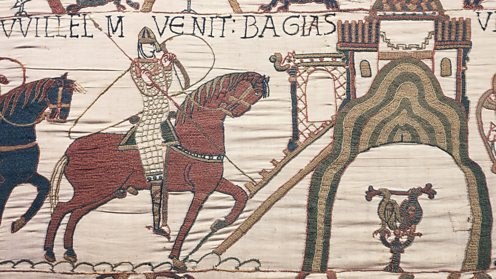
William the Conqueror
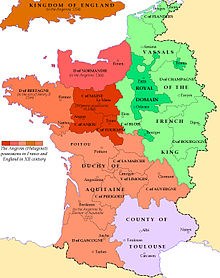
Lands of Henry II in France
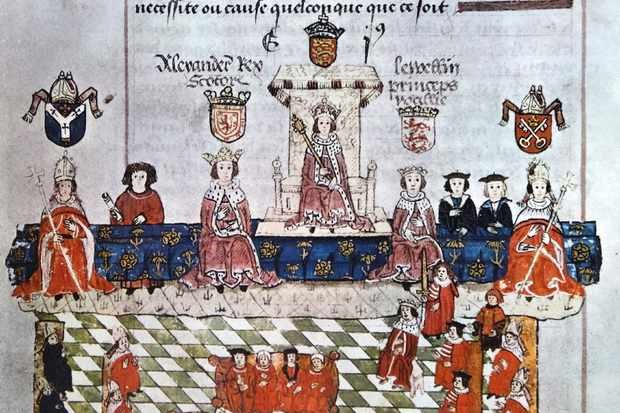
Edward I at Parliament
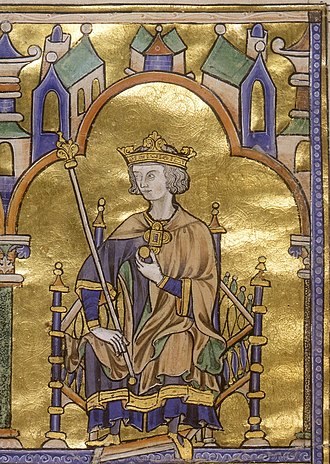
In comparison to the medieval kingdom of England, the Capetian dynasty of France enjoyed great stability and durability. the eldest son as crown prince or Dauphin succeeded his father as king for over two centuries. Over this period, the wealth and power of the French monarchy expanded steadily. At the beginning of the High Middle Ages, the French kings only directly controlled the region surrounding the city of Paris. Early Capetian kings such as Louis VI "The Fat" (r. 1108 -1137) focused on maintaining control over their vassals in this region. His son, Louis VII (r. 1137 – 1180) vastly increased the prestige and standing of the French monarchy by leading the Second Crusade. This Crusade was a failure, but Louis won a reputation as a pious and Christian king. The free towns in France and their middle class residents placed their cities under royal law due to this reputation.
Louis VII's son, Philip II Augustus (r. 1180 – 1223) took advantage of the poor choices and governance of John of England to expand the reach of the French Monarchy. In 1202 John married a French noblewoman , Isabelle of Angouleme. However, she was already engaged to marry a French nobleman, Hugh of Lusignan. Hugh was upset with John and requested that he and John resolve their differences at the feudal court of their mutual lord, the King of France, Philip II Augustus. Even though John was a vassal to the French king for John's lands in France and was expected to attend the king's court in accordance to feudal custom, John refused to attend Philip's court out of pride. Consequently, Philip II declared that John had forfeited all his lands in France because of his defiance of feudal law. The French vassals of John in these lands disliked him due to his reputation for meanness and cowardice , and they sided with King Philip II. In an effort to win back these lands, John made an alliance with his nephew, Otto IV, the Holy Roman emperor. But Philip II and his French army defeated the forces of Otto IV at the Battle of Bouvines in 1214. After this defeat, John lost permanently all of his family's territory in France to the French king except for Gascony in southwest France. As the lands and wealth of the French monarchy expanded due to these conquests, Philip II often appointed university educated men from the middle class to serve as his administrators. These administrators were well schooled in Roman Law , and they applied this learning to royal law. In their view, the French king's power, just like that of a Roman emperor, was absolute. The wealthy French middle class especially supported a strong French monarchy since they desired political positions in the expanding royal bureaucracy.
Of all the Capetian kings, the most renowned was Louis IX (r. 1226 -1270) or Saint Louis. Louis IX's devotion to his Christian faith was evident in his Crusades, which he personally led against the Sultan of Egypt even when fervor for Crusades had diminished across western Europe. During his reign, Louis expanded the royal courts since the nobility in France brought their disputes to the king's judges because of the king's reputation for honesty and fairness. In an effort to promote efficiency and integrity, Louis also expanded the French royal bureaucracy by appointing officials known as enqueteurs, whose job was to perform oversight over other royal officials. Louis IX often appointed members of the French middle class to these positions. Under Louis IX the nobility, the church, and the middle class all supported the monarchy. This support continued under his successors. Philip IV (r. 1285 - 1314) fought expensive wars against Edward I of England. To pay for these wars, Philip raised taxes on his subjects. To win public support for these new taxes, Philip summoned the first meeting of the Estates General in 1302. The three "estates" corresponded to the three "orders" of society, the feudal nobility - "those who fight", the clergy - "those who pray" and the common people - "those who work". Each order elected representatives to attend the meeting of the Estates General after the representatives of these three estates had convened first at the local level. The representatives of common people, the third estate, were usually wealthy merchants and royal officials. The Estates General approved Philip's tax increases and even agreed to levy taxes on church lands over the objection of the Pope himself, which is an indication of the wealth and prestige of the French monarchy in France by the close of the High Middle Ages.
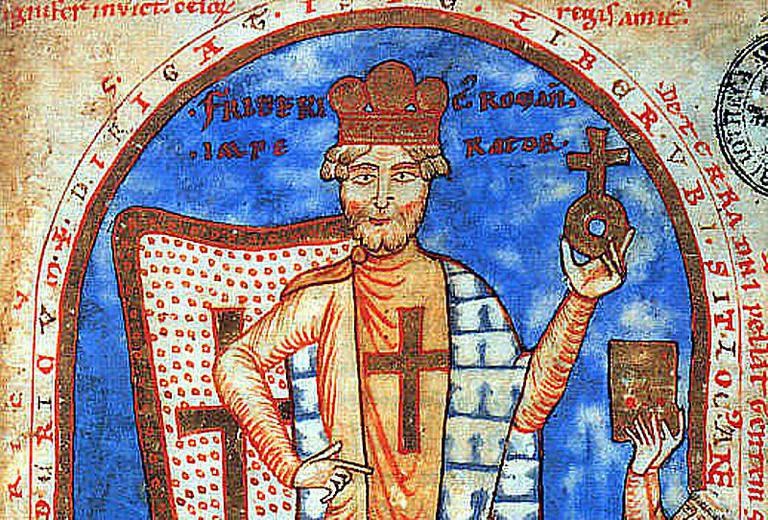
As a result of the Lay Investiture conflict the central government of the Holy Roman Empire declined due to the loss of revenue for the emperors, who had lost the ability to appoint bishops. In the absence of a strong central government, the German landed nobility adopted feudalism. By the 12th century, two noble families were contesting for the position of emperor, the Hohenstaufen dukes of Swabia and the Welf dukes of Saxony. The emperor Frederick I Barbarossa (r. 1152 – 1190) of the Hohenstaufen dynasty was elected emperor by these nobles since these nobles feared the power of his Welf rival even more, Henry the Lion, who was duke of Bavaria as well as Saxony. To secure an advantage over this rival, Frederick invaded northern Italy so that he could control the wealthy cities of this region and draw on that wealth for his showdown with Henry the Lion. The cities organized the Lombard League and allied with the Pope, who did not want to see any one power dominate in Italy and threaten the independence of the Papacy. The cities of the Lombard League successfully defended their independence, but they did reach a settlement with Frederick to pay him taxes in return for their continued self-government. With the revenue from these cities, Frederick now had the resources to defeat Henry the Lion, who went into exile. Frederick awarded his lands in Saxony and Bavaria to loyal vassals.
Frederick's son, Henry VI (r. 1190 -1197) succeeded his father as emperor. Henry married Constance of Sicily, the heiress of the Kingdom of Sicily (a descendant of Roger Guiscard). This marriage united all of Italy under one monarch. Henry died young in 1197, leaving a young son, Frederick II. Pope Innocent III was uneasy with one ruler of all Italy, so he supported efforts among the German nobles to install Otto IV, Henry the Lion's son, as the Holy Roman Emperor, while young Frederick remained king of Sicily. Otto IV however, invaded northern Italy to compel the wealthy Italian cities to pay him taxes as they had paid taxes to Frederick I. Pope Innocent III was alarmed by this move, so he switched his support to Otto's enemies in Germany , who elected Frederick II as a rival emperor to Otto in 1211. After the defeat of Otto IV at the Battle of Bouvines in 1214, support in Germany for Otto collapsed, and Fredrick II became sole emperor.
Frederick II was born and raised in southern Italy in Naples. He dreamed of uniting Italy in a restored Roman Empire. As emperor he focused his efforts on uniting Italy under his government. The cities of northern Italy organized a new Lombard League and forged an alliance with the Papacy to defend their self-government and autonomy against this emperor. In these cities, the population was often divided into competing factions, the Guelphs, who supported the Pope, and Ghibellines, who supported the emperor. Merchants in these cities tended to be Guelphs, whereas the local landed nobility tended to be Ghibellines. At one point in this conflict the Pope excommunicated Frederick. The Pope even declared Frederick to be a heretic and a secret Muslim and called for a Crusade against him. In these wars in Italy , Frederick granted extensive powers to the German nobles in exchange for their financial support. By the end of his reign due to these grants, the German nobles were virtually independent princes, while Frederick's plan to unify Italy had failed. After the death of Frederick's son, the emperor Conrad IV in 1254, the German nobles didn't even bother to elect a new emperor since the position was an empty title. Out of respect for tradition, the German nobles did elect an obscure and poor German noble, Rudolph of Hapsburg, as emperor in 1273. In Italy, Manfred, another son of Frederick II, was king of Sicily and continued the wage war against the Italian cities and the Papacy. Since Manfred was technically the vassal of the Pope and his kingdom a Papal fief, the Pope declared Charles of Anjou, the brother of Louis IX, to be the new King of Sicily since Manfred had defied his lord, the Pope. With his French army Charles invaded southern Italy and forced Manfred off the throne of Sicily in 1266. Charles and his French army became very unpopular in Sicily. In 1282 the Sicilians rebelled against Charles by massacring the French soldiers in an event known as the Sicilian Vespers. The Norman nobility of Sicily then invited Peter, the king of the Spanish kingdom of Aragon to be their king, as he had married Constance, Manfred's daughter. By the end of the 13th century, Italy like Germany was divided up into a number of independent states, the city-states of northern Italy, the Papal States of central Italy, the French successors of Charles of Anjou in the Kingdom of Naples in southern Italy, and the the House of Aragon in the Kingdom of Sicily.
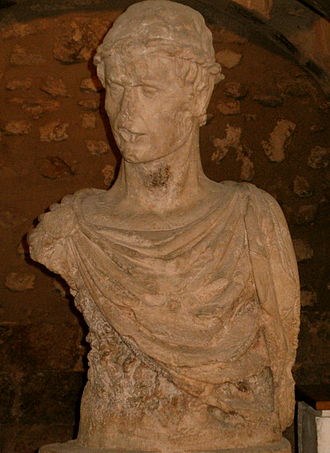
Contemporary statue of Frederick II
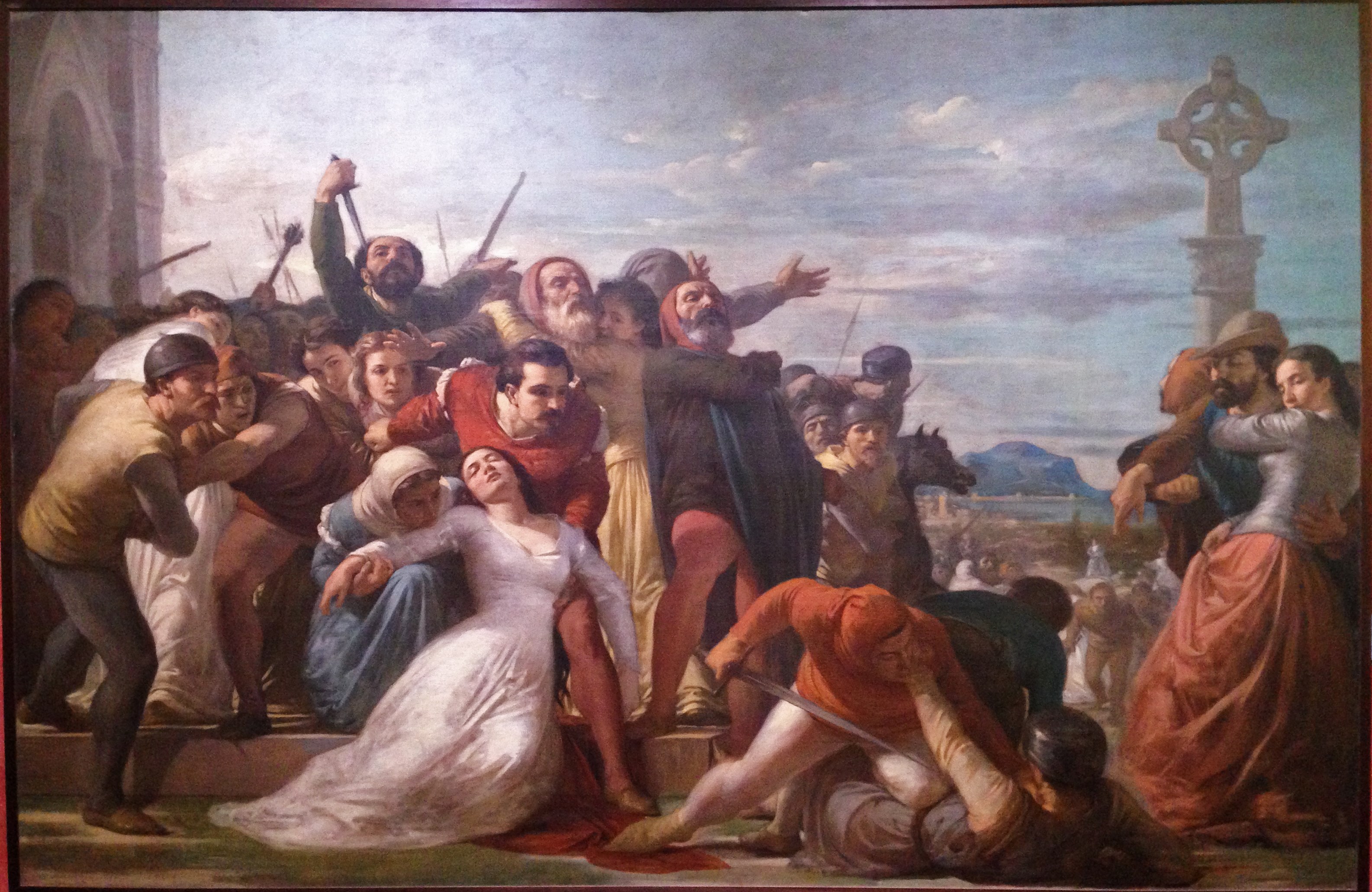
Romantic depiction of the Sicilian Vespers