The Late Middle Ages
Early World22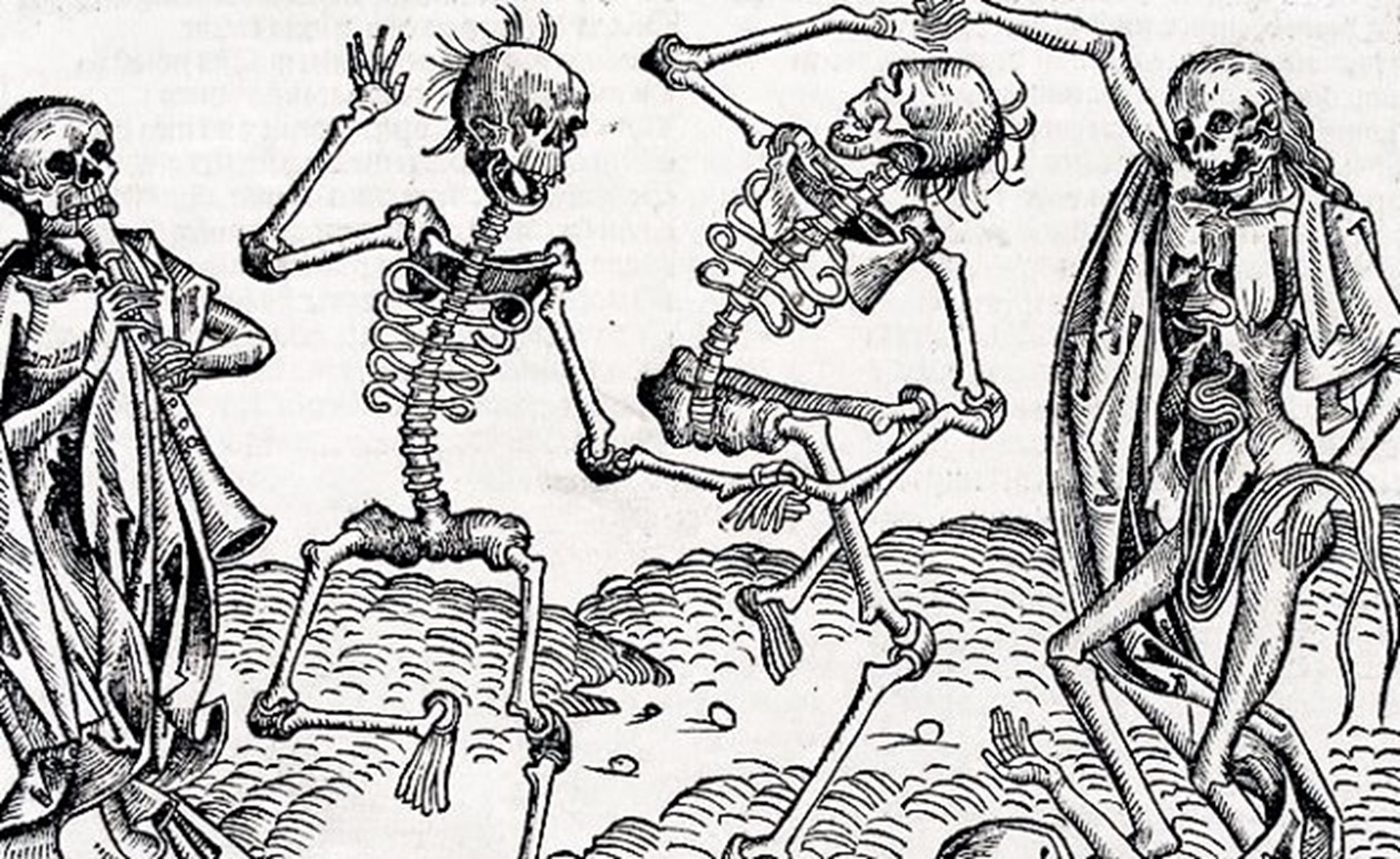
In sharp contrast to the High Middle Ages, the Late Middle Ages (1300 -1450) was a period of population decline and economic contraction. The cultural institutions and systems of the High Middle Ages, Feudalism, serfdom, guilds, and the Papacy, all experienced a decline in this period as wars and rebellions ravaged Western Europe. The decline of these cultural institutions and systems, however, set the stage for the emergence of new ones in the Early Modern period that followed.
The population decline of the Late Middle Ages largely resulted from climate change. In the period 1300 -1750 Europe experienced the Little Ice Age. Temperatures in Europe were far below current levels. Shorter growing seasons in this period resulted in periodic crop failures and poor harvests, which led to famines. Due to these poor harvests and famines, malnutrition was common across Europe. Since malnutrition reduces a human body's natural defenses against disease, the population of Europe was quite vulnerable to devastating epidemic diseases. The worst of these epidemic diseases was Bubonic Plague, which was known as the Black Plague. In 1348 this disease struck first and within decades may have killed up to two-thirds of Europe's population or roughly 75 to 200 million people. This disease originated in Central Asia and was transmitted by fleas. Italian merchants introduced the disease to European cities first, and from the cities the disease spread swiftly to the surrounding countryside.
The rapid population decline resulted in the decline of serfdom across Western Europe. The population decline created a labor shortage. The labor of peasants was therefore more valuable as the supply of this labor declined with the population losses. To retain their peasant labor, the aristocratic landlords of manors agreed to allow their peasant tenants to pay cash rents rather than perform labor services as serfs. Peasants also demanded that they receive wages for their labor on landlords' lands. In the 14th and 15th century some peasants, who saved enough money from their wages, even purchased land from the landlords and became landowners themselves. In England peasants who owned their own land were known as Yeomen, and in France they were known as Villeins. In both England and France the peasantry was empowered and protective of its improved position. In 1358 in France, landlords had raised certain fees that their tenants on manors were obligated to pay such as the tallage. Angry peasants rose up in mass across France in a event known as the Jacquerie. The army of King Charles V of France crushed this uprising, but landlords also stopped collecting the tallage. In England, Parliament, under pressure from aristocratic landlords, passed a law that froze wages for workers in an attempt to lower labor costs. Angry peasants rose up in mass in 1381 under the leadership of a blacksmith, Wat Tyler. The English king, Richard II, was able to suppress this revolt after the assassination of Tyler, but Parliament did revoke this law.
The Late Middle Ages also witnessed the decline of Feudalism. Toward the end of the High Middle Ages, feudal lords allowed their vassals to pay a fee (scutage) rather than perform their military service. Feudal lords could then use this money to hire mercenaries. During the Late Middle Ages, knights were under pressure economically, as labor costs rose to perform labor on their manors. Many of these knights therefore relied on their work as hired mercenaries for income. Historians refer to the employment of these mercenaries by feudal lords in this period as Bastard Feudalism. In England in this era some Barons used their mercenary armies of knights to plunder the peasants and rob merchants. Such Barons became known as Robber Barons.
Guilds also declined as an institution in medieval towns in this period. As the economy contracted, masters desired to keep their numbers small in the guilds, so that they could limit competition and prevents prices for their goods from falling. Consequently the number of journeymen in the towns increased. In the Netherlands in the 14th century, where cloth production was an important industry, dissatisfied weavers, who were journeymen, expressed their anger in violent riots. Across Europe some merchants also began to shift production from these guilds in the towns to the peasants in country villages. A new system of production arose known as the "Putting out System", which relied on cottage industry. In cloth production and in brewing beer and ale in particular, merchants traveled to villages and provided or "put out" the raw materials for peasant households, who would work out of their home or cottage to produce the finished product. Merchant would then collect the finished products and market them in the towns.
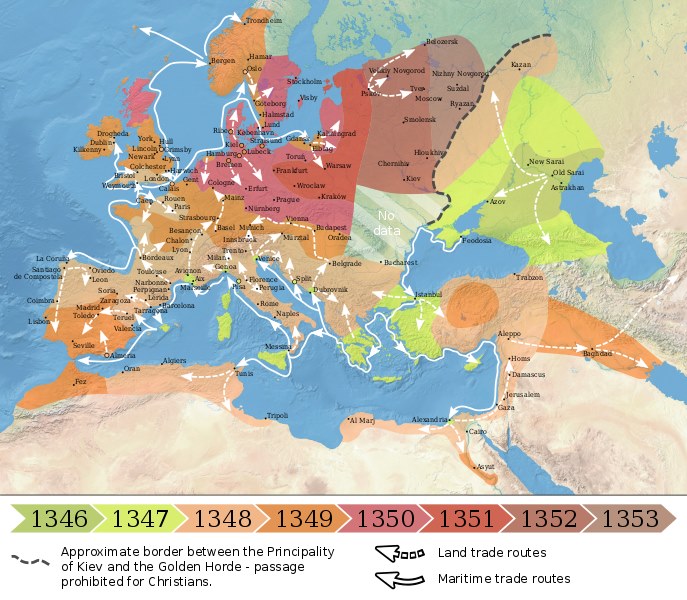
Spread of the Black Plague
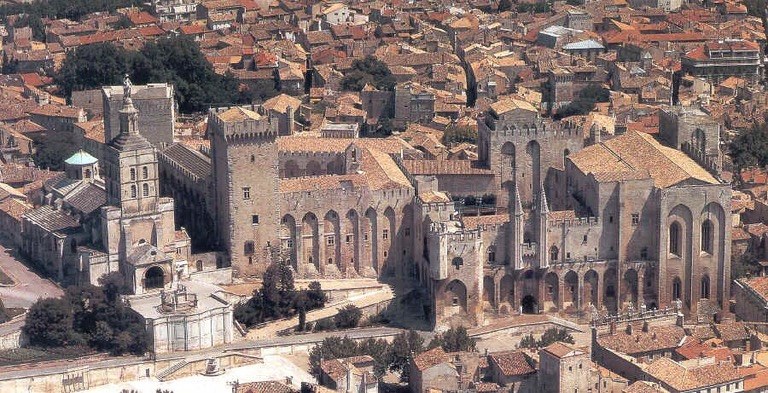
In the Late Middle Ages, the prestige and influence of the Papacy declined under Avignon Popes. In 1305 the newly elected Pope, Clement V decided to move the seat of the Papacy from Rome to the town of Avignon in France. Clement himself was French and he was under pressure to move to Avignon by the king of France Philip IV. Clement, as Pope, appointed other French churchman to be Cardinals, who in turn elected Frenchmen to be Popes. Avignon remained the seat of the Papacy until 1378. Across western Europe many Christians lost respect for the Papacy under these Avignon Popes since they assumed that the Popes were the puppets of the French kings instead of the independent leaders of the Church. The Avignon Popes also earned a reputation for worldliness and greed from their financial practices. For example, these popes required newly elected Bishops to pay the Pope a one time fee (the annate) which consisted of the annual income of the Bishop's province or diocese. Bishops opposed this fee since it funneled resources from local churches to the Papacy. These Popes also provided income for Cardinals by appointing them to be Bishops and Abbots of various churches and monasteries. Such as position was known as a benefice. The Cardinal would collect the income from these positions, while sending a subordinate to run the church or monastery while the Cardinal performed his duties in Avignon. The clergy and the laymen in these churches often complained that these subordinates performed poorly. These popes also raised revenue by selling indulgences. Popes sent out their sales representatives, who were often friars, across Europe to encourage people to purchase an indulgence from the Pope, so that the buyers' deceased loved ones could be released from the horrors of Purgatory.
In 1378 the Avignon Papacy ended, but a schism further weakened the status of the Papacy. In 1378 the Pope died while visiting Rome, which was still administered by the Papacy. The people of Rome pressured the Cardinals in Rome at the time to elect an Italian to be the new Pope. However, when the Cardinals returned to Avignon, they declared this election to be invalid, and they elected a Frenchman to be Pope. The Italian Pope, however, refused to stand down, so now a schism in the church arose as there were two Popes, one in Rome, and the other in Avignon. Each Pope appointed his own Cardinals, so that there were also two separate councils of Cardinals, who each elected a new Pope, when the old Pope died. This schism lasted until 1414 when the Bishops convened at the Council of Constance (1414-1417) and recognized a single Pope, Martin V, with Rome once again as the seat of the Papacy. Many church leaders welcomed this church council as an opportunity for the Catholic Church to address issues such as heresy and corruption within the Church. At the Council of Constance, it was decided that such church councils would meet regularly. However, the Popes feared that these church councils were a threat to the position of the Pope as absolute leader of the Church. At the Council of Basil in 1431 the Pope dismissed this council almost immediately. The angry Bishops of the council responded by electing a different Pope, so that once again the church faced a schism. This schism lasted until 1449 when the Council of Basil dissolved and their Pope resigned. The Pope in Rome won this struggle by winning French and German Bishops over to his side by ending the unpopular practice of collecting annates and the right of clergy in these churches to appeal the decisions of Ecclesiastical Courts to the Pope. These concessions by the Pope resulted in loss of income for the Papacy from these churches. Consequently Popes in the 15th century relied more for income on taxes collected from the Papal States of central Italy. Effective Popes therefore needed to be skilled administrators and statesmen rather than spiritual leaders. These worldly Popes further lessened the status and prestige of the Papacy in the eyes of faithful Christians.
In the Late Middle Ages the declining prestige of the Church stirred up support for heresy or doctrines that went against the official teachings of the Catholic Church. Back In the High Middle Ages, the Cathars , a religious sect in southern France arose, that held beliefs very similar to the Manichaeans. Innocent III in 1208 called for a Crusade to crush this sect, and Saint Dominic went to preach to these heretics. This Albigensian Crusade ended in 1229 after thousands of Cathars had been massacred and burned at the stake. In the Late Middle Ages, such heresies multiplied. In England John Wycliffe around 1350 was a priest who rejected the church teaching that laymen could only receive God's grace from the sacraments of the Church and hear the Gospel only from ordained clergy who had read the Bible in Latin. Wycliffe maintained that Christians received God's grace through their faith in Christ alone. He also maintained that the Bible ought to be translated into a spoken language, so that Christians besides clergy could read the Bible for themselves in their own language. Wycliffe's teachings inspired a group in England known as the Lollards, who translated the Bible into English. Wycliffe's ideas inspired a young priest in the Kingdom of Bohemia (now the Czech Republic) in the Holy Roman Empire, John Huss, who began preaching to large crowds. Huss also maintained that all Christians should be able to eat the bread and drink the wine during the sacrament of communion. The practice of the church at that time allowed only priests to consume both wine and bread during this ritual, while the laymen just consumed the bread. Huss' call for change was based on his belief in the spiritual equality of clergy and laymen. Just as all Christians should read the Bible for themselves, they all should also consume bread and wine in the communion service. In 1415 The Council of Constance invited Huss to attend the council and discuss his ideas. The council found Huss guilty of heresy, and he was burned at the stake. Huss' followers in Bohemia refused to recant their views. The Pope declared a Crusade against these Hussites in 1420, which was led by the Holy Roman Emperor Sigismund. By 1434 this Crusade crushed the Hussites. Some Hussites continued to practice their faith in secret and were known as the Moravian Brethren.
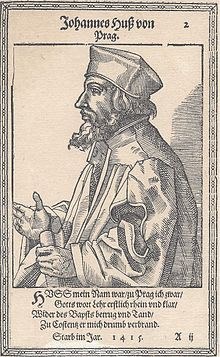
John Huss
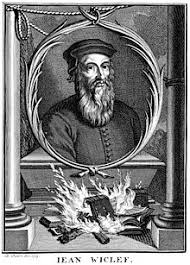
John Wycliffe
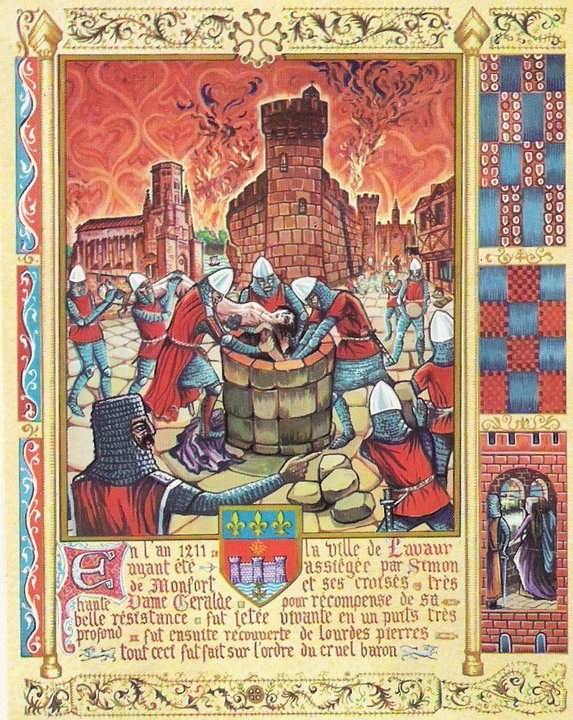
Massacre of Cathars
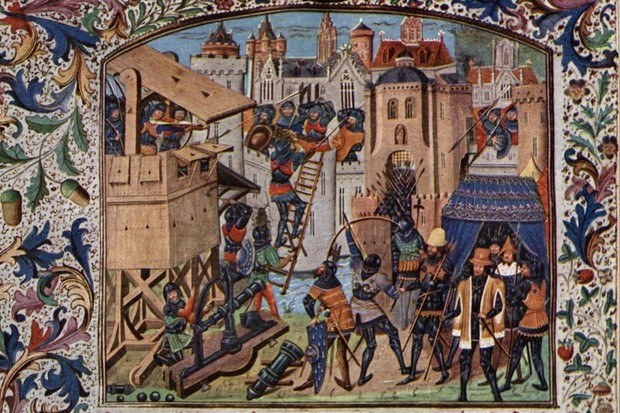
During the Late Middle Ages the Hundred Years War (1337 - 1453) pitted the kings of France against the kings off England in an intermittent conflict that was marked by massive loss of life and property as well a civil wars in both kingdoms. The root of this conflict was competition for territory by the rulers of these kingdoms. The kings of England still controlled territory in France, Gascony, which the kings of France wished to acquire. The two kingdoms also competed for influence in the Duchy of Flanders (the countries of the Netherlands and Belgium today). This area was inhabited by the Flemish, who spoke a Germanic language, and Walloons, who spoke a French dialect. This region included a number of wealthy trading cities. The French kings desired to control this region, but the English kings wished to keep this area independent of the French since English exported large amounts of wool to this area to be manufactured into cloth.
This war began when the Capetian dynasty came to an end with the absence of a male heir to the throne. In 1328 Philip VI of Valois, the cousin of the last Capetian king, became king of France. However, Edward III (r.1327 - 1377) of England claimed the throne of France through his mother, a French princess and daughter of the Capetian king, Philip IV of France. Edward amassed an army to invade France and make good his claim to the throne. Instead of recruiting all knights, Edward assembled an army of English peasants, who were well skilled at the English longbow. At the Battle of Crecy (1346) the English bowman annihilated the French mounted knights. The Black Plague temporarily suspended military operations, but in 1356 at the Battle of Poitiers once again the English bowman destroyed a military force of mounted knights. In this battle the French king, John, the son of Philip, was captured and brought back as a prisoner to England. English armies subsequently occupied much of western France and plundered the countryside. These two battles marked the end of the mounted knight as the dominant military weapon and thus contributed to the overall decline of feudalism in this period. John's son, Charles V "the Wise" (1364-1380) was able to secure tax increases from the Estates General without making any concession to allow the Estates General to play a role in governing France. With this revenue, Charles raised new armies and expelled the English from France. The Treaty of Bretigny (1359) ended the conflict or at least suspended the war for the time being.
In the decades after this treaty, both kingdoms experienced civil wars. In England Richard III (r. 1377-1399), the grandson of Edward III was very unpopular with Barons since he imposed taxes without their approval and imprisoned and executed his many enemies. In 1399 the Henry IV (1399-1413), the Duke of Lancaster, with the support of the Barons, overthrew Richard III and claimed the throne for himself, as another grandson of Edward III. In France Charles VI (r.1380 -1422) was mentally ill.His younger brother Louis of Orleans therefore served as regent. At this time the rising middle class in France was tired of the political domination of the nobility. The middle class found a champion in John the Fearless, the Duke of Burgundy and Flanders with its wealthy trading cities. Louis of Orleans championed the cause of the French nobility. In 1407 John arranged for the assassination of Louis of Orleans. This assassination set off a war between the supporters of John the Fearless and Louis of Orleans.
In 1415 the king of England, Henry V (r. 1413 -1422) renewed the war and claimed the throne of France. At the Battle of Agincourt in 1415 the army of Henry V defeated the French force. The English army was predominantly composed of archers armed with the longbow. In this conflict the Duke of Burgundy and Flanders, Philip the Good, allied with Henry after the Dauphin, Charles had arranged for the assassination of Philip's father, John the Fearless in 1419. In 1420 the Philip and Henry compelled the insane French king, Charles VI to sign the Treaty of Troyes. Under the terms of this treaty, Charles VI agreed to have his daughter Isabella marry Henry and recognized the future son (Henry VI) from this union as his heir as king of France. Henry V died soon afterwards still a young man in 1422, and his son, Henry VI was just a toddler.The Dauphin and son of Charles VI, Charles VII (r. 1422 -1461) understandably rejected this treaty and continued the war against English. In 1428 a 17 year old peasant girl, Joan of Arc, appeared at the court of Charles VII and told the king that God had told her to lead Charles' armies to victory, so that Charles could be crowned the rightful king of France. Charles placed the young girl at the head of his armies, and French forces under her command drove the English away from the town of Orleans. The French army won a series of victories over the English, and Charles VII was officially crowned king of France in 1429 with Joan of Arc at his side. In 1430 the English captured Joan of Arc and burned her at the stake as a witch. Joan of Arc stirred up the French to fight the English because this pious girl reminded the French people that the French monarchy had a reputation for piety and strong support for the Catholic Church. In this period a sense of French national identity was emerging that equated loyalty to France with loyalty to the monarch and the Church. Charles VII was not a pious man nor that competent, but he became known as "Charles the Well-Served" since men and women of talent and ability served in his government due to their love for France and their Christian faith. The Estates-General voted to raise taxes, so that the royal government had the financial resources to create a permanent standing army of professional soldiers. By 1453, this army had successfully driven the English out of France and ended the 100 Years War. This French victory also occurred due to the incompetence and mental illness of the English king at this time, Henry VI (1422 - 1463).
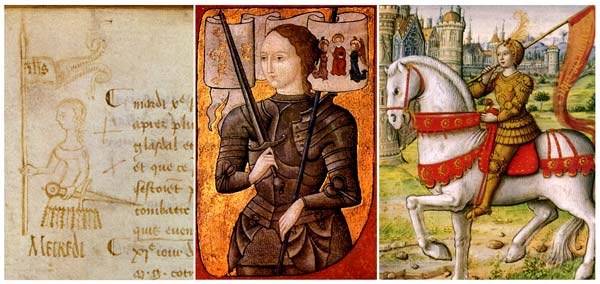
Joan of Arc
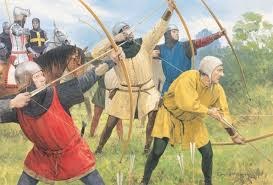
The English Longbow
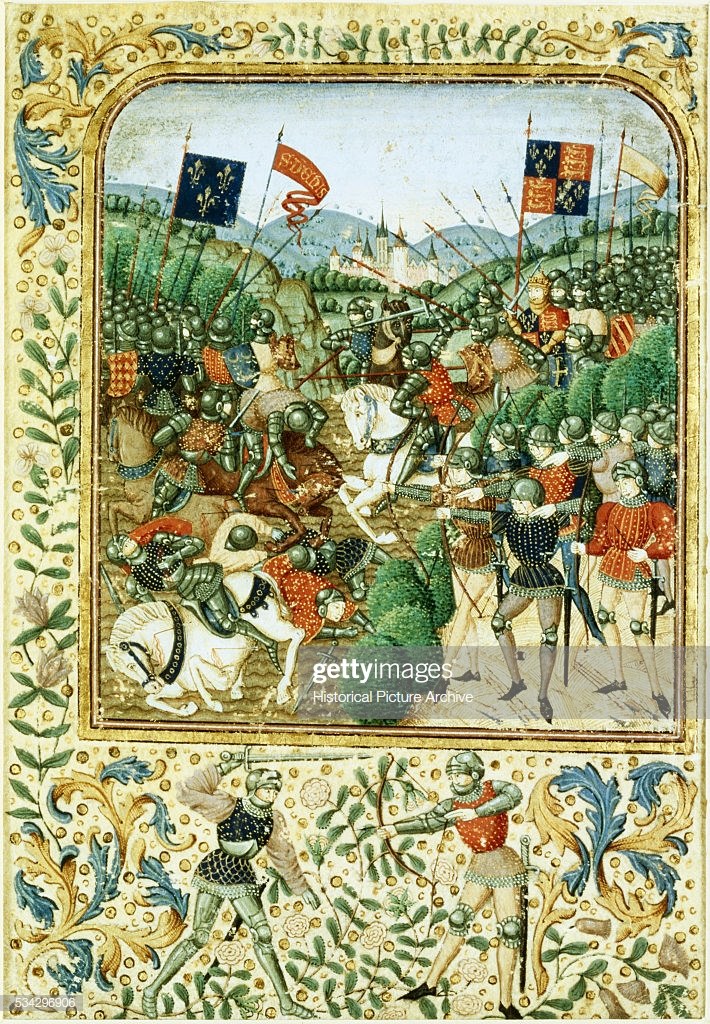
Battle of Agincourt