Medieval China and Japan
Early World23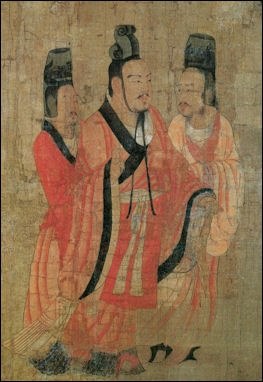
In 589 China was united under the Sui Dynasty after several centuries of disunity following the collapse of the Han Dynasty in the third century. A succession of native Chinese imperial dynasties ruled over China until the Mongol conquest of China in 1279. Over this period China experienced population growth and economic expansion as well as innovations in technology. At this time also on the Korean Peninsula and on the islands of Japan, complex cultures and states developed, which were heavily influenced by neighboring China.
The founder of the Sui Dynasty, Sui Wen-ti was the ruler of a principality in northwest China. He was descended from Turkish peoples who had settled in this region beginning in the third century and adopted the local Chinese language and culture. By 589, he had united all the former lands of the Han Empire in a series of successful military campaigns. In these military operations, Sui Wen-ti recruited Turkish warriors from the Eurasian Steppe into his forces. After uniting the empire by war, the new emperor sought to unite his empire economically with the construction of the Grand Canal to link the Yellow and Yangtze Rivers of north and south China.
The Sui Dynasty (589 -618) did not survive the reign of Sui Wen-ti's son, Yang. Under this emperor, military campaigns against Turkish tribes of the steppe to the west were unsuccessful. Moreover Chinese armies in 614 suffered a humiliating defeat at the hands of the Korean kingdom of Goryeo in what is today North Korea. The Koreans spoke an Altaic language, which was related to the Turkish and Mongol languages. The Korean tribes organized into the Goryeo Kingdom in the first century CE under the cultural influence of the Han Empire. After the fourth century, Buddhism became the predominant religion in the Korean Peninsula without replacing the Korean devotion to their ancestral gods. After the victory of this Goryeo kingdom over the Chinese armies, Yang's own generals assassinated him in 618. The military losses combined with a series of natural disasters and peasant rebellions due to heavy taxes and forced labor convinced these generals that Yang had lost the Mandate of Heaven. One of these generals, Li Yuan, who was related by marriage to the former dynasty, assumed the throne and founded the Tang Dynasty (618-907).
The Tang Dynasty continued sweeping new political and economic policies of the preceding Sui Dynasty. The central government assigned to each Chinese peasant family a plot of land and a tax to be paid in kind to the state. All peasants also performed compulsory labor for the state. At regular intervals the state would redistribute these land allotments equally to the peasants. The purpose of this policy was to prevent large large landowners from acquiring the lands of other farmers and acquiring too much power at the regional level, such as had been the situation under the Han Dynasty. Certain elite families of large landowners , however, who shared the Turkish ancestry of the ruling dynasty were exempt from this policy. The Tang Dynasty also employed a new imperial bureaucratic system. The bureaucracy consisted of three separate branches. Government officials could only serve in one of these branches. One branch was concerned exclusively with military matters, while another branch oversaw the collection of taxes, public works, and the administration of justice. The third branch was the Censorate, whose primary function was to perform oversight over the two other branches to insure that they were operating effectively and honestly. The appointment to positions in the two civilian branches was based on how well applicants performed on comprehensive, competitive exams. These government officials were expected to be Confucian Scholar-Gentleman or Chun-Tsu, and these exams tested students' knowledge, which was based on the curriculum designed by Confucius. However, the members of the elite class of landowners monopolized the highest positions in the bureaucracy.
Under the Tang Dynasty, the war against the Goryeo Kingdom continued. Chinese armies allied with the Korean kingdom of Silla located in what is today South Korea. With this assistance, Silla conquered Goryeo and united the Korean Peninsula under one state by 668. The Kingdom of Silla adopted the political system in place in Tang China. The ruler of the state, the Maripgan, held a position comparable to the Chinese emperor and was similarly revered by his Korean subjects. The Kingdom of Silla also embraced Confucianism. but positions in the bureaucracy were allotted only to elite noble families and appointments within this bureaucracy were based on the hereditary status of the applicants in the strict hierarchy of the elite, known as the Bone Rank System. Buddhism, not Confucianism, also remained the predominant religion in Silla. Until its collapse in 935, Silla remained a vassal state of Tang China. In addition to its wars in Korea, Tang armies advanced deep into Central Asia in an effort to pacify the Turkish tribes of the Steppe. The defeat of Tang armies at the Battle of Talas in 751 by the Arabs halted this expansion and resulted in the conversion of these Turks to Islam.
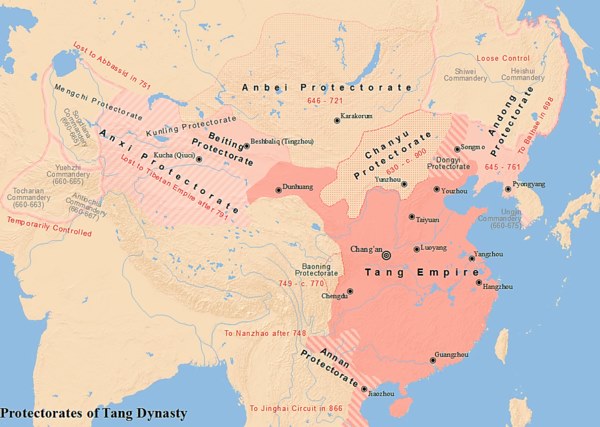
Tang Empire
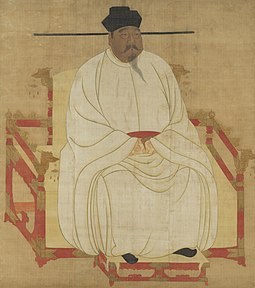
The later Tang emperors left the task of governing China to their wives and eunuchs, who often lacked the training or experience to administer the empire. In the absence of a strong central government, military generals along the western and northern frontiers of the empire acted independently of the emperors in the face of attacks by steppe nomads. In 907 one of these generals forced the last Tang emperor to abdicate. This event began a period of civil war (907-960) known as the Five Dynasties and Ten Kingdoms period in which rival warlords attempted to unite China under their control. In 960, one of these generals, Taizu of Sung (or Song) succeeded in crushing his rivals and established the Sung Dynasty.
The Sung Dynasty's empire was not as extensive as the preceding dynasty. In Korea, a general Wang Geon toppled the Silla Kingdom in 935 and united the Korean Peninsula. He founded the Goryeo or Koryo Dynasty in Korea, which would last until 1392. The Korean rulers of this dynasty maintained their independence from the Sung emperors of China. In Northern China, a nomadic people from the steppe to the north of China, the Khitan, in 916 settled in this region and adopted Chinese culture. Their rulers established a dynasty of emperors of their own, known as the Liao Dynasty. In 1125 another nomadic steppe people the Jurchen who inhabited what is today Manchuria in modern northeast China, conquered this Khitan Empire. The Jurchen rulers also adopted Chinese culture and established an imperial dynasty known as the Jin or Chin Dynasty. In 1127 this Jin empire expanded and occupied much of the Yellow River Valley. The Sung emperors afterwards retreated from this valley and ruled only the Yangtze River Valley in southern China. Historians therefore divide the history of the Sung Dynasty into two periods: the Northern Sung (960 -1127) and Southern Sung (1127 -1279).
Despite its diminished territory, the period of the Sung Dynasty witnessed economic and population expansion and technological innovation. During the period of civil wars, the system of periodically redistributing land allotments to Chinese peasants collapsed. Chinese peasant families came to own their land permanently. In this same period a market economy developed as peasant farmers sold their produce from their farmlands in local markets. The use of coinage in these markets became widespread, and the Chinese state now collected taxes with money rather than in kind or through compulsory labor. In addition the Chinese state now recruited its army by paying salaries in money rather than drafting peasants. The growth of a market and money economy also enabled successful merchants and artisans to amass large fortunes. Merchants and artisans were now independent operators and no longer state employees as in the period of the Tang Dynasty. The period of the Sung Dynasty was also a era of technological innovation. New irrigation methods and new varieties of rice expanded agricultural production in the Yangtze River Valley and resulted in rapid population growth. Chinese farmers also raised new crops such as tea and cotton. This period also saw a host of new inventions, the compass, gunpowder and firearms, and printing. The Chinese state also invented paper money in this period due to the shortage of precious metals for coinage. The Chinese had invented paper (from wood pulp) during the Han Dynasty and printing was invented in this period. The Chinese state now printed on pieces of paper a certain value of coinage, and buyers and sellers could use this paper as currency instead of metal coins.
The economic changes of this period impacted society and government. The period of civil wars had destroyed the landed elite of the Tang Dynasty. Consequently, all positions in the bureaucracy were open to all applicants under the Sung Dynasty since this landed elite no longer monopolized the highest posts. Moreover, the ranks of the Scholar-Gentlemen became more open to new members. Wealthy farmers, artisans, and merchants could now afford to provide their sons with the proper education to compete for positions in the bureaucracy and thereby join the ranks of the Scholar-Gentlemen. During the Sung Dynasty, these Scholar- Gentlemen viewed each other as equals since there was no aristocratic elite within their ranks as in the days of the Tang Dynasty. These Scholar-Gentlemen also further elevated the status and power of the emperor in the political system. In this period Scholar- Gentlemen also expanded the range of study of Confucianism to include metaphysics as a response to the growth of Buddhism in an intellectual movement known as Neo- Confucianism.
In 1279 the Mongols under their Khan or warlord, Kublai Khan defeated the armies of the last Sung emperor. Kublai's grandfather, Timujin in 1206 had united all the Mongol tribes in the steppes north of China and assumed the title Ghengis Khan or "Great Warlord". The Mongols were terrific horseman and expert bowmen. Under Genghis Khan's command, Mongol armies crushed the Jin Empire to the east and conquered the Turkish tribes in Central Asia. Under the sons of Genghis Khan, Mongol "hordes" advanced across the steppes into western Asia and eastern Europe, creating the largest empire in human history. In 1260 Kublai became Khan of the Mongols and directed his armies against the Southern Sung Empire. After uniting all of China in 1279, Kublai assumed the title of Chinese emperor and founded the Yuan Dynasty (1279 - 1368). Kublai Khan maintained the system of governance already in place in China and ruled over China as a traditional emperor. He did appoint only fellow Mongolians to the highest military positions in the state, and he moved the capital of his empire to North China to Beijing (Peking), so that the seat of his empire was closer to his Mongolian homeland. Under Kublai Khan political power in the state also became more concentrated in the hands of the emperor's close circle of advisers. After Kublai's death in 1294, the Yuan Dynasty under his successors collapsed. The Mongol military elite in China fought with each other for power and influence under these emperors. Moreover a series of devastating floods of the Yellow River and famines in the 14th century convinced the Chinese that this dynasty had lost the Mandate of Heaven. Widespread rebellions across China resulted in the expulsion of the Mongols from China and the establishment of a native Chinese dynasty, the Ming Dynasty in 1368.
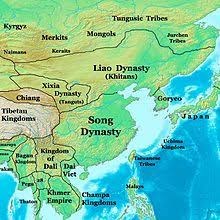
Liao Dynasty
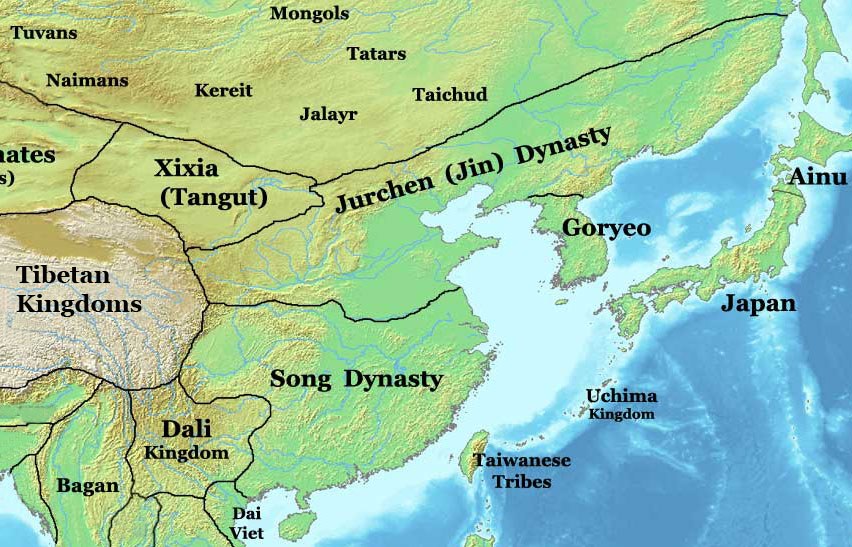
Jin Dynasty
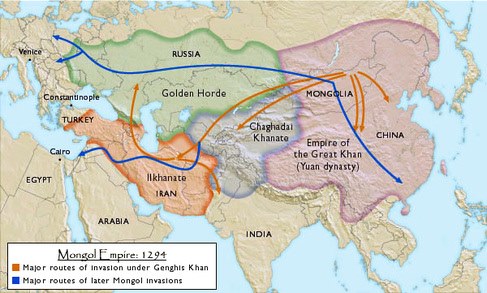
Mongol Empire
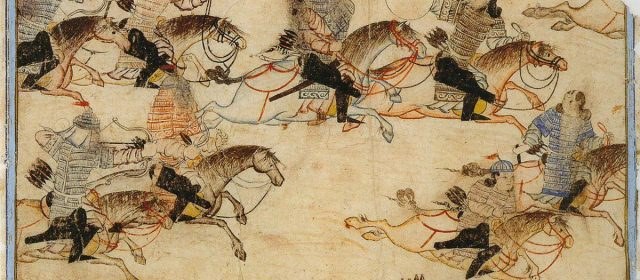
Mongol horsemen
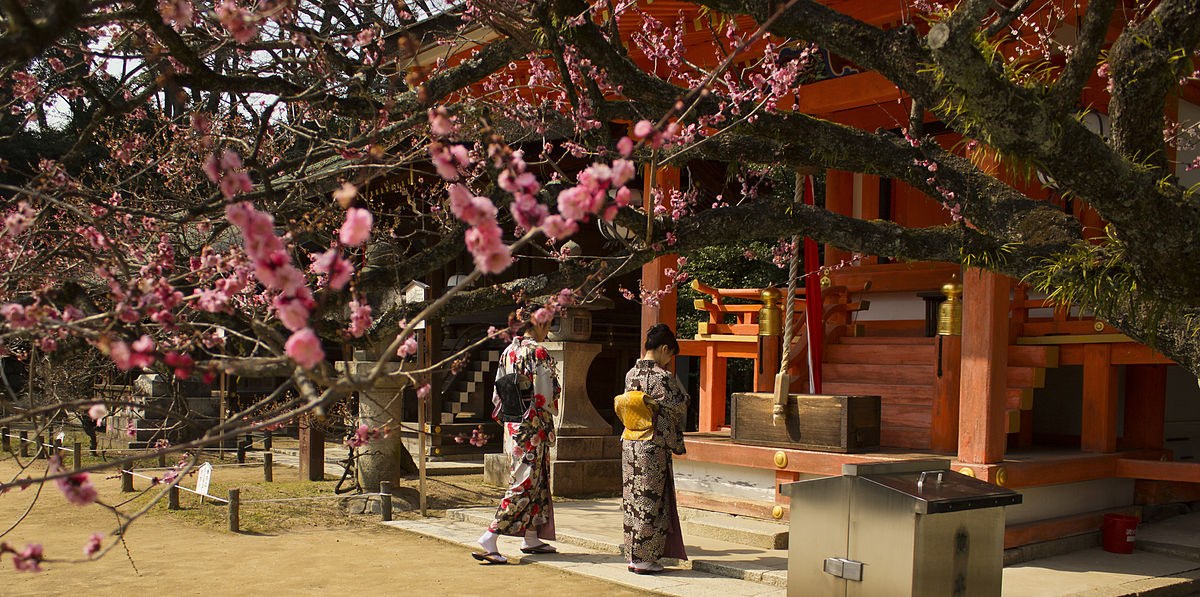
The islands of Japan never experienced a Bronze Age. Around 300 BCE immigrants from the Korean Peninsula, speaking an Altaic language akin to Turkish and Mongolian and armed with iron tools and weapons (Yayoi culture), displaced the indigenous, Neolithic culture (Jomon culture). This indigenous population, the Ainu, still survives in the northernmost islands of Japan. Complex culture developed in Japan in the Yamato Period (300 - 600 CE). In this era, the rulers of the Yamato Plain constructed massive tombs for themselves that were large circular mounds, thereby indicating their control of labor and resources. By the sixth century, Buddhism had spread to Japan from the Korean Peninsula. Buddhism coexisted with Shinto religion in Japan. The Japanese believed that nature (mountains, rivers, trees) were inhabited by spirits, who were also the ancestors of the Japanese people. Across Japan in every region, the Japanese worshiped these spirits associated with natural phenomena through prayer and rituals. In 680 the ruler of the Yamato Plain, Temmu, established his rule over all Japan as the first emperor of Japan. The emperors claimed to be descended from the most powerful of spirits in the Shinto religion, Amaterasu, the goddess of the sun.
The emperors established their capital at Heian (Kyoto) in 794. In the Heian Period (794-1180) Chinese civilization strongly shaped Japanese culture. In the Japanese government, the emperor held a position comparable to the Chinese emperor as the head of state. The Japanese government also created a bureaucracy and system of taxation that imitated the government of the Tang Dynasty. Japanese officials also embraced Confucianism and studied to become Scholar- Gentleman. By 900 the Japanese also adapted Chinese characters to develop their own written script, Kana. Japan did create its own unique culture. In Japan, powerful landowning , aristocratic families controlled the imperial bureaucracy in Heian. There were no competitive exams to determine appointments to positions in the government. Japan also possessed an hereditary class of horsemen and warriors, the Samurai, who served as the armed forces of the emperor.
Over the course of the Heian period, the emperors became less involved in running the government, and devoted more time to performing Shinto rituals. Powerful aristocratic families instead competed for control of the imperial government. By the 12th century, the empire had descended into civil war as rival aristocratic families enlisted the support of the Samurai to fight against each other. In 1185 one of these aristocrats, Minamoto Yoritomo with a loyal army of Samurai warriors defeated his rivals and assumed the title Shogun or "Supreme Warlord". As Shogun, Yoritomo ruled over Japan, and he appointed only his loyalists to the bureaucracy, but the position of emperor remained in name only as the head of state. Yoritomo established his residence and the seat of government at Kamakura, while the court of the emperor remained thirty miles away at Kyoto. After Yoritomo's death in 1199, the Hojo Clan of Yorotomo's wife, Hojo Masaka controlled the position of Shogun until 1331.
By the 14th century other aristocratic families in Japan resented the power of the Hojo Clan and their monopoly over offices in the Japanese bureaucracy. In 1331, one of these aristocrats, Ashikaga Takauji, led a rebellion against the Hojo and in 1335 established himself as Shogun. The Ashikaga Dynasty ruled over Japan as Shoguns until 1467. Under these Shoguns, regional warlords (Daimyo) with their own loyal armies of Samurai governed their domains as independent rulers, while pledging loyalty as vassals to the reigning Shogun in a system comparable to European Feudalism. The political system that developed in Japan at this time maintained peace and order in Japan, which allowed for economic expansion and population growth. Under the protection of the local Daimyo, Japanese farmers introduced new varieties of rice and irrigation methods that boosted agricultural production. The Daimyo also allowed their Samurai to times of peace to oversee their own farms. The Daimyo also granted towns the right to open markets for farmers, artisans, and merchants. A money and market economy expanded in this period.
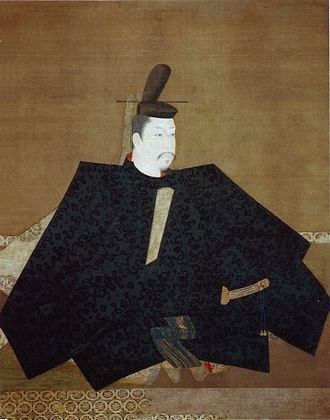
Minamoto Yoritomo