The Russian Empire in the 18th Century
Modern World8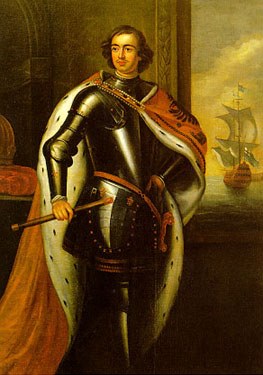
Russia arose as a world power in the 18th century due in large part to the dramatic reforms of the Russian government and society by the Czar Peter I, known as Peter the Great (r. 1682 - 1725). Russia under his direction asserted itself as major force in European affairs. His successors such as Catherine the Great (1762 - 1797) continued the policies that Peter first implemented. One of these policies was to "westernize" the governing class of Boyars, so that the Czar's ministers behaved and dressed like aristocrats and public officials in Western Europe. Peter's fascination with the ways of Western Europe may have been related to his upbringing. Peter was the youngest son of Czar Alexis. After the death of his older brother, Peter ascended the throne at the age of ten, but his half-sister Sophie actually controlled the government. Sophie mistreated her little brother, who found comfort and support among the foreign merchants from Western Europe who lived in Moscow. In 1689 Peter led a successful rebellion against his sister and forced Sophie to enter a convent as a nun. Peter once in power always maintained a strong love for the culture of Western Europe as well as shipping and trade. In 1697 he traveled throughout Western Europe to study the ways of that region, and he actually worked for several months as a shipbuilder in Amsterdam in the Dutch Netherlands.
When he returned to Russia from his travels abroad, he began to require the Boyars to dress like Western European gentleman. For example, since the fashion of Western European men was to be clean shaven, Peter demanded that the Boyars shave off their long beards. He first imposed a heavy tax on beards, so that the Boyars would shave to avoid this tax. But when many Boyars chose to pay this tax and keep their beards, Peter sent his soldiers to shave those Boyars who refused to shave off their beards. In 1697 the imperial bodyguards, the Strelzi, opposed these new measures and revolted. Peter brutally crushed this uprising, abolished the Strelzi, and personally oversaw over 1000 executions of these rebels. Over time, however the Boyars fully embraced these reforms and adopted the ways and customs of Western Europe. In fact by the mid-18th century, Russian Boyars only spoke German and French in public and regarded the speaking of Russian in public to be in poor taste.
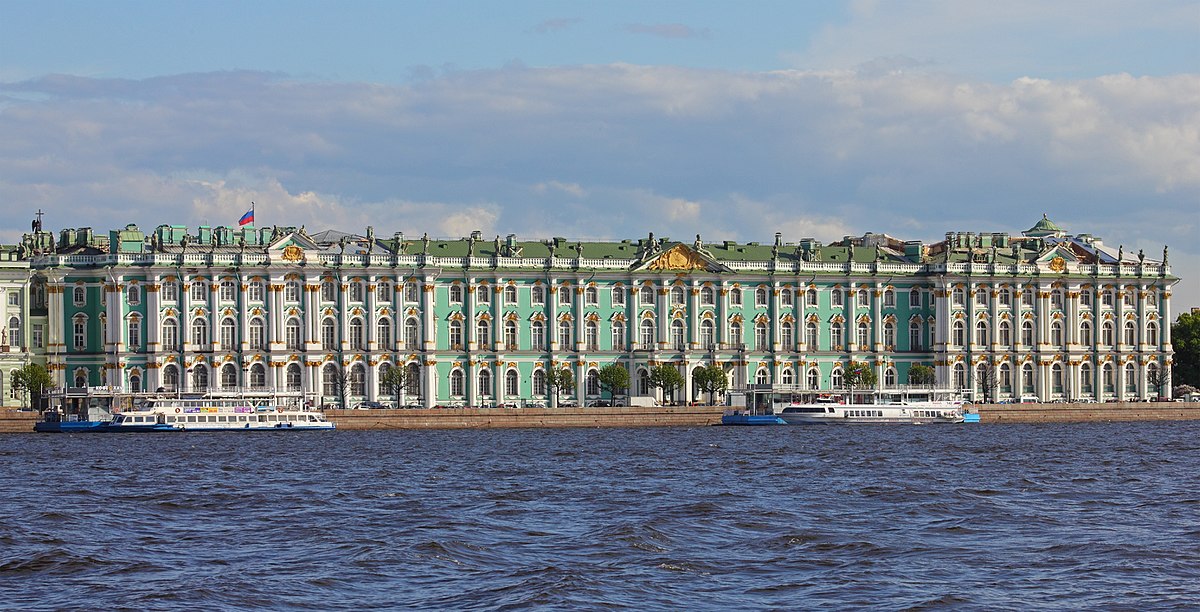
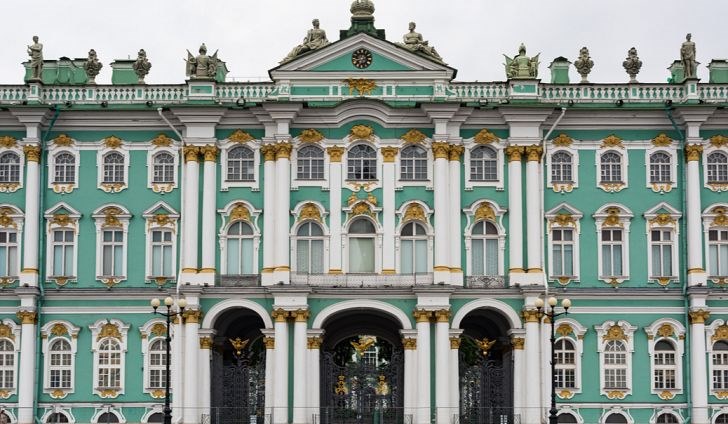
Peter I also decided that his empire needed a brand new capital that had the appearance of a city of Western Europe. Peter moved the capital from Moscow to a city that he founded and named Saint Petersburg. Peter had this city built on the Baltic Sea, so that Russia's capital was located on the sea and faced westwards toward Europe due to his love for ships and Western Europe. Peter required the Boyars to build homes in the city. and within his reign, what had been a large swamp was a city of 80,000 people.
Peter I implemented sweeping reforms to create a large and effective bureaucracy and system of taxation. He often based his reforms on ideas circulating among policy makers and intellectuals in Western Europe. To oversee his bureaucracy, Peter borrowed concepts that had been proposed by the German philosopher Gottfried Leibniz (1646 -1713). Peter divided his government into a number of departments, which he called Collegia, which each oversaw a different function of the government. Each department sent representatives to the Czar's Senate, whose purpose was to advise the Czar regarding government policies. As the Czar only Peter had the absolute authority to implement policies.
Peter also developed a merit system to determine appointments to the bureaucracy. In 1722 Peter issued the Table of Ranks. According to this Table of Ranks, appointments to government positions was based on talent and ability. This table listed the qualifications and level of education required for all major positions in the government bureaucracy. Of course only aristocratic Boyars were eligible to join this bureaucracy, but they had to earn their spot through experience and education. This Table of Ranks remained in force until the fall of the Romanov Dynasty in 1917.
Peter also needed to raise revenue through new taxes to pay for his government. He imposed a new Poll Tax on all of his subjects. First, he conducted a census to determine the population of his empire. Once he had collected this data, he could then create a government budget based on the poll tax that each of his subjects paid. Peter also paid for his government by continuing the practice of granting land to Boyars as a reward for their services. During Peter's reign, the number of enslaved serfs continued to increase. As in years past, oppressed peasants often found refuge with the Cossacks. In 1707 -1709 a Cossack warlord, Conrad Bulavin led a revolt of Cossacks and peasants, claiming that the Czar had been led astray by evil advisers. Peter crushed this revolt with his new and improved army.
Peter's efforts to reform the bureaucracy and raise new taxes served the purpose of providing the resources to expand his military and to extend his empire. Peter over his reign drafted thousands of peasants into his army, that became the largest in Europe, numbering over 250,000 troops. Peter also encouraged artisans and merchants from Western Europe to immigrate to Russia so that they could build workshops and shipyards in Russia and supply the Russian military with guns, cannon, and ships. Peter was also quite innovative in his military tactics. He introduced mobile units of artillery pulled by horses, so that he could deploy cannons quickly on the battlefield. He also introduced the bayonet to his infantry, so that a gun could double as a spear in hand to hand combat.
Peter's goals to expand his empire were focused on obtaining control of lands along a coast, so that his empire, that bordered the Arctic Ocean, had access to a warm water port. Peter desired to expand south towards the Black Sea and west towards the Baltic Sea. These coasts were under the control of the Ottoman Empire and Sweden, so Peter went to war against these two powers. In 1695 Peter formed a military alliance with the Austrian Hapsburg Empire since both empires faced a common enemy in the Ottoman Empire. This Hapsburg - Romanov alliance remained in effect until the 19th century.
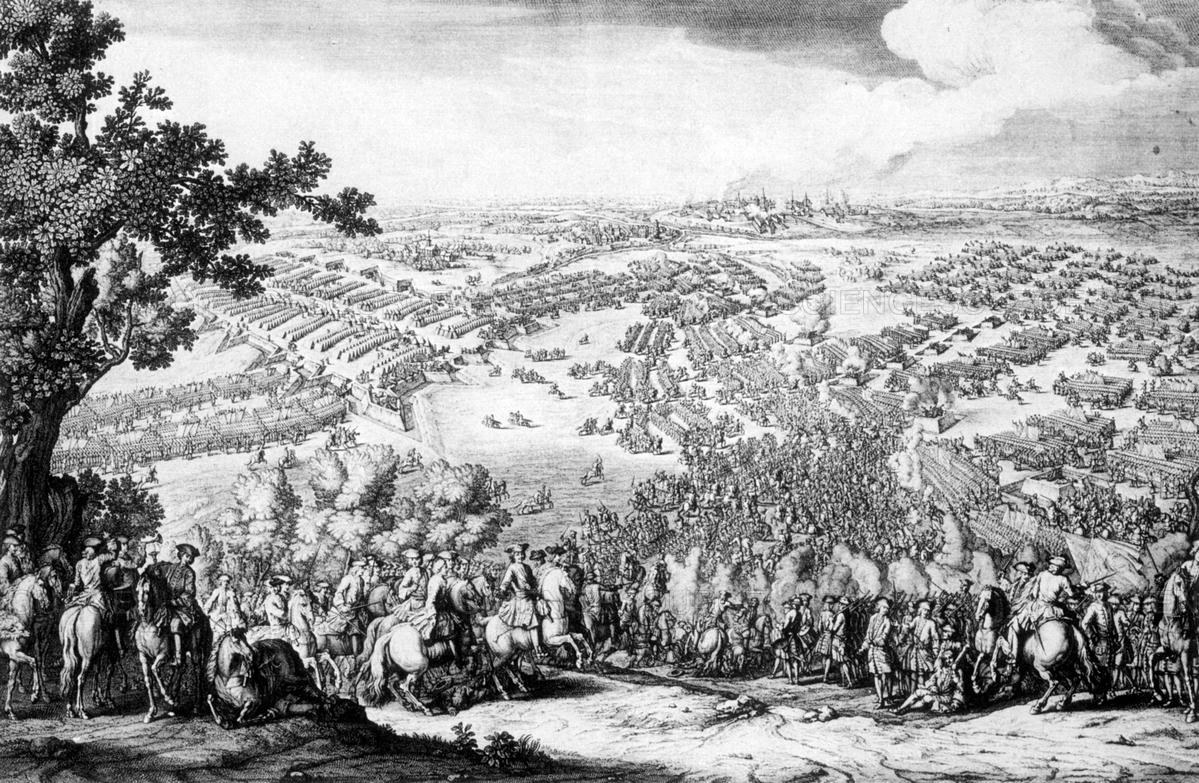
Peter also engaged in a long war with Sweden known as the Great Northern War (1700 - 1721). In 1700 Peter's forces advanced toward the Baltic Sea, but the Swedish king, Charles XII led the Swedes to victory over the Russian army at the Battle of Narva in modern Estonia. Charles XII subsequently moved against Frederick Augustus of Poland, who was allied to Peter. In 1704 Charles XII pressured the Polish Sejm into deposing Frederick Augustus as king and replacing him with a prominent Polish nobleman, Stanislaw Leszcynsky, as king of Poland. Charles XII also formed a military alliance with the Ottoman Empire against Peter. In 1709 Charles XII invaded the Russian Empire and led his army into the Ukraine. At the Battle of Poltava Peter's forces won a stunning victory over the Swedes and effectively turned the tide of the war in favor of Russia. Peter's army in 1709 then restored Frederick Augustus, as king of Poland, who was now a puppet of the Russian state. By 1721, Peter had amassed a large army in Denmark, a Russian ally, and planned to use Denmark as a base to launch an invasion of Sweden. Consequently Sweden asked for a peace agreement, and signed the Peace of Nystad, by whose terms Sweden ceded the contested territories along the Baltic Sea (modern Estonia and Latvia) to Russia. Peter's victory in the Great Northern War established Russia as one of the great European powers.
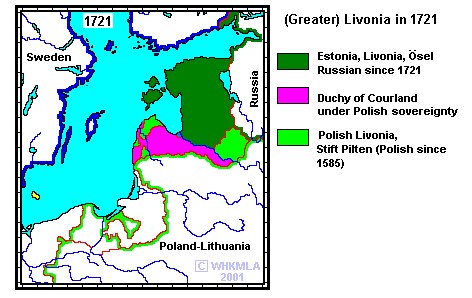
Peace of Nystad
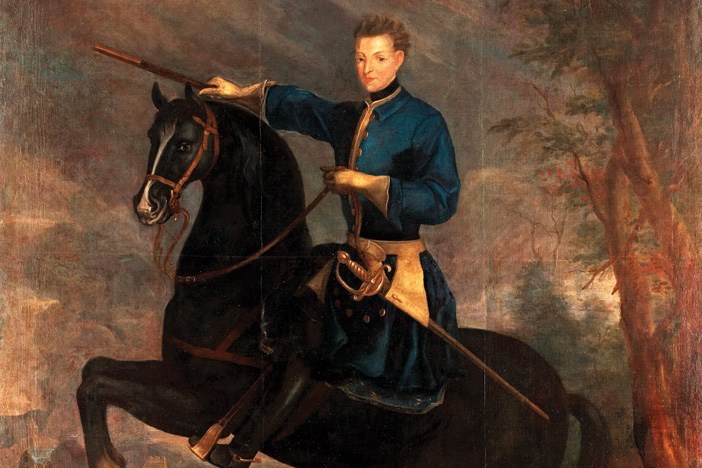
Charles XII of Sweden
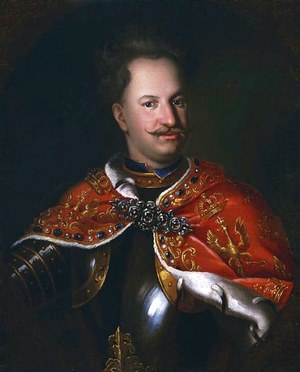
Stanislaw Leszcynsky
The immediate successors of Peter I lacked his charisma and strength of will, but the bureaucracy that Peter had built and fostered continued to provide the Russian Empire with stability. In the absence of a strong monarch, the Boyars in the Senate oversaw the operation of the government. Peter's only son Alexis, who had opposed his father's reforms and had sought to overthrow him, died in prison in 1718. Peter was therefore succeeded in 1725 by his wife, Catherine I, who was born a Polish peasant. After her death in 1727, Peter II, the son of Peter's son, Alexis, and only a boy, inherited the throne, but he died of illness in 1730. The next two rulers were Peter's niece, Anne (r. 1730 - 1740) and his daughter, Elizabeth (1740 - 1762), who devoted much of their time as rulers to throwing parties and expanding their wardrobes.
Between 1725 and 1762, the Boyars in the bureaucracy, however maintained the domestic and foreign policies that Peter the Great had established. Over this period Russia remained strong allies of the Austrian Hapsburg Dynasty during the wars that shook Europe at this time. During the War of Polish Succession (1735 -1737), Russia and Austria supported Frederick Augustus II, the son of Frederick Augustus I, as king of Poland, but France supported the election of former Polish king, Stanislaw Leszcynsky as king. In the end, Russian forces secured the throne for Frederick Augustus II. In 1740, Russia stood by the Hapsburg ruler, Maria Theresa, when France and Prussia went to war against Austria in the War of Austrian Succession (1740 -1748). In 1756 Russia joined Austria and France in waging war against Prussia in the Seven Years War (1756 -1763).
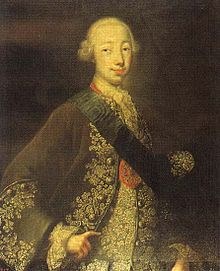
In this last war, Russian forces in 1762 were poised within Prussia to strike a decisive blow to the forces of the Prussian king, Frederick II, when the Russian empress, Elizabeth, died, and the throne passed to her nephew, Peter III. Anna, the daughter of Peter the Great had married Charles Frederick of Schleswig-Holstein-Gottorp, the duke of a small principality of the Holy Roman Empire in northern Germany. Peter III was their son. Peter III had grown up in Germany and strongly admired the Prussian king, Frederick II. When Peter III assumed the throne in 1762, he immediately withdrew Russia from the Seven Years War due to his respect for Frederick II. The sudden withdrawal of Russia from the Seven Years War ultimately enabled Frederick II to survive and win this conflict in 1763.
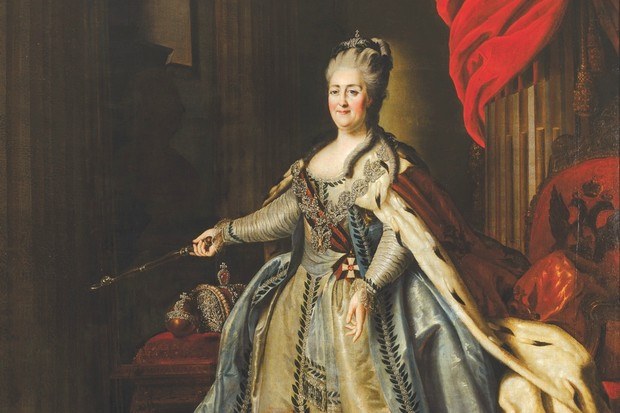
When Peter III came to the Russian throne in 1762, he arrived in Russia with his wife, Catherine, who was a German princess from the principality of Anhalt- Zerbst in the Holy Roman Empire. Her marriage to Peter had been arranged by Peter's aunt, the Empress Elizabeth, when the couple were only children. Catherine and Peter hated one another. In 1762, Catherine successfully imprisoned and murdered Peter III with the aid of a Russian military officer, Gregory Orlov, with whom Catherine was having an affair. After seizing power, Catherine declared herself to be regent for her son Paul, who was just a boy. However, even when Paul reached adulthood, Catherine continued to hold on to power.
Catherine was a great patron of the arts and sciences, and intellectuals such as the French philosopher Voltaire, expressed their admiration for Catherine in this Age of Enlightenment. In 1767, she created a Legislative Commission to codify and rationalize Russian laws. Catherine also granted rights to the Boyars, so that they possessed title to their lands and could not be subjected to torture or cruel and unusual punishment. Catherine also encouraged the Boyars to invest in industry to promote Russia's economic development.
Catherine's generosity to the elite Boyars didn't extend to the mass of peasants in her empire. Just like her predecessors, she granted land to Boyars as well as authority over the serfs to work this land, to reward Boyars for their services. During her reign an estimated one million free peasants were enslaved and became serfs. In 1773 a Cossack warlord, Yemelyan Pugachev, claimed to be the "true" Czar, Peter III, and led a massive uprising of peasants and Cossacks, promising to end the oppression of the peasants. However Catherine's armies crushed this uprising, and Pugachev was captured and executed in 1774.
Catherine also pursued the foreign policy goals of Peter the Great. Russian armies sought to dominate the Baltic Sea to the west and the Black Sea to the south, while maintaining an alliance with the Austrian Hapsburg Dynasty. In the west in 1764 Catherine arranged for a prominent Polish nobleman, Stanislaw Poniatowski to become elected by the Sejm as the king of Poland, following the death of Frederick Augustus II in 1763. Catherine and Stanislaw were lovers, and Catherine hoped that Stanislaw would show his gratitude for his election by subservience to Russia. Stanislaw, however, desired Poland to be fully independent, and he refused to follow Catherine's wishes. Consequently, Catherine negotiated with Poland's other neighbors, Austria and Prussia, and together in a series of agreements in 1772, 1793, and 1795, these three states partitioned Poland among themselves, so that by 1795 , Poland no longer existed. Russia annexed the largest portion of the former Polish Kingdom.
Catherine also went to war against the Ottoman Empire. Between 1787 and 1792 Russia secured control of regions surrounding the the Black Sea. As a result of this war, Russia expanded into the Caucasus, which was the territory between the Black Sea and the Caspian Sea, and annexed the lands of Circassia, Georgia, Ossetia, Chechnya, and Dagestan, which all had formerly been subject to the Ottoman Empire. The population of much of these territories was Muslim and resented Russian domination. To cement Russian control of the region just to the north of the Black Sea in the Ukraine, Catherine settled Germans and Greek exiles in this region. Catherine had encouraged the Greeks, who were also Orthodox Christians, to rise up against the Ottoman Empire, and she settled the Greeks, who had participated in these revolts, in the Ukraine when the Ottoman Empire crushed these uprisings. The region of the Ukraine where these colonists settled became known as "New Russia".
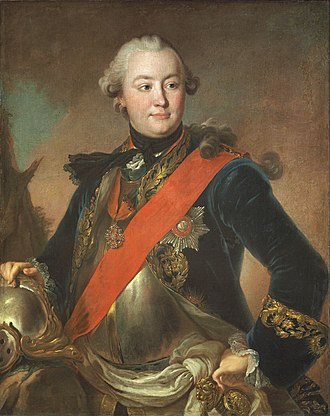
Gregory Orlov
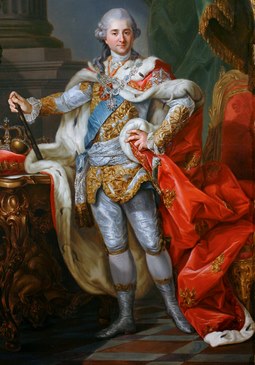
Stanislaw Poniatowski
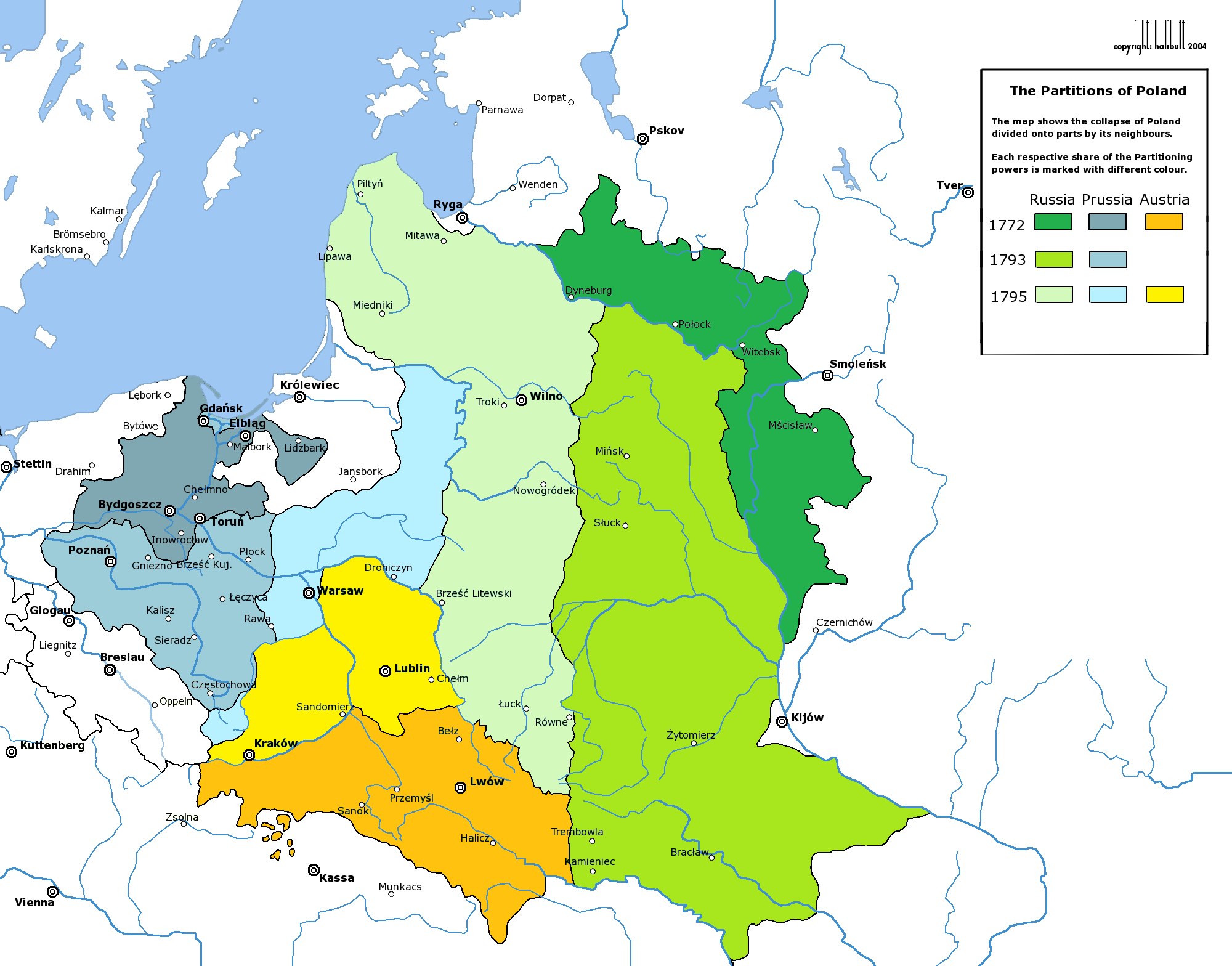
Partition of Poland
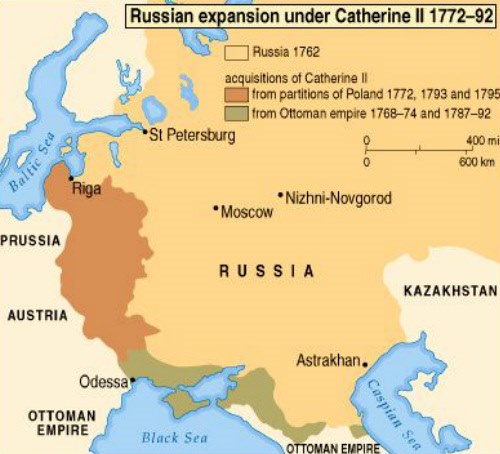
Expansion under Catherine the Great
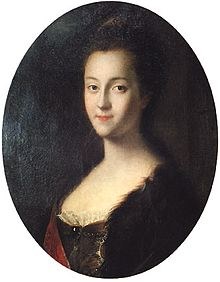
Young Catherine the Great
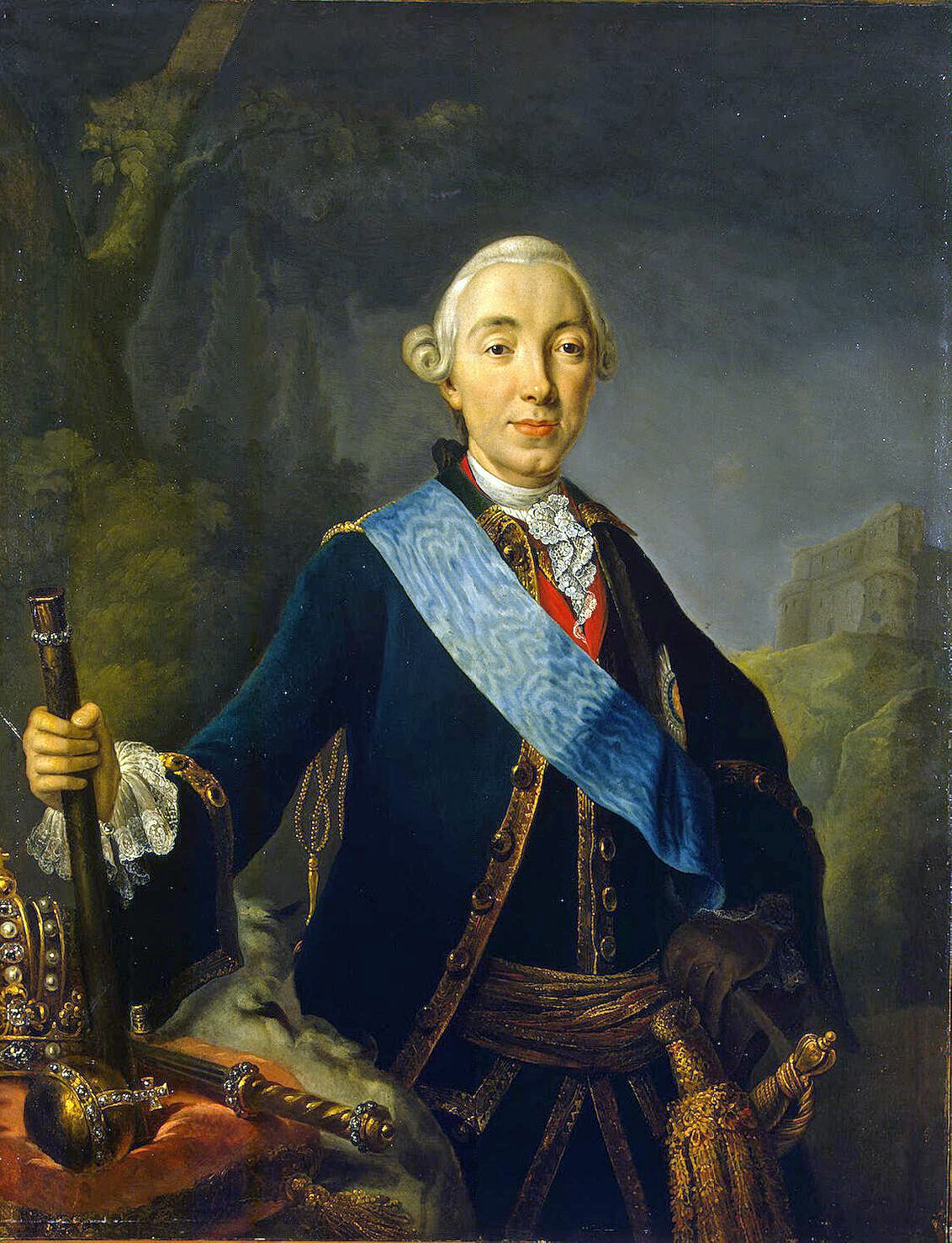
Peter III