World War II
Modern World24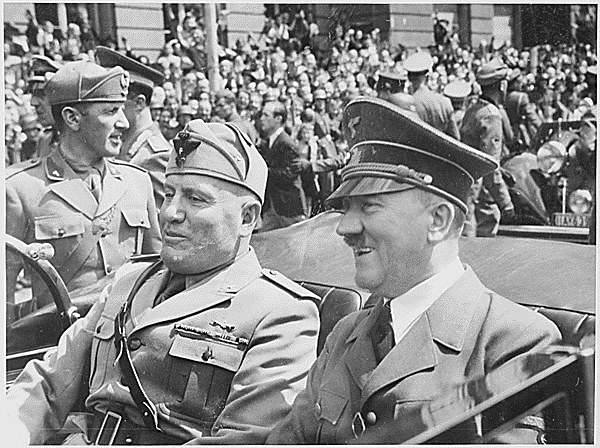
The carnage of the Great War, disillusionment and resentment over the Versailles Treaty, and the hardships resulting from the Great Depression planted seeds of doubt regarding the current political and economic systems, Liberalism and Capitalism. This skepticism eventually sprung up and emerged as support for alternative political and economic systems, which were based on the principle of Totalitarianism. Whereas Liberalism and Capitalism focused on the liberty and freedom of the individual as a citizen and owner of private property and saw government as a means to protect individual rights, Totalitarianism maintained that only the government possessed liberty and freedom, whose citizens collectively must submit their own will and resources in their totality to the good of the state. The spirit of Totalitarianism emerged from the battlefields of the Great War, where soldiers were expected to sacrifice their lives for the good of their military unit and their country. In the decades after World War I in the 1920's and 1930's Totalitarian governments emerged in the Soviet Union, Fascist Italy, Nazi Germany, and in Imperial Japan. These regimes in Germany, Italy, and Japan started World War II since these states saw war as the way for their countries to achieve greatness and world domination. Following World War II, the Soviet Union waged an ongoing struggle against its perceived enemies in the Cold War.
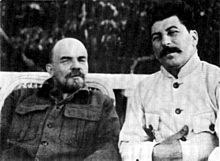
Under the leadership of the Communist dictators, Lenin and Joseph Stalin, the Soviet Union emerged as a Totalitarian state, whose citizens were expected to sacrifice everything for the Communist cause and world revolution. In 1918 the new Bolshevik (Communist) controlled state and its Red Army faced a revolt by the Whites, whose ranks included Socialist Mensheviks, Liberals, and Conservatives, who had supported the former government of the Czar. Even though the White armies received some limited military aid from the United States and the United Kingdom, the Communists enjoyed certain advantages that would enable them to win this Russian Civil War (1918-1920). Since the Whites included people associated with the former government of the Czar, many Russians therefore supported the Red Communists in this war. Moreover many non-Russians (i.e. Georgians, Armenians, Ukrainians) of the former Russian Empire feared that a victory for the Whites would restore their former subordination to the Russians, whereas Lenin and the Bolsheviks promised self-government and autonomy to these peoples as long as they remained loyal to the Communist Party. The Communists also were united under the leadership of Lenin, whereas the Whites were divided in their loyalties and included people with different and even conflicting ideologies. In this war, Lenin was inspired by the French Revolution and the "Reign of Terror", and he therefore sought to terrify and intimidate his opponents through brutal, violent tactics. In 1918 Lenin created the Cheka, a secret police force, to terrorize the enemies of the party. The Cheka also kidnapped the families of prominent Russian generals and held them hostage, so that these generals would fight for the Red Army.
By 1920, the Communist Party and Red Army had crushed the forces of the Whites and successfully repelled invasions from Poland and Finland. The Communists were now in a position to consolidate their position and control over the former Russian Empire. In 1920 - 1921, The Red Army and the Cheka crushed revolts by peasants and Cossacks, who were still loyal to the Czars and the Orthodox faith and opposed the Communists' atheistic regime. Thousands of peasants and Cossacks were killed or sent to labor camps in Siberia (The previous regime of the Czars had sent political opponents to such labor camps too.). Lenin however, didn't rely on repression alone to secure power. In 1921, Lenin and the Communist Party announced the New Economic Policy. In the wake of the revolution, the Bolsheviks had seized and broken up the landed estates of the aristocracy and distributed these lands to the peasants. Now under this new policy, peasants were free to sell their crops from their own private farms and purchase goods at local village markets. This new policy was very popular among the peasants, who were still a majority of the population. Consequently, peasants came to revere Lenin. In 1923 Lenin came through with his promises during the civil war to non-Russians to grant them self-government. The Communist Party drafted a new constitution that created the Union of Soviet Socialist Republics (USSR) or simply the Soviet Union. Under this constitution, ethnic groups of the former Russian Empire were organized into their own separate republics. In these republics though, only Communist Party members could hold public office, and the leaders of the local Communist Party chose the candidates who ran for these offices in elections.
Following the death of Lenin in 1924, a power struggle developed for the leadership of the Communist Party. Leon Trotsky maintained that the Soviet Union should focus on promoting class struggle and revolution world wide, whereas Joseph Stalin argued that the Soviet Union first must rapidly industrialize and model for the world the economic benefits of Marxist-Leninist Socialism. In this struggle, Stalin, a native of Georgia in the Caucasus, used his position as secretary of the Communist Party to win support and loyalty from local party leaders from the different Soviet republics. By 1928, Stalin had consolidated his position as leader of the Communist Party, and Trotsky went into exile to Mexico, where Stalin in 1940 sent assassins to murder him.
In 1929 the Soviet Union began the first of a series of Five Year Plans which were designed to industrialize rapidly the Soviet Union. Under this plan, all economic enterprises such as farms, mines, and factories, were state owned and operated. In this command economy, the Communist state set production quotas for all state enterprises as well as the prices which these enterprises and consumers paid for goods. By the end of the first Five Year plan in 1934, industrial output in the Soviet Union had exceeded Russia's output prior to World War I even though 20% of Russia's industrial resources has been lost in the 1918 Treaty of Brest-Litovsk. Newspapers around the world, including the New York Times, hailed this achievement and contrasted the high unemployment rate in Capitalist countries during the Great Depression with the full employment enjoyed by the citizens of the Soviet Union. This dramatic growth, however, came at a high cost. The Five Year Plan included the Collectivization of all farms. The state forced all peasants to surrender their private farms and join agricultural collectives, which were owned and operated by the state. The Communists designed this policy to modernize and mechanize agriculture, boost agricultural production, and transfer much of the peasant population to the cities to work in state run factories. Peasants, however, especially in the Ukraine, were often unwilling to surrender their private farms. The Cheka, consequently, arrested thousands of peasants and sent them to labor camps in Siberia. The Communist Party labeled these peasants "Kulaks", who were depicted in state propaganda as dangerous "counter-revolutionaries" and "terrorists". In the 1930's a famine struck the Ukraine and as many as 15 million people may have died. Historians still debate whether this famine was an unfortunate result of the Collectivization policy or a deliberate effort by the Communist state to punish the Ukraine for the resistance of its population to Soviet policy.
Beginning in 1935, Stalin began "purging" the Communist Party by eliminating any opposition to his leadership, whether real or merely imagined. In 1934 an unknown assassin murdered a young rising leader of the party. "comrade" Sergei Kirov. Stalin and the Communist party blamed this assassination on dangerous enemies of the people and party. Between 1935 and 1938 during this "Great Purge" the Cheka arrested these suspected enemies, who were described in state propaganda as "terrorists", "Fascists", and "Trotskyists". The Communist Party conducted "show trials" where these suspects confessed to horrible crimes and were promptly executed. These suspects may have confessed to such crimes to spare friends and loved ones from being arrested and executed. The Communist state publicized these show trials, which created an environment of fear and mass hysteria. The Communist Party encouraged the population to revere Stalin as the "Great Leader" who alone could save the Soviet Union and the revolution in this time of crisis. Historians estimate that the Communist state may have executed as many as two million people during this Great Purge. However, the execution of many officers in the Red Army during this purge damaged the morale and effectiveness of this army, which suffered a series of military disasters against the German army during World War II.
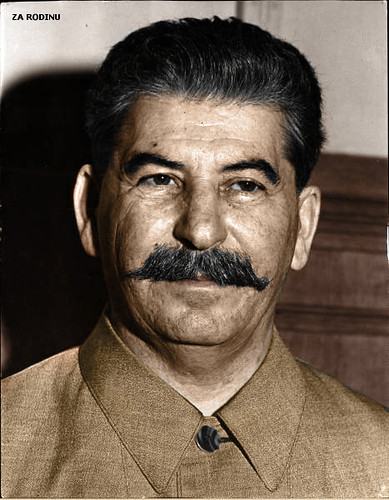
Joseph Stalin
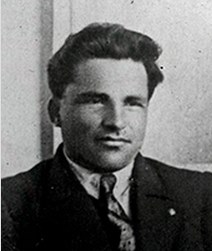
Sergei Kirov
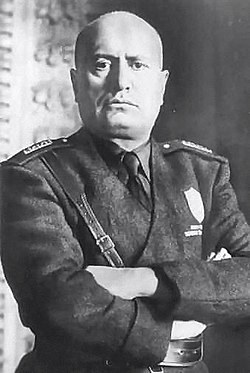
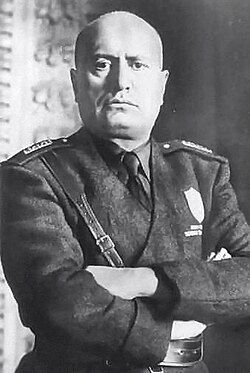
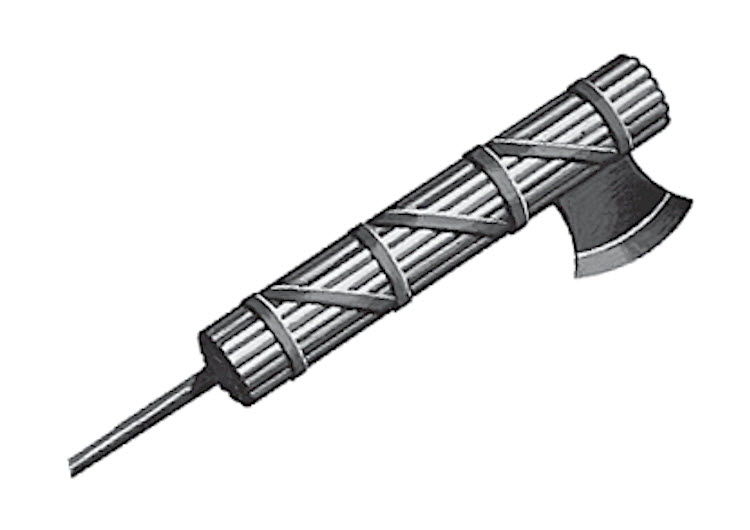
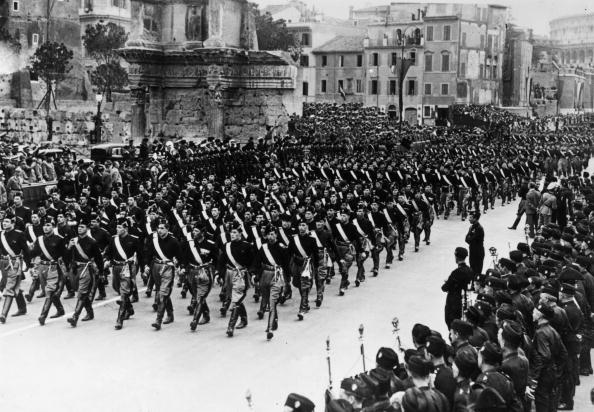
In the 1920's and 1930's Italy and Germany developed their own versions of a Totalitarian state, which is known as Fascism. Benito Mussolini (1883-1945), prior to World War I, was an Italian Socialist, but after he served as a soldier in World War I, Mussolini became an ardent nationalist, who believed that the Liberal democracies, France and the United Kingdom, had denied Italy its rightful "place in the sun" as a great world power. In 1919, Communists flooded the streets in Italian cities, hoping to start a Communist Revolution. In that same year, Mussolini founded the Fascist Party to oppose the Communists. The goal of this party was to glorify the Italian people and state. The party took its name from the "Fasces", which were the ancient symbol of the Roman state, whose empire Mussolini hoped to recreate. In 1919, many middle class Italians supported the new Fascist Party out of fear of the Communists. Conservative Roman Catholics in Italy also supported this party since they opposed the militant atheism of the Communists. Mussolini created his own private paramilitary organization known as the "Black Shirts" due to their distinctive clothing. These Black Shirts waged street battles with Communists and other political opponents of the party. Mussolini also cultivated his own personality cult, so that his party followers would revere and idolize him as the Duce (Leader). In 1922, Mussolini mobilized a massive "March on Rome" in which the Black Shirts and Fascists descended on the capital, Rome in mass and demanded that King Victor Emmanuel III immediately appoint Mussolini Prime Minister of Italy. The frightened and intimidated Italian king consented and Mussolini assumed this position. By 1925, Mussolini had used his control of the army and police to arrest or exile his political opponents and had created a one party state, where only loyal Fascist Party members could hold public office.
The Italian Fascist state allowed its citizens to own private property, and small businesses still operated freely. Large industries, however, were under state supervision. Mussolini portrayed himself as the champion of workers and peasants.Mussolini's government organized workers into state-sanctioned unions which negotiated with large employers to raise wages and provide workers with benefits such as paid vacations. These businesses often supported the Fascist regime simply because it was preferable to Communism, which didn't allow for private enterprise at all. The Fascist government also through massive public works programs drained swamps and constructed irrigation canals to provide landless peasants with their own farms on state lands. With the onset of the Great Depression after 1929, the Fascist state had already set up a "safety net" for the working class, so that the impact of this economic crisis was less severe here than in Capitalist states.
Mussolini envisioned a state where class conflict had disappeared as Italians all joined together as one. According to Mussolini, victory in war was the highest expression of national unity and purpose. In 1935, Italian forces invaded and occupied the African nation of Ethiopia to avenge Italy's humiliating defeat at the Battle of Adowa in 1896. During the Spanish Civil War, Italy provided Franco's armies with arms and supplies in Franco's conflict with the Popular Front. In 1939, Italian forces invaded and annexed Albania, which had been promised to Italy, but never bestowed by France and the United Kingdom in the secret 1915 London Treaty.
Over in Germany Adolph Hitler (1889-1945), modeled his own early political career on that of the Duce. Hitler was Austrian and born and raised in the Austro-Hungarian Empire. He moved to Germany just prior to the outbreak of World War I and, like Mussolini, served as a soldier in World War I. After the war in 1919, Hitler joined the National Socialist German Workers Party or simply the Nazi Party and quickly became its leader. Hitler organized his own private paramilitary force, the Sturmabteilung (SA), who were also known as the "Brown Shirts" because of their uniforms. Hitler also cultivated his own personality cult, so that his followers revered and idolized him as the Fuhrer ("Leader"). Hitler's Brown Shirts engaged in street battles with Communists and other political opponents. The Nazi Party drew support from many Germans, who opposed the Communists and the new Weimar Republic. In 1923, Hitler decided to follow Mussolini's example and mobilize his followers in Munich into a mass movement to overthrow the Weimar Republic. This Munich Putsch, however ended in failure and Hitler's arrest on the charge of treason. Hitler used his trial in 1924 as a platform to broadcast his views on a national stage. Afterwards, Hitler used his five months in prison to write his manifesto, Mein Kampf (My Struggle). In this book, Hitler outlined his vision for German domination of the world. According to Hitler, the Germans were the superior Aryan race, who historically had been victimized by racially inferior peoples and especially by Jews, whom Hitler viewed an inherently evil. Hitler maintained that Germany under the leadership of the Nazi Party could achieve its destiny and overcome its enemies. Hitler's ideas were not that original. In his native Austria in the days of the Austro-Hungarian Empire, many Germans in Austria had viewed the Jewish and Slavic populations in the empire as inferior races.
Hitler's Nazi Party remained a small political party as long as the German economy was prospering in the late 1920's. With the onset of the Great Depression after 1929, this economic crisis provoked fears once again of Communist revolution and dissatisfaction with Weimar Republic. Consequently, the popularity of the Nazi Party skyrocketed. By 1932, the Nazi Party was the second largest party in the German Parliament (Reichstag) after the Social Democratic Party. In 1933, the Nazi Party formed an alliance with Conservative, aristocratic members of the Reichstag, who supported the German army. This alliance enabled Hitler to have a sufficient number of votes in Parliament to serve as Chancellor (Prime Minister), and the German president, the war hero, Paul Hindenburg, appointed Hitler Chancellor. Shortly thereafter, the Reichstag building burned down. Hitler claimed that Communists were responsible for this fire and declared a state of emergency. By arresting and intimidating his political opponents while possessing emergency powers, Hitler was able to secure enough votes in the Reichstag to pass an Enabling Act, which authorized Hitler as Chancellor to rule by decree. After Hindenburg's death in 1934, Hitler combined the office of Chancellor and President into one office, the Fuhrer, with himself in that position. In 1934, Hitler also won the strong support of the German army with his plans for its expansion. Since the German army feared the Brown Shirts as potential rivals, Hitler abolished the SA and ordered the arrest and execution of its leaders in the so-called "Night of the Long Knives". Germany became a one party state where only loyal members of the Nazi Party held any public office and positions in government.
Nazi Germany, like Fascist Italy, allowed for its citizens to own private property, and small businesses were free to operate.Large industries were subject to state supervision. German industrialists nonetheless preferred the Nazi regime to rule by Communists. Like Mussolini, Hitler claimed to be the champion of the German Volk ("people"), and workers and peasants especially. Hitler had long admired the American industrialist, Henry Ford, and he promised the German people that every German citizen would be able to afford their own car. Hitler even had designed a special people's car or Volkswagen (the famous Volkswagen "Beetle"). Nazi Germany also constructed freeways (autobahn) to link the country together. Under Nazi rule, the German economy did experience a rapid economic recovery, which served to increase the popularity of the Nazi Party among the German people. This economic recovery resulted from German government's spending to expand the German military in defiance of the Versailles Treaty. In 1936, the Nazi regime announced its Four Year Plan to expand rapidly the German army, air force, and navy. This plan created millions of new jobs in German factories, building planes, ships, tanks, guns, and artillery. The Nazi regime also stimulated the economy by negotiating free trade agreements with the military dictators of eastern European states including Hungary, Bulgaria, and Romania. All these states became allies of Nazi Germany during World War II.
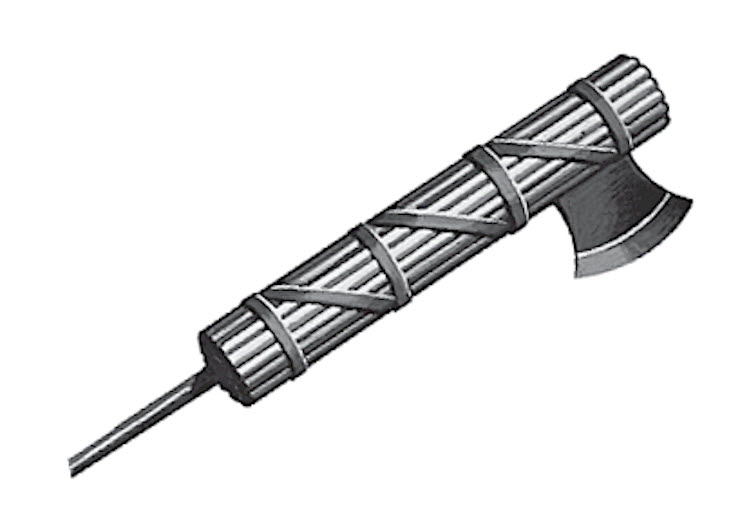
Fasces
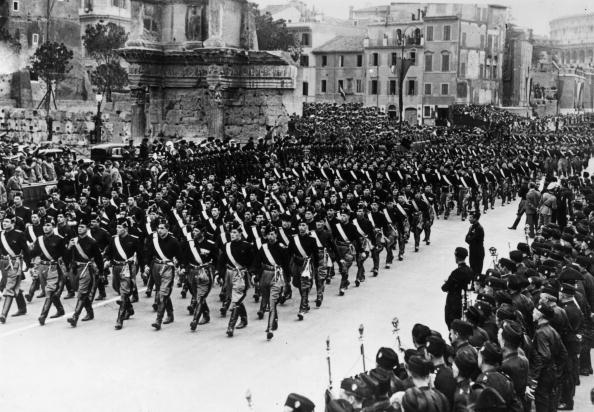
"Black Shirts"
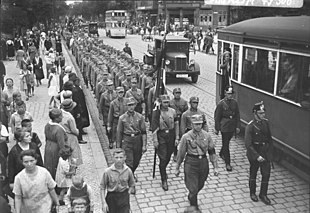
"Brown Shirts"
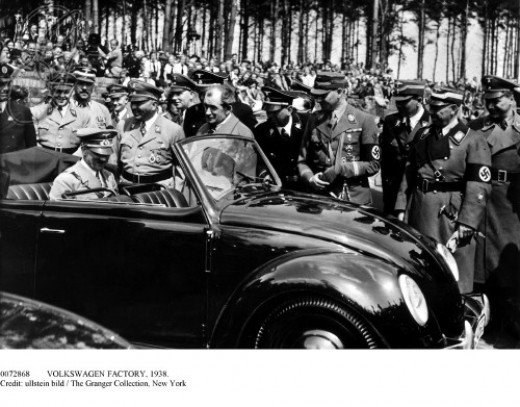
Hitler and the Volkswagen "Beetle"
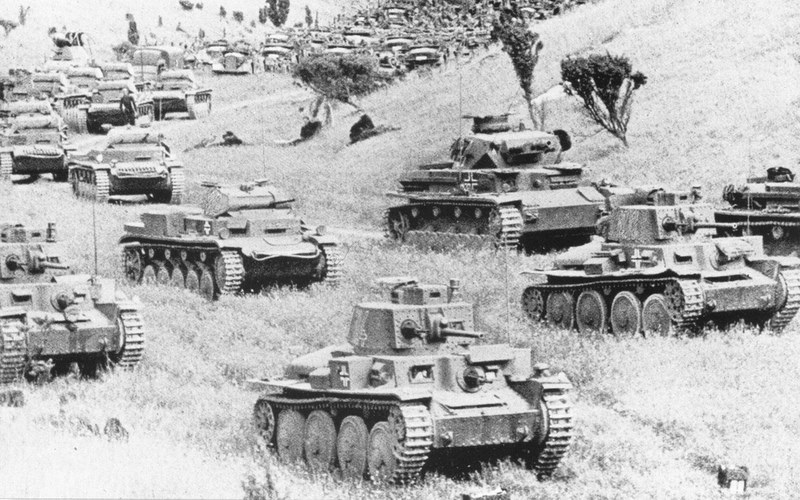
Once in power in Germany, Hitler's Nazi Party sought to achieve Hitler's vision to annul the Versailles Treaty and to establish Germany as the dominant European nation. Hitler's actions to obtain this goal resulted in the outbreak of war in Europe in 1939. In 1936, German troops occupied the Rhineland in open defiance of Versailles Treaty. Germany also joined Italy in providing arms and supplies to Franco's forces during the Spanish Civil War (1936 - 1939), while the Soviet Union provided weapons for the Popular Front. In 1938, in another violation of the Versailles Treaty, German forces occupied Austria and annexed the country in the Anschluss ("union"), as Hitler announced his intention to unite all Germans under a single state. Next, Hitler announced his plan to annex the Sudentenland, which was a territory in western Czechoslovakia with a large German population. Since both France and the United Kingdom had military alliances with Czechoslovakia, such a move by Germany was opposed by these countries. The Prime Minister of the United Kingdom, Neville Chamberlain, hoped to avert a war by appeasing Hitler and allowing Germany to annex the Sudentenland. At the Munich Conference in 1938, France and the United Kingdom betrayed their ally, Czechoslovakia, and agreed to approve this annexation. Chamberlain's Appeasement Policy didn't stop Hitler's aggressive moves. In early 1939, German forces occupied all of Czechoslovakia. Next, Hitler announced his plan to annex all of East Prussia in Poland, as this region also possessed a large German population. Hitler, however, realized that a German invasion of Poland would lead to war against France and the United Kingdom since these countries were both allies of Poland. Since Hitler wanted to avoid a two-front war, which had proven to be a problem for Germany during World War I, Hitler reached out to Stalin and the Soviet Union and agreed to a Non-Aggression Pact between Germany and the Soviet Union. Under this agreement, these two countries agreed to partition Poland and occupy separate halves of that country. Stalin saw this agreement as a way to buy time to prepare the Soviet Union for a future war against Nazi Germany. After reaching this deal, German forces invaded Poland on September 1, 1939. France and the United Kingdom declared war on Germany in response, and World War II had begun.
German forces successfully conquered Poland within six weeks. The German invasion was the world's first demonstration of the German Blitzkrieg ("Lightning War"). This new method of warfare involved rapid troop movements, employing tanks and trucks, along with coordinated air strikes, to outflank, surround, and pulverize opposing armies. In 1940, German forces employed this same tactic to occupy Norway and Denmark as well as invade the Netherlands, Belgium, and France. In June, 1940, France agreed to an armistice. France's humiliating and swift defeat in this war resulted in the collapse of the Third Republic. German forces, afterwards continued to occupy northern France. In southern France, the Germans set up a Fascist regime, Vichy France, as a German "puppet state". In the summer of 1940, the German air force, the Luftwaffe, launched massive attacks on the United Kingdom and began the Battle of Britain (1940-1941), during which the United Kingdom stood alone in the struggle against Nazi Germany. The Luftwaffe was unsuccessful in its effort to bomb the British people into submission. The planes of the Royal Air Force (RAF) proved superior the Luftwaffe' planes. Moreover, British forces employed recently invented radar (invented in 1935) to locate and target incoming German planes.
The year 1940 also witnessed the expansion of the war to new fronts. In June, 1940 Italy entered the war as an ally of Germany. Italian forces afterwards invaded Egypt from Libya and Greece from Albania to accomplish Mussolini's dream of recreating ancient Rome's Mediterranean empire. Both campaigns ended in failure for Italian forces. Consequently, in 1941 Hitler dispatched German forces to Libya, the famed Afrika Korps under the command of the German general Erwin Rommel, to support his Italian ally. In 1941, German forces also invaded and occupied Yugoslavia and Greece to provide support for Italy's failed war effort.
In 1941, Hitler also made the fateful decision to launch an invasion of the Soviet Union. In Mein Kampf Hitler made clear his contempt for Slavic peoples and his dream to exterminate these races and convert eastern Europe into lebensraum ("living space") for the German race. Hitler therefore planned to attack the Soviet Union at some point, but his decision to attack in 1941 resulted from his overconfidence that the defeat of the United Kingdom was imminent and from recent aggressive moves by Stalin. In 1939, Soviet forces invaded Finland and forced Finland to cede territory in 1940. Soviet forces also occupied the Baltic countries, Estonia, Lithuania, and Latvia in 1940. In 1940 Soviet forces occupied Bessarabia, which was a region belonging to Romania. In June, 1941, Germany invaded the Soviet Union and quickly occupied much of the western half of the country. The demoralized troops of the Soviet Red Army initially surrendered in mass to German armies, but the Russian forces stiffened their resistance when it became clear that German forces were executing Russian prisoners of war and allowing them to starve. In December, 1941, the German offensive stalled, as a cold and severe winter season slowed the German advance. The Russian armies also destroyed supplies as they retreated, a strategy that had worked well against Napoleon's army in 1812. As the German armies advanced farther eastwards, their supply lines therefore became longer and less secure. German forces were thus not able to capture Moscow, the Russian capital.
In December, 1941, Hitler also decided to declare war against the United States after hearing about the Japanese attack on Pearl Harbor, the American naval base in Hawaii. By Hitler's calculations, the war between Japan and the United States would make it difficult for the United States to devote much resources to the war in Europe. A war against the United States would allow German submarines to target American ships providing supplies to the United Kingdom. When war broke out in Europe in 1939, Isolationist sentiment in the United States was still strong , and the United States declared its neutrality. Due to the swift victory of German forces over France in 1940 and the brutal bombing of British civilians during the Battle of Britain, American public opinion became increasing supportive of the United Kingdom. In early 1941, the US Congress approved the Lend-Lease Act, which authorized the American president, Franklin Roosevelt to provide the United Kingdom with military supplies. Hitler hoped that his war declaration against the US would enable Germany to cut off the United Kingdom from support from the United States.
The entry of the United States in the war in 1941 along with the failure of Germany's invasion of the Soviet Union marked the beginning of the end of Nazi Germany. The combined resources of the United States, the Soviet Union, and the United Kingdom would prove too much for the Nazi regime. Hitler's Germany by the end of 1941 would not have imagined that Germany would suffer utter defeat in 1945. At the beginning of 1942, German forces occupied almost all of Europe. In 1942, The triumphant Nazi regime was busy executing its plans to exterminate the Jewish race in an historic event known as the Holocaust. Jews from across German occupied Europe were rounded up and transported by railroad in cattle cars to designated ghettos in Poland. From these ghettos, special German military units, the Schutzstaffel (SS), dispatched these Jews to concentration camps where Jews worked as slaves and were methodically executed in gas chambers. The Nazi regime continued this deadly business even as German armies were in retreat in 1944-45. An estimated six million Jews died in the Holocaust.
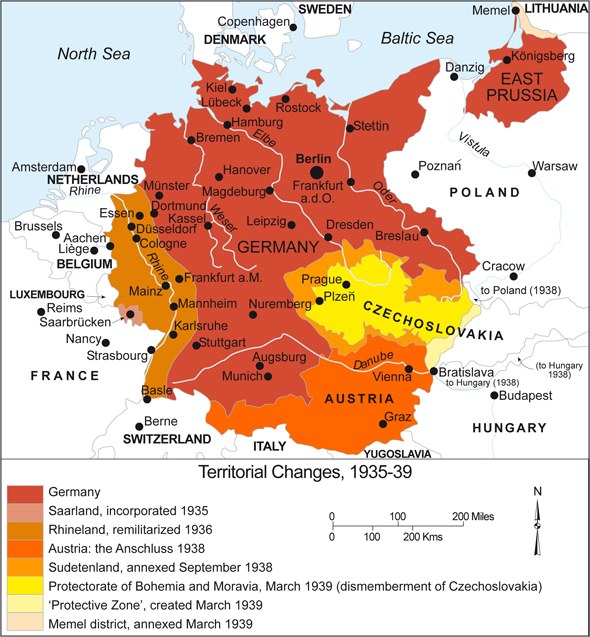
German Expansion, 1936 -1939
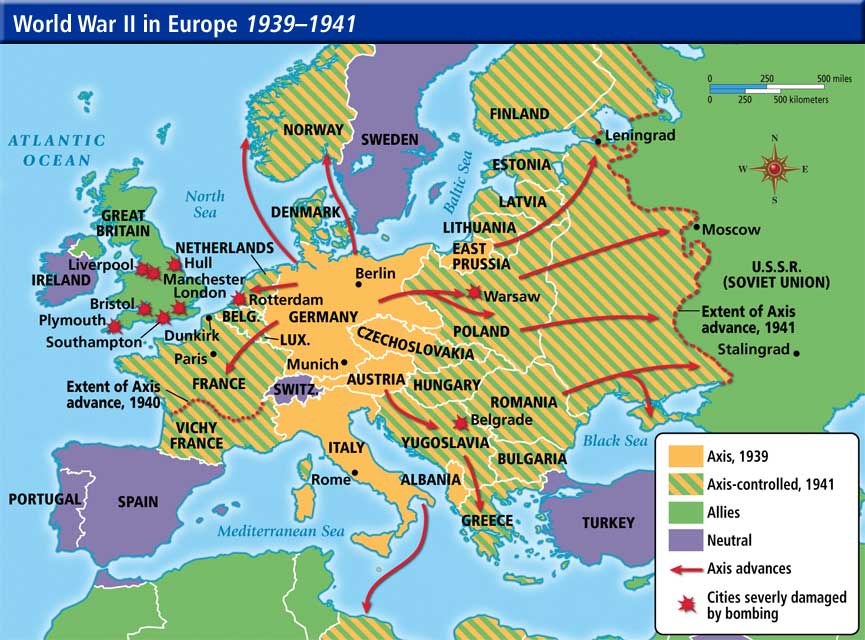
War in Europe, 1939 -1941
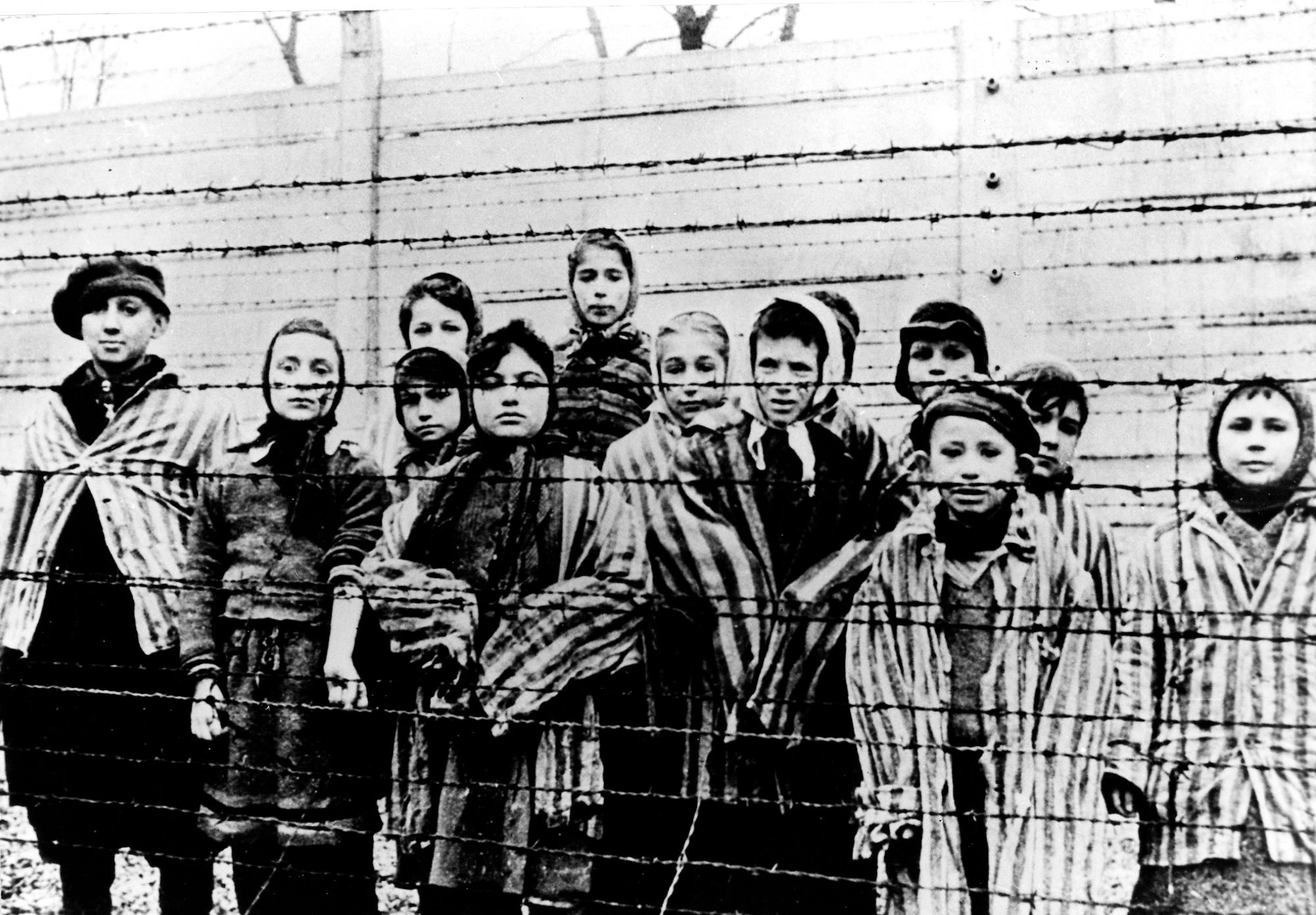
Jews in Nazi concentration camp
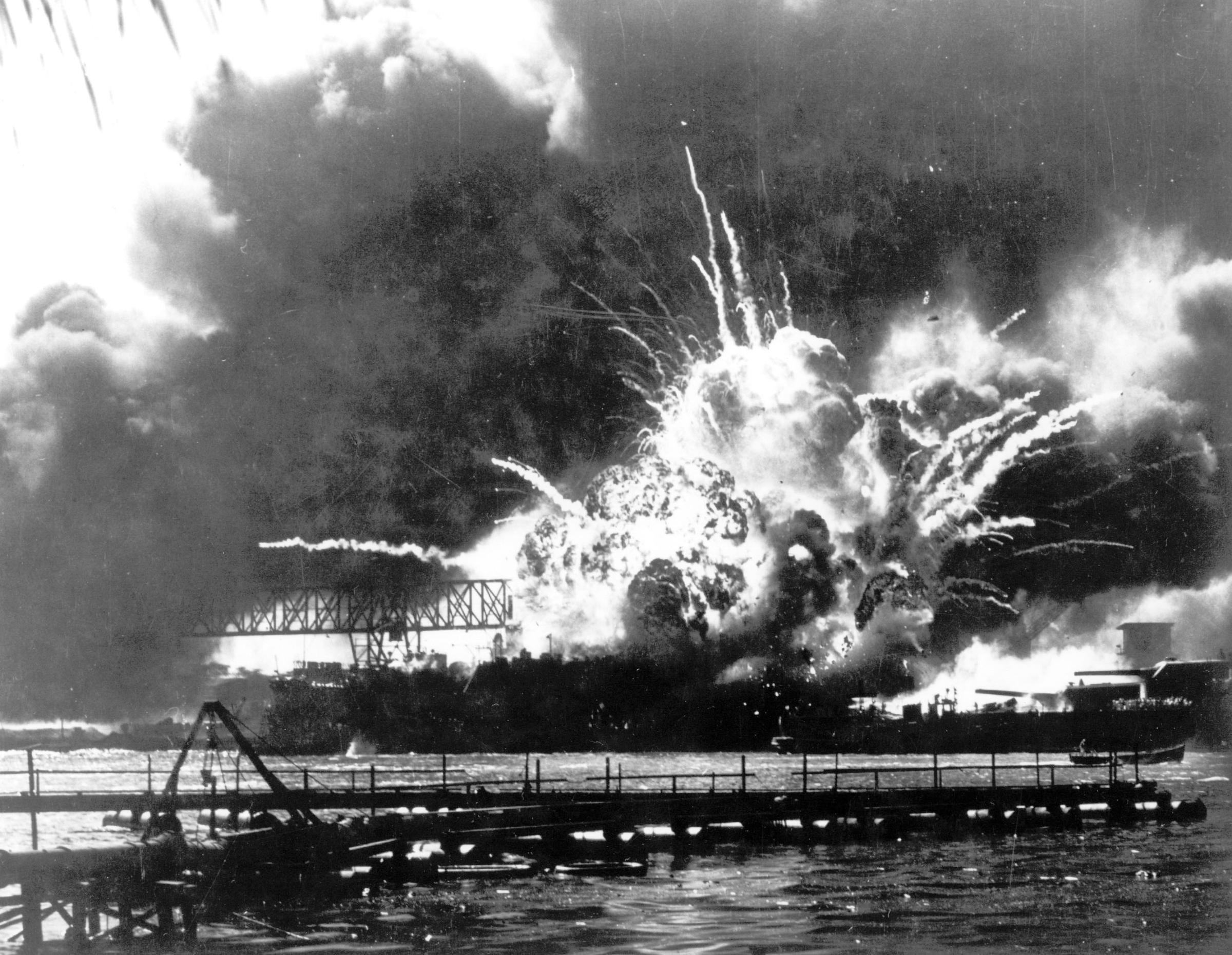
The Japanese surprise attack on Pearl Harbor on December 7, 1941 and the entry of the United States into World War II resulted from a long period of tension between the United States and Japan in the 1930's. In the 1920's Japan and the United States had enjoyed fairly good relations. Japan exported much of their manufactured goods to the United States and relied on the United States to supply Japan with key raw materials such as oil. The Japanese Prime Minister, Kato Komei (1924-1926) sought good relations with the United States and even extended democracy in Japan by supporting a measure to extend the right to vote to all adult males over the age of 25. The American public, however was not too friendly to Japan. In 1924, the US Congress passed an Immigration Act that banned immigration from Japan and other Asian countries. The impact of the Great Depression in Japan was quite severe as the Japanese economy relied on exporting its goods to overseas markets. Consequently, many in the Japanese government, especially in the military, came to believe that Japan must acquire territory and establish an empire across Asia so that Japan could secure markets for its goods as well as raw materials. Japan would therefore no longer be dependent on other nations to establish a strong, vibrant economy for its citizens. These policy makers were confident that the Japanese were a superior race. They assumed that the inferior peoples across East Asia would naturally rally in support of their Japanese superiors in a war of liberation against European powers. Japanese leaders viewed the United States, who controlled the Philippines, as their foremost rival and enemy for domination of East Asia.
In the 1930's Japan first sought to create this empire at the expense of China, which ever since the collapse of the Qing Dynasty was experiencing internal turmoil. In 1908, Puyi, aged two, became the last Qing emperor with his father Prince Chun serving as regent. Chun was hoping to modernize China and transform China into a constitutional monarchy. In 1910 a national assembly convened in Beijing. In 1911, however, a rebellion in Wuhan, China resulted in the collapse of support for the Qing Dynasty. In 1912, Puyi abdicated the throne, and China became a republic. The revolutionaries of 1911 found inspiration in the leadership of Sun-Yatsen (1866 - 1925). Sun-Yatsen had grown up among Chinese immigrants in Hawaii and was educated at a Christian missionary school. He wanted China to imitate Japan under the Meiji restoration and to modernize rapidly. He also envisioned China as a democratic republic which was founded on a mixture of Socialist, Christian, and Confucian ideals. In 1905, Sun-Yatsen had founded in China the Revolutionary Alliance, which became in time the Kuomintang or Nationalist Party. In 1912 Sun-Yatsen and his party agreed that Yuan Shikai, a former high ranking Manchu official, should serve as president of the Chinese republic, so that civil war could be avoided between Sun-Yatsen's supporters and Conservatives. In the first democratic elections in 1913, however, the Kuomintang Party dominated. In response, Yuan Shikai, fearing for his position, seized power with the support of the army and ruled as a dictator. In 1915, he even declared himself emperor. Following his death in 1916, China became a republic again under the leadership of Sun-Yatsen and the Kuomintang Party. The authority of the Chinese Republic, however, didn't extend much farther than the area around Nanjing in southeast China, with the rest of China under the control of different military warlords. After 1919, the Kuomintang Party formed an alliance with the newly formed Communist Party under the leadership of Mao Zadong (1893 -1976). The new Communist Party found support especially among Chinese who were strongly opposed to European and other foreign influences in China. Many Chinese in 1919 were outraged that the European powers under the Versailles Treaty had granted the Shandong Peninsula, which had been occupied by Germany, to Japan. Mao Zadong agreed with Lenin and the Bolsheviks in Russia that capitalism and imperialism were twin evils. The Communist and Kuomintang Parties remained allies until the death of Sun-Yatsen in 1925. The new leader of the Kuomintang Party, Chiang Kai-Shek, however, broke with the Communist Party and outlawed it. Mao Zadong and his Communist followers subsequently dispersed into the countryside and waged war against the Kuomintang Party in alliance with Chinese peasants. In 1934, Mao Zadong led his followers on the Long March to establish a new base for the Communist party in northwest China.
Japanese imperialists viewed the disunity and civil war in China as an opportunity to advance the Japanese Empire. Japan had controlled the Manchurian railroad since the conclusion of the Russo-Japanese War. In 1931 Japanese troops occupied all of Manchuria. In 1937 Japanese forces invaded northern China and the Second Sino-Japanese War began. In 1937, Japanese forces also captured Nanjing, executed Chinese civilians, and raped an estimated 80,000 Chinese women. During this conflict the Kuomintang and Communist Parties agreed to cease their warfare and wage war together against the Japanese invaders.
With the outbreak of war in Europe in 1939, Japan decided in 1940 to form an alliance with Germany and Italy, the so-called Axis Powers, since Japan viewed the United Kingdom along with the United States and the Soviet Union as its major competitors for control of East Asia. The German invasion of the Soviet Union in 1941 further emboldened Japan to move aggressively against the US and the United Kingdom since the Soviet Union was too busy dealing with the German invaders to pose a threat to Japan. In 1941, Japanese forces occupied French Indo-China with the permission of the German puppet state, the Vichy French government. The United States and United Kingdom both condemned this move, and the United States refused to sell oil to Japan and froze Japanese assets in the United States. This action by the United States outraged the Japanese, and the recently appointed Prime Minister of Japan, the major general, Hideki Tojo, with the support of the military, decided that it was time to strike swiftly and decisively the military bases of both the United States and United Kingdom. This strategy had proven effective in winning the Russo- Japanese War. The Japanese attack on the main US naval base at Pearl Harbor was followed in the early months of 1942 by the Japanese occupation of the Philippines and Guam, American possessions in the Pacific Ocean, along with the conquest of British Hong Kong, Singapore, and Malaysia, and the Dutch East Indies (Indonesia).
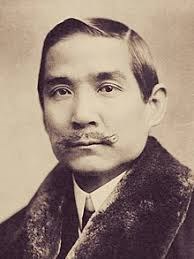
Sun Yatsen
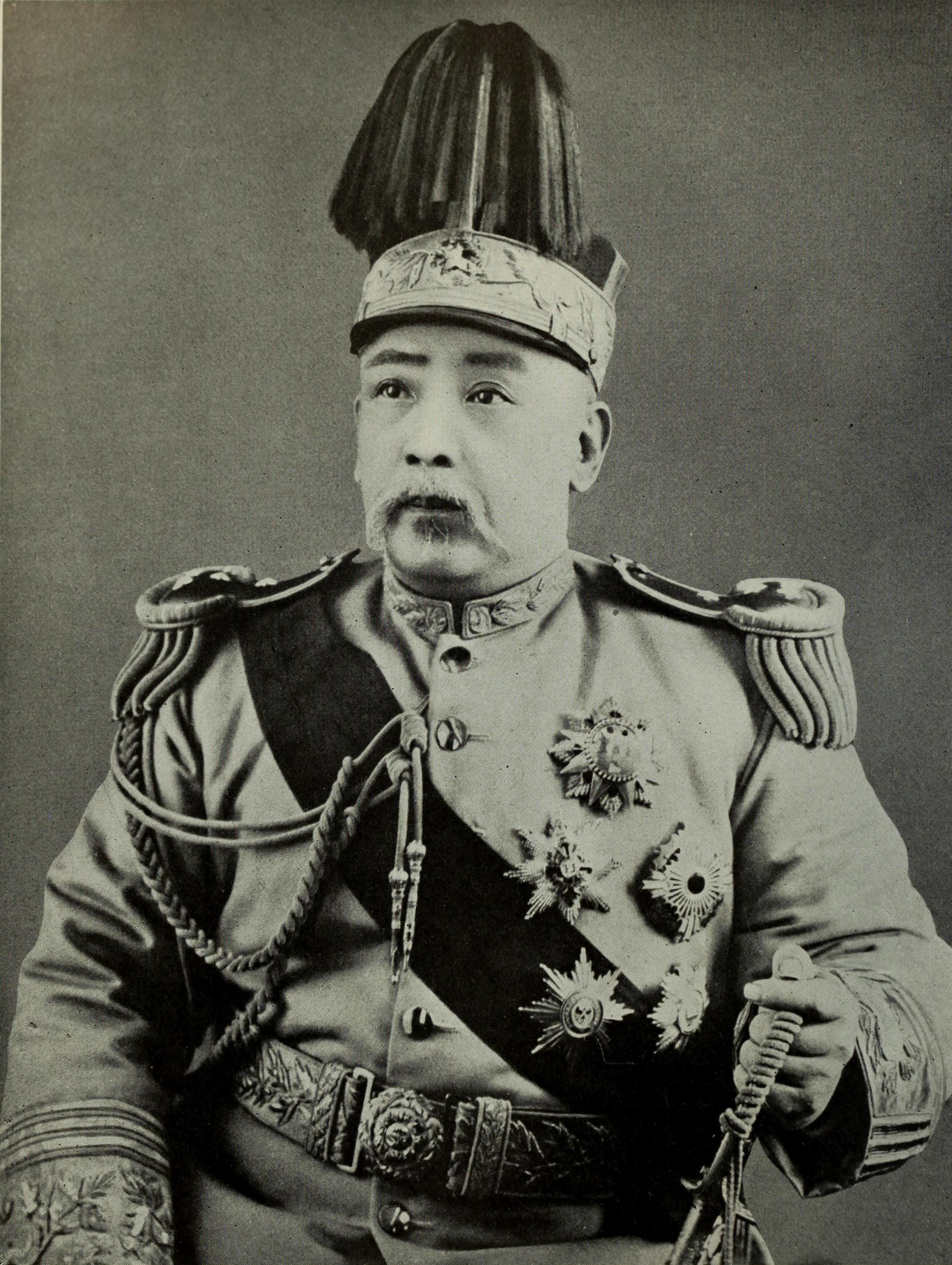
Yuan Shikai
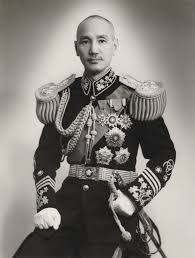
Chiang Kai-Shek
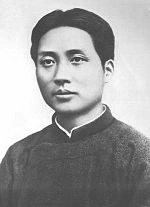
Mao Zadong in 1925
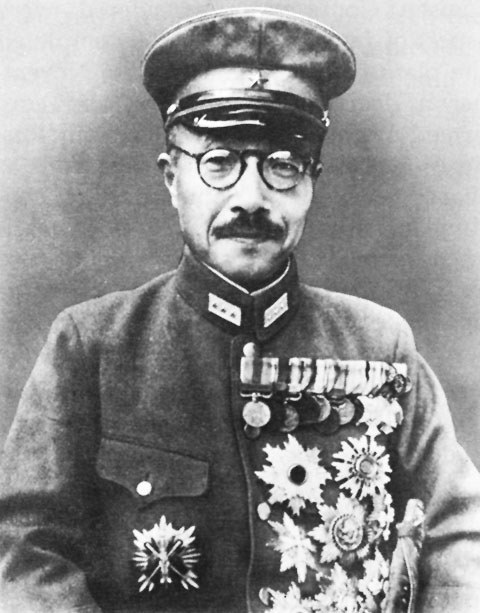
Hideki Tojo
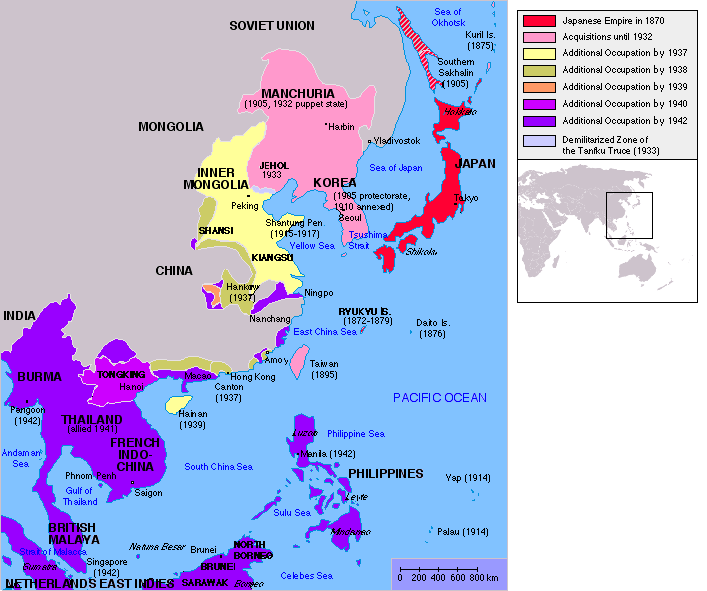
Japanese Empire in 1942
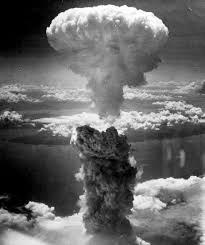
Both Nazi Germany and Imperial Japan grossly underestimated the strength and power of the American economy, which was able to provide the materials to crush both these powers after the United States entered the war. The Axis Powers also overextended their reach and suffered a series of defeats in 1942, which were turning points in the war. In Egypt at the Battle of El-Alamein, British forces inflicted the first defeat on Rommel's Afrika Korps and forced German forces to withdraw. At the Battle of Stalingrad, the Soviet army encircled and destroyed the German army. In the Pacific Ocean, the American navy crushed a Japanese fleet at the Battle of Midway near Hawaii. Between 1943 and 1945, Axis powers were everywhere in retreat. In 1943, British and American forces together invaded Italy, and Mussolini's Fascist regime collapsed. In 1944, American and British forces launched the Normandy Invasion and swiftly liberated France from German occupation. By late 1944, Soviet forces had expelled the German army from the Soviet Union and were moving westward toward Germany. In 1945 Nazi Germany was facing an invasion from British and American forces from the west, and Soviet forces from the east. In April 1945 Hitler committed suicide and the Nazi regime unconditionally surrendered in May, 1945.
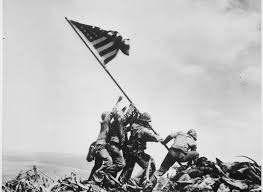
Over in the Pacific, US forces employed a "Island hopping strategy" to advance toward Japan. US forces captured only strategic Japanese naval bases in the Pacific, such as Tarawa in the Gilbert Islands in 1943, which allowed US forces to progress ever closer to the Japanese islands. In 1945 United States forces captured the islands of Iwo Jima and Okinawa, which lay adjacent to Japan. US forces suffered heavy casualties in the face of fierce Japanese resistance. Japan also launched kamikazi attacks, in which Japanese pilots would commit suicide by aiming their planes to crash and sink American ships. Given the level of Japanese resistance as American forces closed in on Japan itself, the new American president, Harry Truman, decided that an American invasion of japan would be too costly in American lives. Truman therefore decided to employ against Japan a powerful new weapon that American scientists had just recently invented, the Atom Bomb. In August 1945, American planes dropped atom bombs on the Japanese cities of Hiroshima and Nagasaki. That month the Japanese emperor, Hirohito, against the wishes of his generals, surrendered to the Unites States to spare his people further suffering, on the condition that he remain as the ceremonial head of state. World War II thus came to an end after the death of an estimated 85 million soldiers and civilians.
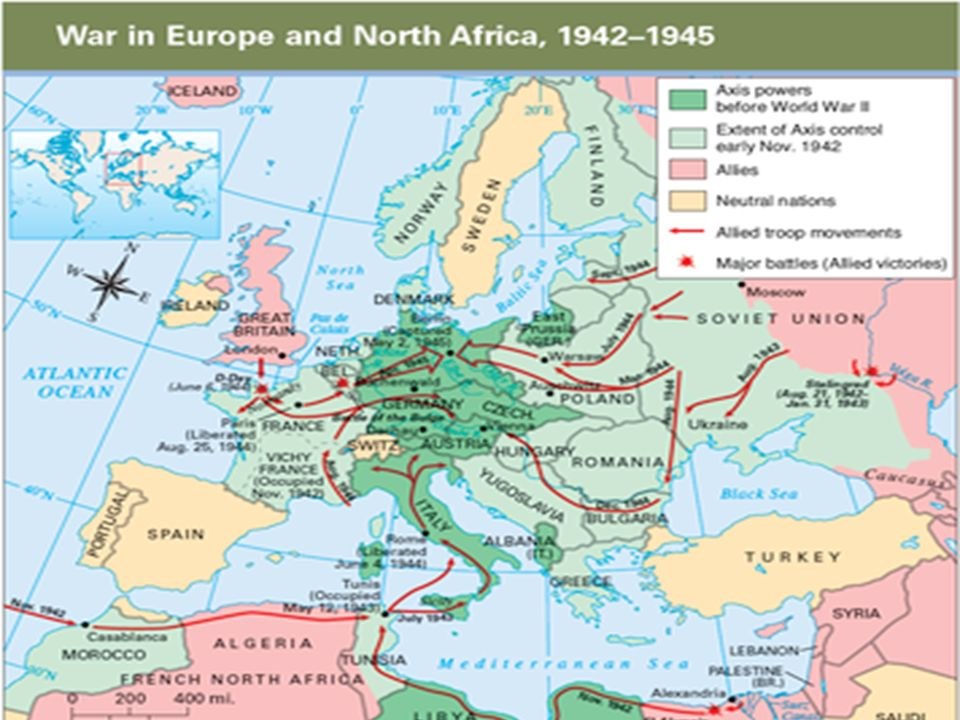
World War II in Europe
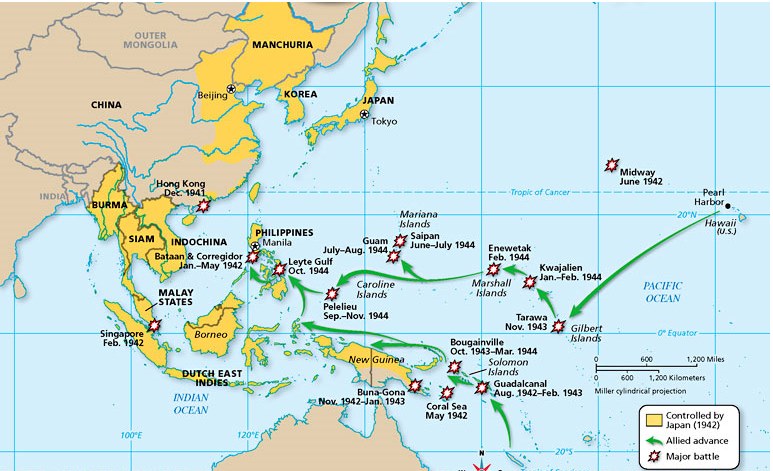
World War II in the Pacific
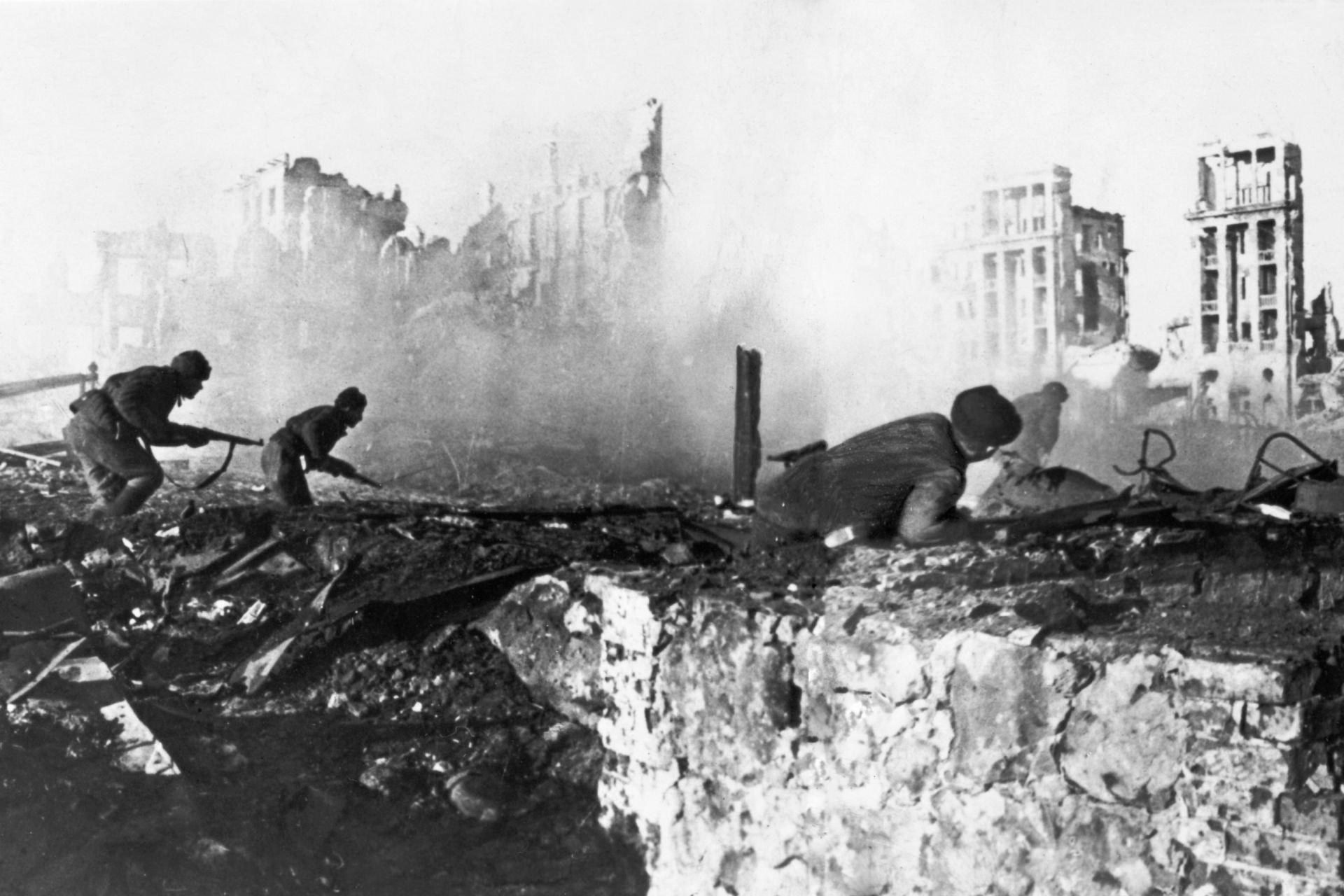
Battle of Stalingrad
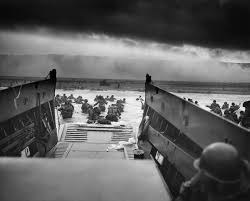
Allied troops landing at Normandy
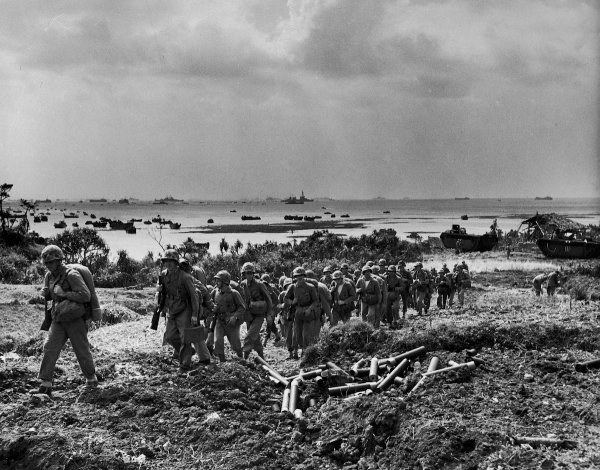
Battle of Okinawa
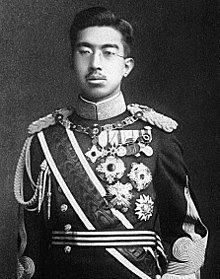
Emperor Hirohito